
Unilever, PepsiCo Scale AI to Cut Costs, Accelerate Product Cycles
Serge Bulaev
Unilever and PepsiCo are using AI to cut costs and speed up product development, and early results suggest these tools give them a lasting competitive edge. AI models may help companies launch products faster, forecast demand more accurately, and manage supply chains better. Some studies report that Unilever's use of AI raised sales by 30 percent and cut extra inventory by 15 percent, while PepsiCo shortened development time from months to weeks. Experts note that the biggest gains may come to companies that make AI a key part of their daily operations, rather than a side project. The impact of AI on profits and growth is still uneven, but experts believe that how deeply a company uses AI will matter more than its size.

Leading consumer packaged goods (CPG) firms like Unilever and PepsiCo now scale AI to build competitive advantages that are difficult to replicate. By embedding artificial intelligence into core operations, these companies are accelerating product cycles and cutting costs. For instance, Unilever's Magnum AI strategy has driven significant sales improvements, demonstrating how targeted AI applications can enhance performance across product lines. When AI becomes institutionalized, it fundamentally alters the economics of competition. Companies that integrate AI into daily decision-making can develop products faster, generate real-time demand forecasts, and allocate capital more efficiently than competitors. This shift requires treating data infrastructure and model governance as essential, not experimental.
Four Ways AI Creates a Competitive Advantage in CPG
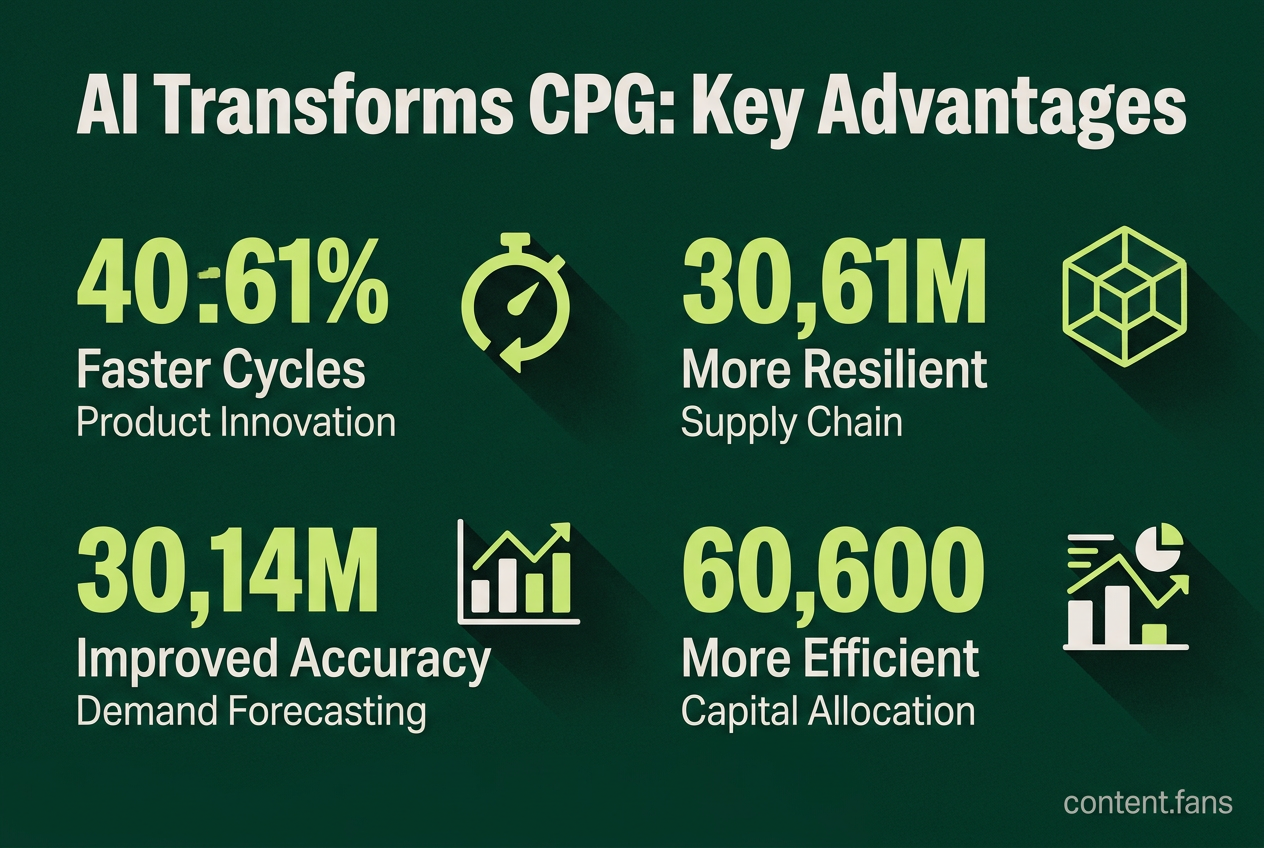
CPG leaders are deploying AI to accelerate product innovation, build more resilient supply chains, and optimize capital allocation. By integrating predictive models and generative AI into daily workflows, companies can shorten development timelines, improve forecast accuracy, and respond faster to market changes, creating significant operational efficiencies.
-
Product Innovation Speed
Major CPG companies are experimenting with generative AI to accelerate concept development and prototype creation, with many reporting substantially shortened innovation cycles. Companies are using AI-powered platforms to generate product ideas and streamline routine tasks. These faster innovation cycles tighten consumer feedback loops, potentially increasing new product success rates. -
Supply Chain Resilience
AI-powered control towers, like those at Tyson Foods, unify inventory, logistics, and demand data to recommend daily operational adjustments. Industry analysts project that scaled AI implementation can deliver meaningful revenue improvements and EBITDA gains for CPG firms. Advanced forecasting systems are helping companies reduce working capital requirements through improved demand prediction. -
Retail Partnership Rewiring
Shared demand models between brands and retailers are improving forecast accuracy, according to industry reports. As autonomous shopping agents gain prominence, machine-readable product data becomes essential for discovery. This is shifting CPG investment from traditional trade spend to rich attribute tagging and joint promotional simulations. -
Capital Allocation and M&A
In an AI-driven market, mergers for volume alone yield diminishing returns. Industry analysts report a strategic pivot toward capability acquisitions, targeting data assets, model portfolios, and specialized AI talent. Acquirers increasingly favor brands with strong discoverability metrics, such as clean metadata and rapid formulation capabilities.
Key AI Investment Priorities for CPG Leaders
- Developing an end-to-end data fabric that unifies consumer, operational, and third-party data.
- Building "model factories" to accelerate the development, testing, and deployment of AI across business functions.
- Creating shared "digital twins" of demand with retail partners and implementing automated replenishment systems.
- Focusing M&A on acquiring AI talent, commerce technology, and high-quality labeled data assets.
While financial results from AI adoption vary, clear patterns are emerging. Success stories demonstrate how AI creates margin for reinvestment through improved operational efficiency and enhanced warehouse automation. However, agile startups using accessible cloud models can identify and serve niche markets faster than slow-moving incumbents. Ultimately, experts agree that competitive advantage will be determined not by a company's size, but by the depth of its AI integration across the entire value chain.
How are Unilever and PepsiCo using AI to cut costs right now?
Unilever applies weather-integrated demand sensing to its ice-cream portfolio. An AI agent feeds live temperature forecasts into planning models and automatically re-orders inventory or triggers promotions. The company reports improved forecast accuracy and operational efficiency gains from these AI implementations.
PepsiCo simultaneously deploys PepGenX (an internal Gen-AI stack) plus KoiReader vision agents in warehouses. The combination has lifted forecast accuracy, streamlined production schedules, and significantly reduced label-scanning errors at its distribution centers.
What measurable speed gains are companies seeing in product development?
Industry reports suggest that generative AI is significantly compressing innovation cycles across the CPG sector.
- A major global CPG company reduced development timelines and achieved substantial R&D cost savings within months of implementation.
- Leading CPG firms are reducing concept-to-launch timelines using Gen-AI-generated concepts and virtual consumer panels.
- Companies are turning digital-prototype testing from months to days by simulating numerous SKUs with virtual shoppers.
How does AI reduce capital tied up in inventory?
AI-driven demand forecasting and dynamic replenishment move the supply chain from reactive to predictive. Unilever has reported significant efficiency gains from AI implementations, while Tyson Foods' AI control tower gives planners real-time visibility that has reduced inventory levels while improving service levels. Industry surveys indicate that a significant majority of AI adopters report cost reductions and revenue improvements, largely driven by lower safety stock and fewer write-offs.
Will AI advantage favor big incumbents or smaller start-ups?
The playing field is balancing out. Start-ups benefit from low legacy drag and faster experimentation loops; they can pivot a formulation or pack size in weeks. Incumbents still win on scale, shelf space, and proprietary multi-year data lakes, but only if they rewire operating models rather than bolt on point solutions. Analyst consensus suggests that winners will be AI-operating-model leaders, regardless of size.
How will AI change M&A and retail partnerships?
- M&A: Expect fewer "scale-only" acquisitions; buyers will target AI talent stacks, commerce-tech platforms, and data assets that plug capability gaps.
- Retail partnerships: The traditional quarterly assortment review is being replaced by shared AI twins and automated replenishment agreements that update daily. Retailers are also renegotiating retail-media value because AI-mediated product discovery now depends on machine-readable product attributes rather than prime shelf space alone.