
UBS Requires AI Skills for Junior Investment Banker Hires
Serge Bulaev
UBS now requires junior investment banker applicants to show they have used AI to improve research or efficiency. Reports suggest the bank asks about real AI experience, such as using AI for financial research, making pitch materials, or automating tasks. Santander is the only other major bank mentioned that openly seeks advanced AI skills in some roles, so UBS and Santander may be early movers. Surveys show more banks are using AI, and many finance workers already treat AI as a routine tool. This trend may lead universities and training programs to make AI training a standard part of finance education.

In a significant shift for Wall Street hiring, UBS now requires AI skills for its junior investment banker applicants, signaling a new benchmark for entry-level talent. According to reports first detailed in the Financial Times and relayed by Adalytica, the Swiss bank is screening its 2027 graduate and intern candidates for practical experience using AI to improve research and efficiency. Analysts view the move as a key indicator of AI's growing integration into front-office investment banking workflows.
What UBS is Asking For
Candidates face new interview questions focused on AI fluency, requiring them to demonstrate experience beyond basic chatbot interactions. UBS expects applicants to have used AI for practical banking tasks, such as drafting pitch materials, running faster comparable company analyses, and using generative code to test financial models.
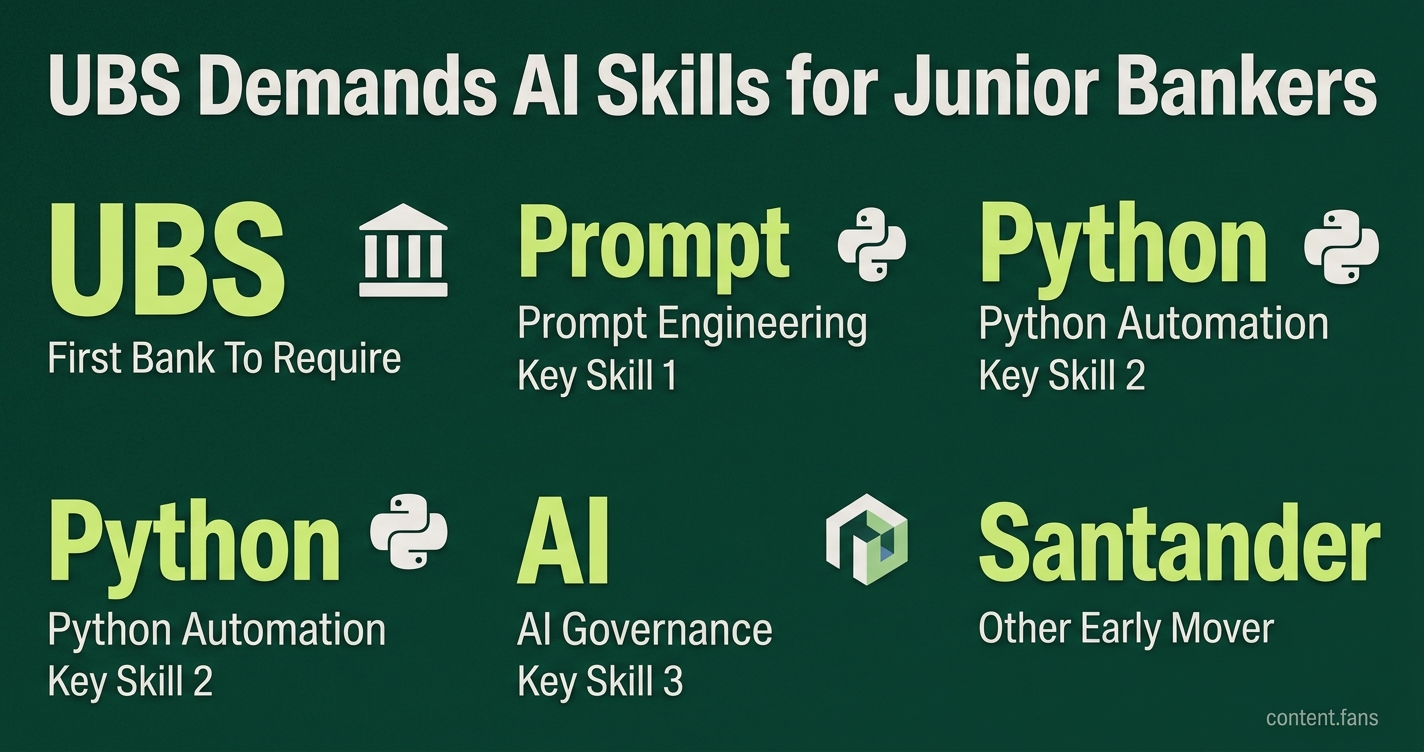
UBS is screening junior banking candidates for practical AI skills in financial research, pitch material creation, and workflow automation. The bank expects applicants to demonstrate responsible experimentation with AI tools, advanced prompt engineering, Python automation skills, and a fundamental awareness of AI governance and its limitations.
The bank is looking for proof that new hires can "experiment with AI responsibly" and apply the technology to client-facing work, as noted by The Next Web. While no specific software is mandated, key discussion points include Python automation, advanced prompt engineering, and model governance.
Key skills UBS reportedly values:
- Summarizing financial research with AI assistance.
- Designing effective prompts for market and company analysis.
- Automating manual tasks using Python or advanced spreadsheet functions.
- Understanding AI governance and the risks of model "hallucinations."
Signs of a Wider Hiring Shift
While UBS's move is prominent, it is not entirely isolated. Banco Santander also explicitly seeks "advanced AI users" for certain investment banking trainee positions, signaling an expectation for pre-existing tool experience. Although other global banks are heavily investing in internal AI training programs, they have not yet made these skills a formal prerequisite for entry-level roles. This positions UBS and Santander as potential early movers, setting a trend that the rest of the industry may soon follow.
AI's Growing Role in Banking Workflows
The push for AI skills reflects the technology's rapid shift from pilot programs to daily production use in finance. Recent industry reports highlight this trend, with a significant portion of investment firms having adopted generative AI tools. Furthermore, other research indicates that a growing number of banking professionals now consider generative AI a workplace collaborator. This widespread adoption means junior bankers are increasingly expected to join teams where AI-driven summarization, analysis, and draft modeling are standard operating procedures.
How Education is Adapting to AI in Finance
In response to industry demand, universities and professional training programs are quickly integrating applied AI into their finance curricula. Institutions like the University of Cincinnati and Boston University now offer specialized certificates and concentrations in AI for finance. The new focus is on practical skills, including Python labs, prompt-engineering workshops, and model validation. Professional trainers like CFI and Wall Street Prep are also launching hands-on courses designed to equip students with job-ready AI competencies.
The requirements set by UBS are being interpreted as a clear hiring signal, not a niche preference. As more financial institutions inevitably follow suit, AI competence is poised to become a fundamental baseline skill for the next generation of finance professionals, much like spreadsheet proficiency became the standard a decade ago.
What specific AI skills is UBS requiring from junior investment banking candidates?
UBS is asking graduate and intern candidates for its 2027 Global Banking and Markets intake to demonstrate they have used AI to improve outcomes and efficiency in their work. The bank has added AI-fluency questions to junior-hire interviews and wants evidence that applicants can use and experiment with AI responsibly - going beyond basic chatbot use. Candidates should show capability in applying AI to analysis, research, and client work.
Is UBS the only major bank making AI skills a formal hiring requirement?
Based on available reporting, UBS appears to be among the most explicit in formalizing this requirement. While Banco Santander has also sought "advanced AI users" for some graduate programmes, other major banks including JPMorgan, Goldman Sachs, Morgan Stanley, Citigroup, Barclays, and Bank of America are described as deploying AI internally and training staff rather than imposing formal AI-skills requirements for junior hires in the same direct way. This suggests UBS is helping set a new standard that may spread across the sector.
How are universities and training programs responding to these new industry demands?
Finance education is shifting rapidly from "AI awareness" to job-ready capability. Universities now offer specialized credentials like the University of Cincinnati's Applied AI in Finance graduate certificate and Boston University's AI Applications concentration. Curricula increasingly emphasize hybrid finance + data skills - including Python for financial analysis, prompt engineering for workflows, NLP for earnings-call analysis, and model validation and governance. Professional education providers are also adapting, with programs from CFI and Columbia Business School/Wall Street Prep targeting immediate workplace application.
What does current data show about AI adoption in investment banking workflows?
Industry reports from recent years show AI is moving from pilot to production in finance, with many investment firms now using GenAI tools and a significant portion of banking professionals using genAI as a "work collaborator." Financial organizations are increasingly deploying AI agents across their operations.
The strongest task-level adoption is concentrated in research summarization, report drafting, and financial modeling support rather than full automation - indicating why banks now want candidates who can leverage these tools effectively rather than being replaced by them.
What does this shift mean for the future of investment banking careers?
This development signals that AI literacy is becoming a baseline employability skill rather than a niche specialization. The most valued emerging profile combines finance judgment + AI tool fluency + verification and ethics capabilities. As one analysis notes, firms are allocating AI budgets toward research and communications use cases where human oversight remains essential. Junior bankers who can supervise, validate, and govern AI outputs - while using these tools to enhance productivity - are likely to see expanded responsibilities as routine tasks become increasingly automated.