
Nvidia acquires Hugging Face for $12.9 billion
Serge Bulaev
Nvidia announced plans to buy Hugging Face for about $12.9 billion, but the deal has not closed yet and needs approval from regulators. Nvidia says Hugging Face will stay open for all users and will not require Nvidia hardware, but some experts warn that future changes could favor Nvidia technology. Developers may still use Hugging Face with different hardware and cloud providers for now. Some people are hopeful about possible improvements, while others worry the platform might stop being neutral over time. The only confirmed change so far is that Nvidia may own Hugging Face if the deal is approved.

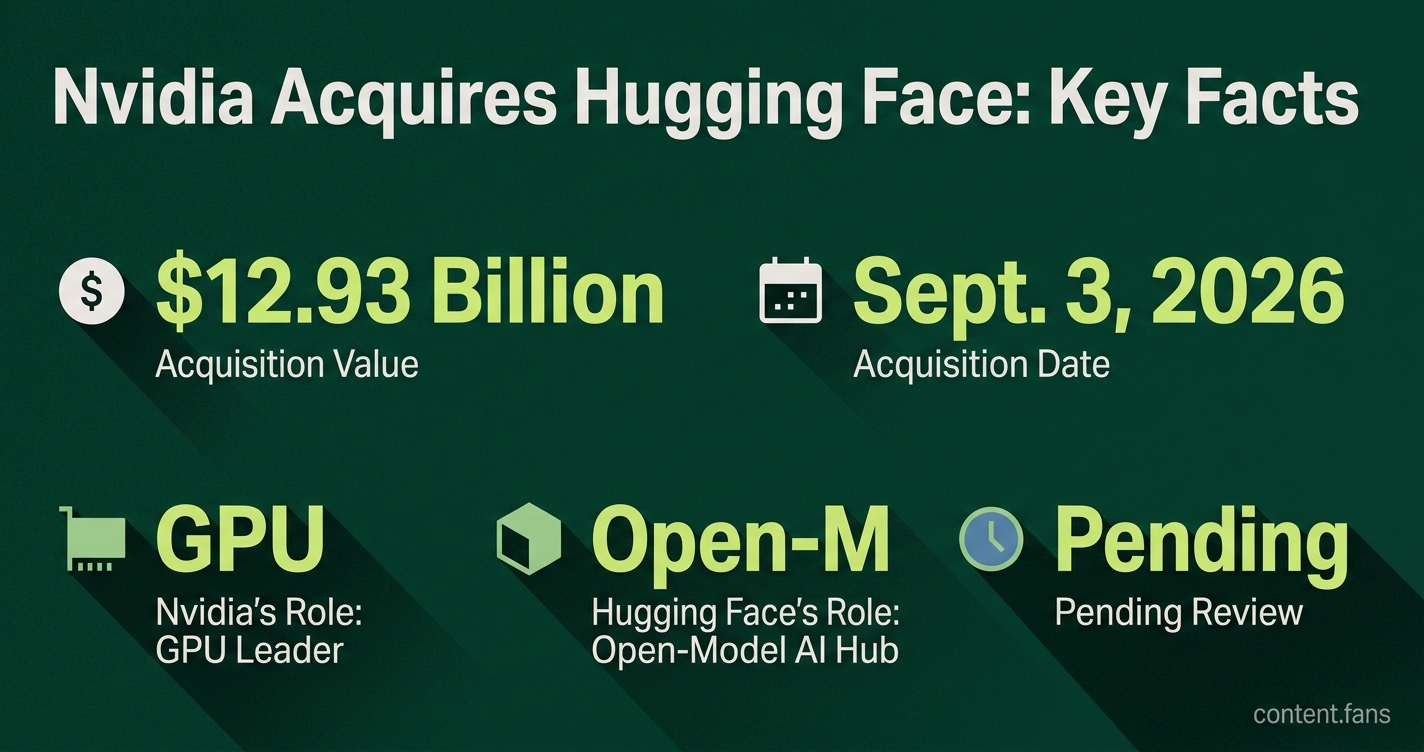
Nvidia will buy Hugging Face for $12.93 billion; the deal was announced on Sept. 3, 2026 and is not yet closed. The transaction unites the GPU leader with the world's foremost open-model AI hub. The deal has not yet closed and is pending antitrust review.
The acquisition positions Nvidia to deeply integrate its hardware ecosystem with Hugging Face's highly popular repository for open-weight AI models, datasets, and developer resources.
What the companies say will stay open
The acquisition combines Nvidia's dominant hardware ecosystem with Hugging Face's vast repository of open-weight AI models, datasets, and developer tools. This vertical integration aims to create a powerful pipeline from model development to deployment, though the deal remains subject to regulatory approval before closing.
In its official statement, Nvidia assured that Hugging Face "will remain an open platform for the entire AI ecosystem" and that "Nvidia compute will not be required." CEO Jensen Huang confirmed in a CNBC Q&A that developers will retain the freedom to choose their preferred models, chips, and clouds. However, a Reuters report observed that the deal could still establish a strong "pipeline of customers" for Nvidia's processors.
Vertical integration and potential pressure points
By controlling the primary model distribution hub, Nvidia gains direct influence over significant monthly model downloads. Analysts suggest this could naturally guide training and inference workloads toward CUDA-based GPUs, even without an official mandate. Industry observers warn that this could create significant challenges for competitors like AMD's ROCm and other cloud GPUs if future platform optimizations favor Nvidia's architecture.
Key concerns and potential friction points highlighted by industry analysts include:
- Governance: The post-acquisition board structure and governance charter have not been made public.
- Pricing: Future changes to Hugging Face hosting fees or inference endpoint costs remain possible, although none have been announced.
- Portability: Developers are concerned about a potential, subtle shift that could favor CUDA-specific integrations over other hardware.
How rivals are responding
Competitors are already promoting their own model ecosystems, such as AWS Bedrock, Google's Vertex AI Model Garden, and Databricks' MosaicML. This trend reflects a wider industry push to control the end-to-end AI pipeline instead of depending on one neutral hub. Companies like AMD and CoreWeave, who offer competing compute solutions, are seen as potentially vulnerable if Hugging Face's platform neutrality diminishes. Despite these concerns, Nvidia has reiterated its commitment to multi-vendor support, a claim also covered by TechCrunch.
Timeline and regulatory status
Reuters reported on Aug. 26, 2026 that Nvidia had agreed to buy Hugging Face; Reuters then published a detailed announcement on Sept. 3, 2026. The deal is expected to close in the first half of 2027, contingent upon successful competition and regulatory reviews. The initial absence of a signed definitive agreement introduced some uncertainty into the final timeline.
What this means for developers today
For now, Hugging Face operates independently, with its public repositories, Spaces, and inference APIs functioning without change. If Nvidia honors its commitments, developers should be able to continue deploying models to various clouds, exporting them to formats like ONNX, and running them on non-Nvidia hardware. The developer community remains divided: some are optimistic that Nvidia's resources will lead to lower inference costs via enhanced optimizations, while others fear a gradual erosion of platform neutrality. Currently, the only confirmed change is the proposed transfer of ownership, which awaits regulatory sign-off.
What is the deal between Nvidia and Hugging Face?
Nvidia has agreed to acquire Hugging Face for approximately $12.93 billion. The acquisition represents one of the largest consolidations in the AI infrastructure space, combining Nvidia's hardware and software leadership with Hugging Face's open-model ecosystem and developer tooling. According to Nvidia's official announcement, the company described the move as a strategic bet on open AI models while maintaining platform neutrality.
How did the acquisition come about?
The deal originated from direct outreach by Hugging Face CEO Clément Delangue to Nvidia CEO Jensen Huang, according to media reports. This proactive approach by Hugging Face's leadership signaled strategic alignment between the two companies. A CNBC report on the planned acquisition included a Q&A with both CEOs discussing their vision for the combined entity.
Will Hugging Face remain open and independent?
Nvidia has publicly committed to keeping Hugging Face open, though the deal has not yet closed as of the latest reports. Key commitments include:
- Hugging Face will "remain an open platform for the entire AI ecosystem"
- "NVIDIA compute will not be required" to build on or deploy through Hugging Face
- Developers can choose their preferred models, chips, and cloud platforms
- Continued support for open-source and open-weight models from all model builders
However, analysts note that ownership by a hardware vendor creates inherent governance questions about long-term neutrality, even with these public pledges. The closing is expected in the first half of 2027, subject to regulatory approval.
What are the main concerns from the developer community?
Community reaction remains sharply divided:
Potential benefits:
- Cheaper inference costs through tighter hardware-software integration
- Better optimization across the full Nvidia stack
- Streamlined developer workflows
Key risks raised:
- Vendor lock-in - fears that Hugging Face could gradually favor Nvidia infrastructure
- Governance changes - loss of independence in platform decisions
- Portability guarantees - uncertainty about multi-vendor support long-term
- Pricing shifts - potential bundling strategies that disadvantage competitors
Some developers are already exploring alternatives like Ollama for local inference, AWS Bedrock, Google Vertex AI Model Garden, and ModelScope to reduce dependency.
How are competitors responding to this vertical integration?
The acquisition has triggered strategic repositioning across the AI landscape:
- AMD faces particular exposure if Hugging Face tooling becomes CUDA-centric, disadvantaging its ROCm software ecosystem
- Google and Microsoft risk losing neutral-ground access to a critical open-model distribution layer
- GPU cloud providers like CoreWeave could face new dependency risks
Rather than direct product launches, competitors are accelerating their own vertical integration:
- Doubling down on proprietary model hubs and hosting layers
- Emphasizing platform neutrality and portability in marketing
- Building alternative distribution channels for open models
Analysts view this as part of a broader battle over who controls the model distribution layer - with Nvidia now positioned to potentially steer developer choices from model selection through to hardware deployment.