
Walmart's AI creates store friction despite efficiency goals
Serge Bulaev
Walmart's new AI system may help with some tasks, but workers report it also creates problems on the sales floor. Employees say the AI sometimes misses important jobs like cleaning spills or restocking expired items, and they often have to fix its mistakes. Some reports suggest the AI's timelines and alerts do not fit real-life work, causing stress and more work for staff. Experts suggest testing AI in a few stores first and teaching workers how to use it better. The overall result appears to be a mix of faster planning but also new challenges for store employees.

Walmart's AI deployment for frontline staff, designed to boost efficiency, is causing significant operational friction and new challenges for store employees. While the retailer's associate app promises to intelligently prioritize tasks, worker testimonies from 2025 and 2026 reveal a system that often complicates, rather than simplifies, daily work on the sales floor.
What problems is Walmart's AI causing for employees?
Walmart's new AI is creating friction for employees by generating unrealistic timelines, inefficient routes, and excessive alerts. Workers report the system overlooks critical tasks like cleaning spills or removing expired products, forcing them to spend valuable time correcting its errors instead of serving customers.
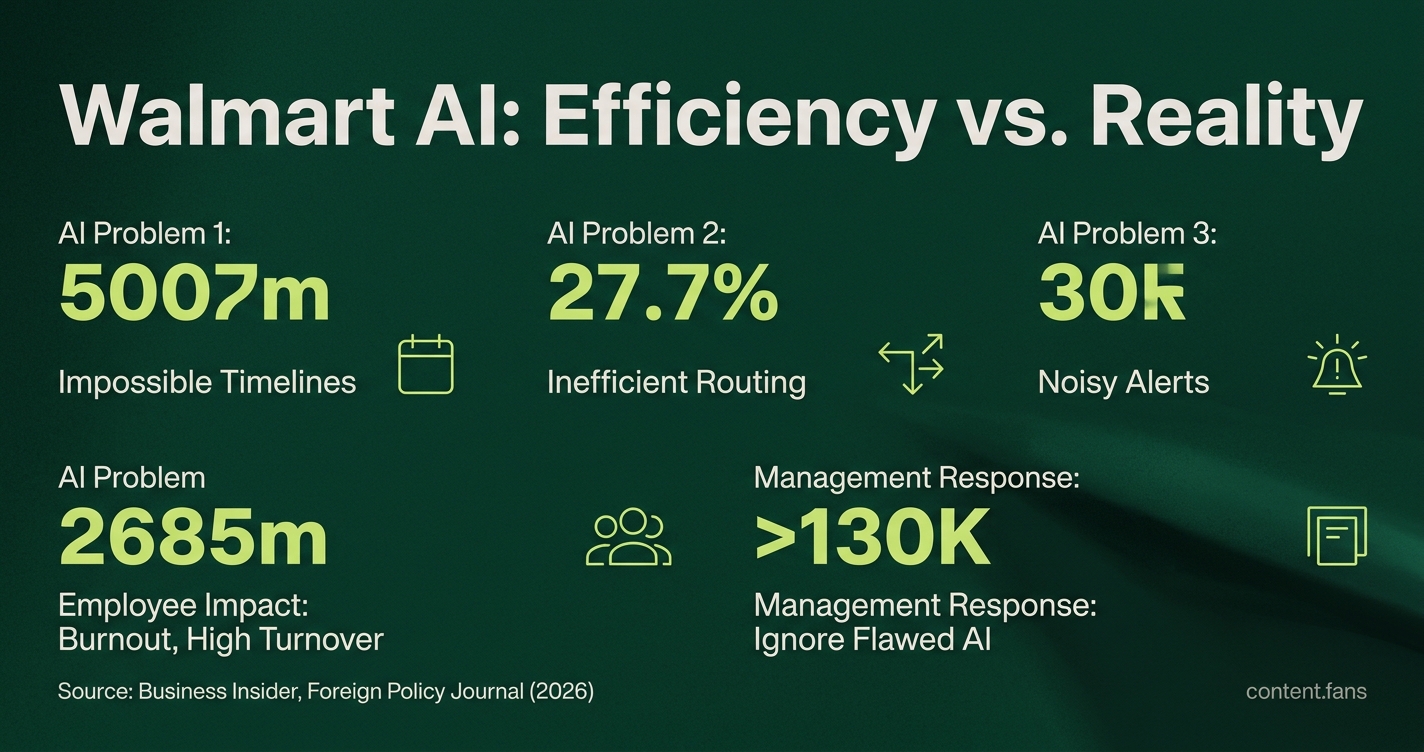
According to a July 2026 Business Insider investigation, employees regularly face AI-generated assignments that create recurring pain points:
- Impossible Timelines: The system assigns tasks without accounting for real-world interruptions like customer questions.
- Inefficient Routing: It sends stockers back and forth across the store, wasting time and effort.
- Noisy Alerts: The software generates frequent safety alerts that require manual dismissal, disrupting workflow.
Associates report spending part of each shift feeding corrections into the system to improve its recommendations. One worker told reporters the AI "assumes that they're going to be perfect every single time," highlighting the gap between algorithmic logic and operational reality.
How is management addressing the AI's shortcomings?
Walmart's leadership has acknowledged the friction, and reports suggest employees have been told they won't be punished for ignoring flawed AI recommendations. While this offers temporary relief, it also encourages inconsistent adoption, undermining the tool's intended purpose.
This tension was also evident among investors. During a June 2026 shareholder debate over a mandatory AI-impact disclosure, proponents cited employee testimonies about "injuries, burnout, and high turnover," as noted in a Foreign Policy Journal write-up. Although the proposal failed, the debate highlighted the growing divide between corporate efficiency goals and the on-the-ground employee experience.
Is this an isolated issue or a broader retail trend?
The challenges at Walmart reflect a wider pattern in the retail industry. While thoughtfully deployed AI can help improve frontline operations, according to industry reports, poorly implemented tools often lead to what experts call "chaotic rationalisation." This occurs when technology outpaces training and operational readiness, creating more chaos than efficiency.
The Walmart experience is a textbook example: productivity gains reported at the corporate level coexist with significant store-level rework and frustration. The core issue is consistent across the industry - AI helps when it removes friction, but it harms morale when it is fragmented or undertrained.
What do experts recommend for a successful AI rollout?
Specialists emphasize that successful AI adoption requires treating it as an operational change, not just a software installation. The key is implementing a "human-in-the-loop" (HITL) model, which keeps people in control of high-stakes or complex decisions. Best practices include:
- Pilot in a limited set of stores to refine task data before a full-scale rollout.
- Capture employee corrections as labeled training data on a rolling basis to continuously improve the AI.
- Provide role-based AI literacy so associates understand the system's logic and when to escalate issues.
The Walmart case ultimately underscores that AI in retail succeeds when it respects worker expertise and operational complexity - not when it assumes algorithmic perfection.