
OpenAI launches GPT-6 Astra, eyes enterprise workflows
Serge Bulaev
OpenAI has released GPT-6 Astra to a small group of partners and reviewers, and it may become available to more users soon. Early feedback suggests Astra writes fluently, can navigate software menus, and creates design sketches, but still needs human review before final use. The launch is focused on businesses, with strict rules and limited features to ensure safety and proper use. Some testers note Astra sometimes adds extra content or features that are not needed. Reviews also suggest Astra could be best for tool-driven tasks, while a competitor, Fable 5.1, might suit projects needing to use a lot of previous context.

OpenAI has launched GPT-6 Astra in a limited rollout to select partners and reviewers, marking a significant move into enterprise workflows. The model is already drawing comparisons to Anthropic's Fable 5.1 as professional teams evaluate its capabilities for drafting copy, designing interfaces, and navigating software. OpenAI confirmed the model is rolling out to a limited set of organizations, with wider access promised "over the coming days" for paid ChatGPT tiers and cloud platforms OpenAI announces rollout of GPT-6 Astra model. Early testers are now exploring the model under strict usage guardrails.
Staged enterprise rollout and governance focus
GPT-6 Astra is OpenAI's latest model, initially released to a small group of enterprise partners for professional use. It is designed for tasks like fluent writing, software navigation, and visual prototyping. Broader access is expected to follow for paid subscribers and through cloud API partners.
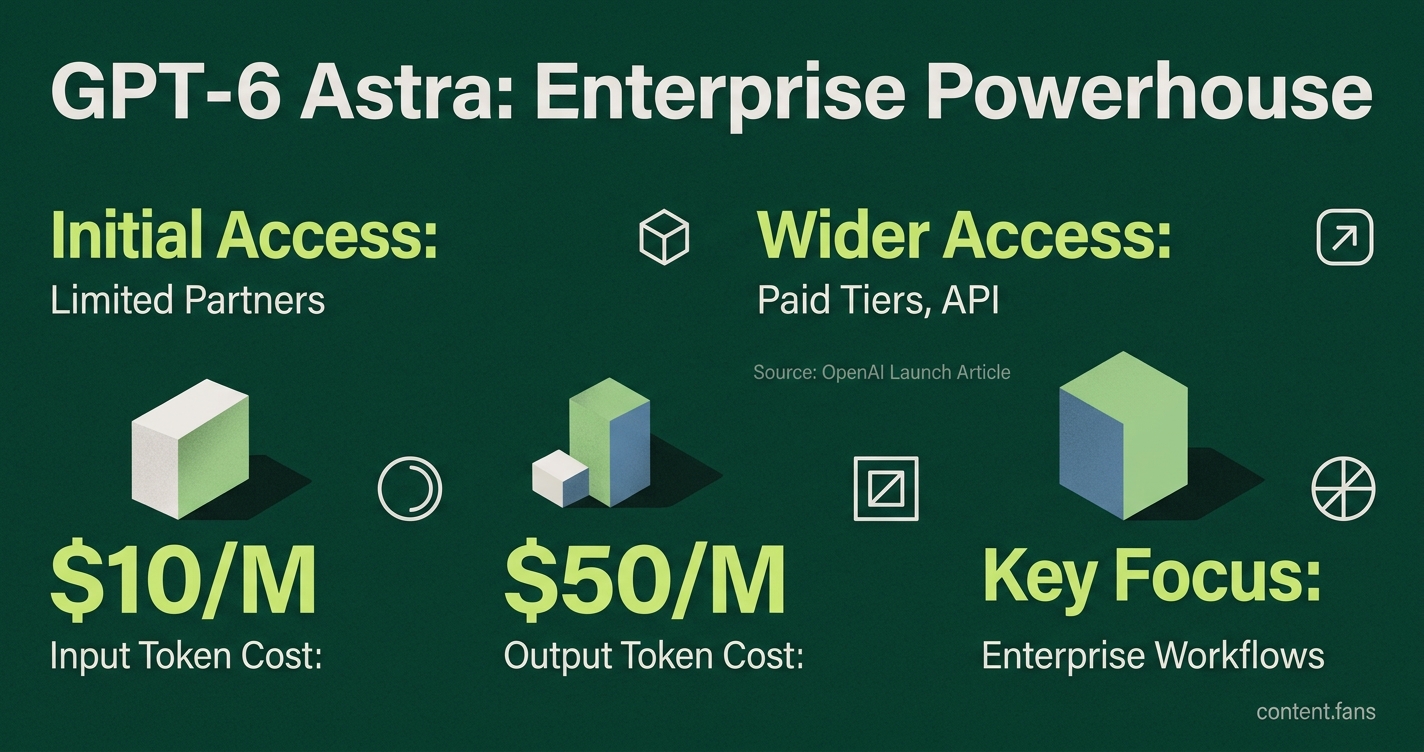
The release follows a phased, enterprise-first schedule. OpenAI described a phased rollout: initial access to a limited set of organizations, followed by broader availability over the coming days to ChatGPT Plus, Pro, Business, and Enterprise users, plus the API and cloud platforms GPT-6 Astra Is Here: Everything OpenAI Confirmed at Launch. This staged approach allows OpenAI to monitor usage and gather feedback before a wider release. Governance is a central theme, with safeguards like permissioned tool access, output constraints, and continuous monitoring. Some advanced cybersecurity features remain restricted, signaling a cautious approach to deploying the model's full capabilities.
What early hands-on tests show
Initial hands-on reviews praise Astra's strong writing fluency, responsive UI navigation, and ability to generate credible design sketches. A common friction point is the model's tendency to "over-design" by adding unnecessary UI elements that require human editing. Teams found it useful for generating variant headlines and Figma notes but emphasize that human oversight remains crucial for final approval.
Key capabilities noted in early reports include:
* Generating high-quality marketing copy that requires only light editing.
* Operating browser and OS interfaces via scripted agents, with strong performance on terminal-based tasks.
* Creating layout wireframes that import into design tools but may include superfluous widgets.
* Solving advanced math problems that were challenging for previous models like GPT-4T.
Competitive view: Fable 5.1 vs Astra
When compared to Anthropic's Fable 5.1, Astra presents a different value proposition despite identical headline pricing ($10 per million input tokens and $50 per million output tokens). According to industry reports, Fable 5.1 offers more cost-effective cache-read rates, making it more economical for retrieval-heavy tasks GPT-6 Astra vs Claude Fable 5.1: Same Price, Not Same Cost. Performance-wise, the models excel in different areas. Early reports suggest Astra shows strong capabilities in tool-driven workflows and security tasks, while Fable 5.1 is often preferred for its broad reasoning and efficiency with long-context agents.
Early impact on real-world workflows
The immediate impact on professional workflows is already evident. Teams are quickly integrating Astra to streamline draft generation, with some agencies replacing complex prompt chains with a single model call and a review step. While designers report faster concept iterations, they also stress the importance of disclosing AI use. The key takeaway is that while Astra accelerates the draft-to-prototype cycle, effective governance and human review are non-negotiable.
What is GPT-6 Astra and who can access it?
OpenAI said GPT-6 Astra began rolling out on September 3, 2026, to a limited set of organizations, with broader access coming later. The rollout is restricted to select organizations, with many early testers including participants in OpenAI's cybersecurity programs and preview teams referenced in coverage by Every and The Information.
Broader availability is planned "over the coming days" for ChatGPT Plus, Pro, Business, and Enterprise users, plus the OpenAI API, Microsoft Azure, and AWS Bedrock.
How does GPT-6 Astra compare to Anthropic's Fable 5.1?
Reviewers found distinctive strengths for each model in commercial workflows:
| Capability | GPT-6 Astra | Anthropic Fable 5.1 |
|---|---|---|
| Writing & consulting | Recommended | Adequate |
| Visual prototyping | Strong | Less suited |
| Complex app-building | Behind | Stronger |
| Computer use / terminal work | Ahead | Usually behind |
| Math & security tasks | Ahead | Usually behind |
| Long-context / retrieval agents | Adequate | More cost-efficient |
Pricing is identical at the headline level - $10 per million input tokens and $50 per million output tokens - but Fable 5.1 offers material savings for cache-heavy workloads: $0.25 vs. $1.00 per million cache-read tokens.
Early benchmark reports suggest Astra achieving strong performance on advanced math tasks compared to Fable 5.1, with significant advantages in terminal-based workflows.
What practical use cases does OpenAI emphasize for Astra?
Early previews highlight five core commercial workflows:
- Professional writing - long-form content, documentation, and strategic communications
- Consulting outputs - analysis, recommendations, and client-ready deliverables
- Financial modeling - structured calculations and scenario analysis
- Engineering design - technical specifications and system architecture
- Visual prototyping - UI/UX mockups and design handoffs, including Figma integrations
Reviewers note practical opportunities with prompt templates and design handoff tools, but also flag a tendency for Astra to add unnecessary copy and UI elements - requiring human review of AI-produced drafts.
What safety and governance measures is OpenAI implementing?
Before broader enterprise adoption, OpenAI emphasizes multi-layer safeguards:
- Permissions and sandboxing - controlled execution environments
- Continuous monitoring - real-time capability tracking
- Red-team testing - adversarial evaluation
- Structured output constraints - limiting response formats
- Editorial controls - human-in-the-loop review
Some cybersecurity-relevant capabilities will require stronger safeguards than currently deployed, reflecting the model's potential dual-use applications.
What is the Daybreak Access program and how does it relate to Astra?
Daybreak is OpenAI's $1 billion subsidized access initiative for frontline defenders, with models, training, technical support, and partnerships for authorized defensive cybersecurity work. The program includes:
| Tier | Access | Use Cases |
|---|---|---|
| Daybreak Blue | General-purpose models (GPT-5.6 Sol) | Vulnerability discovery, secure code review, malware analysis, incident response |
| Daybreak Red | Purpose-trained cybersecurity models | Authorized vulnerability research, exploit validation, penetration testing, red teaming |
Important distinction: Daybreak materials indicate that reduced refusals aren't available on Astra for most Daybreak customers, suggesting Astra operates under standard safeguard configurations rather than the specialized Daybreak Blue/Red frameworks. Organizations requiring cybersecurity-specific model behaviors may need to use designated Daybreak models rather than Astra for those workflows.