
OpenAI Halves Inference Costs by 50% With Software Tweaks
Serge Bulaev
OpenAI appears to have lowered its inference costs by more than 50 percent through software improvements, though the exact method is still secret. Reports suggest the savings are real and come from better GPU use, but details are not public, and outside experts can only guess the techniques used. This cost drop may let more companies use large language models in production and has led to lower prices across the AI industry. Vendors are reacting by cutting prices, adding new pricing tiers, and offering discounts for certain workloads. It remains uncertain if other companies will be able to match OpenAI's efficiency gains without more information.

OpenAI reportedly found a software-only optimization that cut certain inference costs by more than 50%, a move shaking up AI economics. Reports from The Information, followed by a TechTimes report, confirm the savings stem from improved GPU utilization rather than new hardware, though the exact methods remain secret.
Reshaping the Economics of AI Deployment
This significant cost reduction fundamentally reshapes the economics of deploying large language models (LLMs). AI workloads previously considered marginal, such as customer support chat, document triage, and multi-agent orchestration, are now becoming viable for production-scale use. According to industry reports, reducing inference costs could significantly advance the break-even point for enterprise pilots.
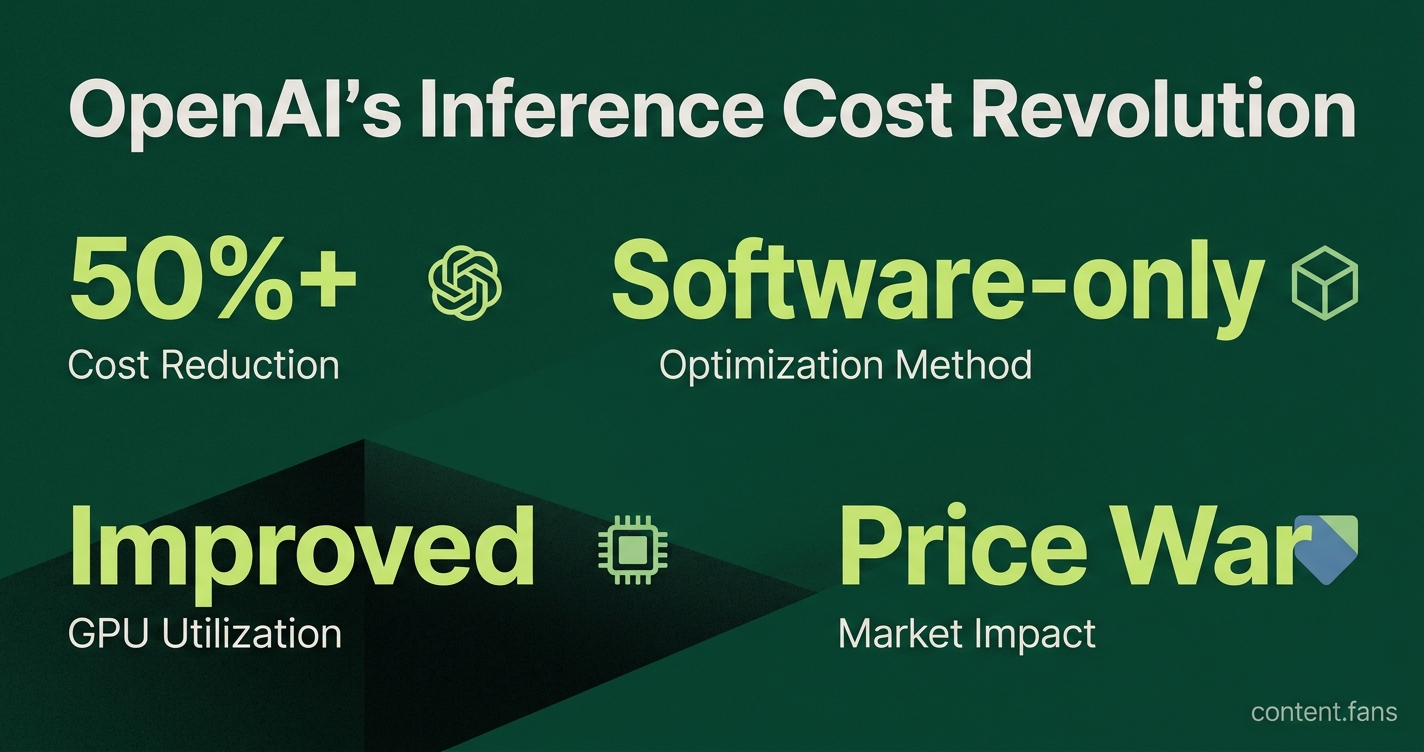
OpenAI achieved a significant cost reduction for AI inference, reportedly over 50%, by implementing software-only optimizations. These improvements focus on increasing the efficiency of existing GPU hardware. Although the specific techniques are secret, industry speculation points toward methods like dynamic batching, quantization, and improved caching strategies.
The Undisclosed Software-Driven Method
Public reports agree on three key points: the cost savings are real, the method is software-based, and OpenAI has not disclosed the technical details. While independent validation is unavailable, reporting from The Information suggests internal dashboards confirm higher GPU occupancy after the changes. Industry experts speculate the gains could come from a combination of known optimization techniques, including dynamic batching, key-value (KV) caching, quantization, speculative decoding, and intelligent request routing. Each method aims to increase throughput by reducing redundant computation or memory usage, but without official confirmation, these remain educated guesses.
Market Impact and Industry-Wide Price Adjustments
The impact of cheaper inference has been immediate, triggering what many analysts call a sector-wide price war. The cost reduction has pressured competitors, with Forbes noting that vendors like Cursor and Salesforce are adjusting their own pricing downward. As raw compute costs fall, analysts suggest enterprise spending will shift from tokens to data governance and workflow integration. This may increase overall AI budgets as expanded usage and new applications become economically feasible.
The Path Forward for Competitors
The central question is whether competitors can replicate OpenAI's efficiency gains. Without a public blueprint, rival labs must embark on their own research to rediscover the optimal mix of caching, batching, and other software tweaks. Until they succeed, OpenAI's undisclosed optimization will remain a key competitive advantage and a central topic in the ongoing narrative of AI costs.
What exactly did OpenAI achieve with this cost reduction?
OpenAI reportedly discovered a software-only optimization that cut inference costs by more than 50% through better utilization of existing GPU servers. The exact technical method remains undisclosed - no public technical paper or official engineering post has validated the specific technique. While sources speculate about approaches like KV cache reuse, quantization, dynamic batching, and speculative decoding, these remain hypotheses rather than confirmed details. The strongest validation available is secondary reporting from The Information that OpenAI's internal discussions described this reduction as achievable through software improvements alone.
How does significant inference cost reduction change AI economics for businesses?
This cost shift fundamentally reshapes deployment viability for enterprise AI. Workloads that were marginal at previous prices - such as customer support automation, document processing, and multi-agent workflows - become economically viable at scale. The path from pilot to production shortens because teams can iterate more cheaply without prohibitive token bills. However, total AI spend often increases rather than decreases as cheaper inference unlocks higher-frequency usage, more agentic workflows, and broader token consumption. The binding constraint shifts from raw compute pricing to integration quality, governance, and data infrastructure - areas now taking larger shares of enterprise AI budgets.
What pricing model changes should enterprises expect?
The market is moving toward cheaper baseline inference with more differentiated premium tiers. Key shifts include:
| Trend | What Changes |
|---|---|
| Per-token API pricing | More aggressive price competition and lower rates |
| Tiered model access | Premium pricing for frontier quality, "good enough" models at discount |
| Batch inference discounts | Significant lower costs for latency-tolerant workloads |
| Hybrid/self-hosted options | More credible "buy API vs. run your own" comparisons |
| Value-based packaging | Monetization shifting from compute to workflow integration and governance |
Vendors increasingly differentiate through latency, reliability, compliance, and orchestration rather than competing solely on raw token pricing.
How are competitors responding to OpenAI's cost advantage?
According to industry reports, OpenAI's price cuts triggered a broader price-response cycle across the industry. Reuters reported that OpenAI reduced Luna pricing from $1 to $0.20 per million input tokens and output from $6 to $1.20 - an 80% reduction for that tier. This forced enterprise AI providers including Cursor, Uber, and Salesforce to adjust prices downward amid margin pressure. The market has seen U.S. labs cut inference costs significantly overall, with enterprise AI costs hitting recent lows driven by price wars and competitive pressure from Chinese open-source models. Average inference prices reportedly reached approximately $1.16-$1.18 per million tokens by early August 2026.
What practical steps should engineering and product teams take now?
Teams should treat this cost reduction as infrastructure leverage rather than simple budget relief. Immediate actions include:
- Implement intelligent routing - direct routine queries to smaller, cheaper models while reserving larger models for complex cases
- Deploy caching strategies - capture additional savings through KV cache reuse and prefix caching to eliminate redundant computation
- Evaluate batch processing - shift latency-tolerant workloads to discounted asynchronous inference where available
- Model total cost of ownership - compare API consumption against hybrid or self-hosted options as the economics shift
- Reinvest savings strategically - redirect budget toward data quality, evaluation frameworks, and governance infrastructure that become the new bottlenecks
Significant cost reductions represent a material leverage point, but sustainable competitive advantage comes from how efficiently organizations convert cheaper compute into higher-quality, more reliable AI-powered products.