
UBS Names Microsoft, OpenAI, Nvidia "Key Enterprise AI Winners"
Serge Bulaev
UBS says Microsoft, Nvidia, and OpenAI may be the main winners in enterprise AI, based on a survey of IT leaders and new analyst ratings. The report suggests that more companies are using AI, with Nvidia chips and Microsoft Azure leading in their areas, while OpenAI's models seem to be the top choice. UBS analysts believe these three firms work well together for businesses, making it easier for companies to use AI from hardware to apps. The report also notes other companies might benefit, but leadership appears to stay with Microsoft, Nvidia, and OpenAI for now, although this could change if new technology costs drop quickly.

A new UBS report names Microsoft, OpenAI, and Nvidia as the "Key Enterprise AI Winners," drawing on a comprehensive survey of 125 IT executives. The findings, sourced from a study published by Investing.com, reveal powerful revenue momentum for these incumbents across cloud infrastructure, AI models, and silicon.
A separate UBS note referenced by Yahoo Finance suggests this strong outlook can counter recent investor concerns about concentration risk in big tech. The research highlights that enterprises are increasing their spending on integrated AI platforms with established distribution and reliable technology stacks.
Survey Shows AI Deployment is Accelerating
UBS identifies Microsoft, Nvidia, and OpenAI as leaders due to their synergistic, three-layer stack. Nvidia provides the essential GPU hardware, Microsoft offers cloud distribution via Azure, and OpenAI supplies the foundational models, creating an integrated, end-to-end solution for enterprise AI adoption.
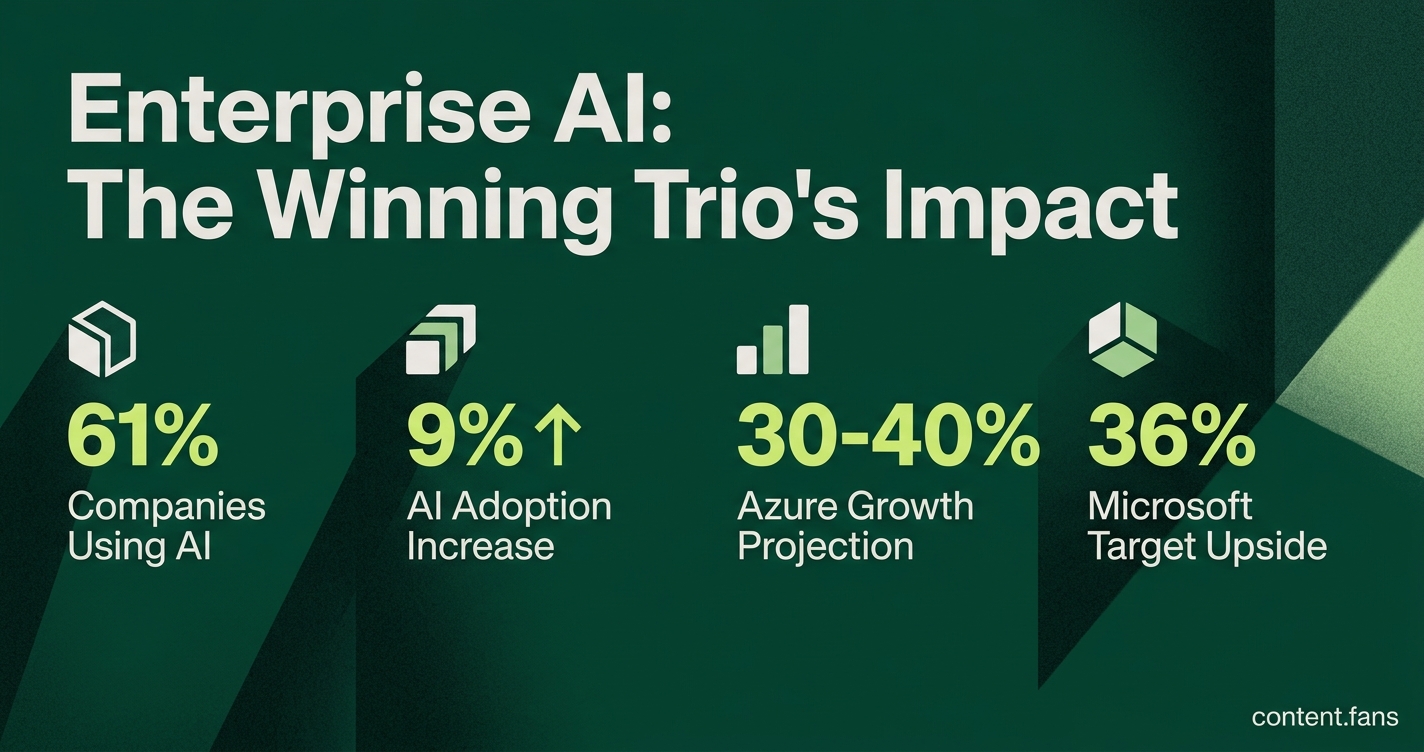
The survey reveals that 61% of companies now actively use AI in at least one business area, a significant increase from 52% in May 2024. Hardware preferences are firm, with executives naming Nvidia GPUs as the top choice for training and inference. Microsoft Azure maintained its lead in cloud infrastructure over AWS, while OpenAI's GPT-4.0 and GPT-3.5 models extended their dominance.
Why the Three-Layer AI Stack Wins
UBS analysts credit the trio's success to a powerful three-layer stack that resonates with enterprise buyers:
- Hardware: Nvidia supplies the dominant silicon for AI computing.
- Cloud & Distribution: Microsoft offers unparalleled reach through Azure and Microsoft 365, with Azure growth projected in the high-30% to low-40% range.
- Models: OpenAI delivers the foundational models behind leading tools like Copilot and DALL-E, driving user adoption within Microsoft's ecosystem.
This integrated structure provides a seamless path from hardware to application, simplifying AI projects and improving the perception of near-term return on investment (ROI) for decision-makers.
Analyst Ratings and Market Outlook
In response to the findings, UBS analysts issued strong endorsements. Software specialist Karl Kierstead reiterated a BUY rating for Microsoft, lifting its 12-month price target to $650, which represents roughly 36% upside. Timothy Aruri updated his BUY rating on Nvidia with an increased target of $245, citing strong demand for inference workloads. While private, OpenAI was described as "foundational to enterprise workflows."
Addressing investor concerns about competition from startups, UBS argues that enterprises prioritize the security and accountability offered by established platforms. The firm projects "low-teens" upside for the broader AI theme in 2026, driven primarily by earnings growth.
The Wider Competitive Landscape
While the report notes secondary beneficiaries like ServiceNow, Databricks, and Snowflake, UBS asserts that leadership remains firmly concentrated with Microsoft, Nvidia, and OpenAI. This dominance is supported by ongoing GPU scarcity, Azure's massive infrastructure expansion, and OpenAI's advancements in multimodal AI like Sora. However, analysts caution that the market could shift if alternative hardware or open-source models become more cost-effective faster than expected.
What methodology did UBS use to name the "key enterprise AI winners"?
The bank surveyed 125 IT executives across multiple industries. All respondents are exploring AI, and 61% now deploy it in at least one function, up from 52% in May 2024. This real-time adoption data, not forward-looking estimates, drove the selection of Nvidia, Microsoft, and OpenAI as the clearest beneficiaries.
Why does UBS give Microsoft the top cloud-infrastructure score?
Microsoft Azure was ranked the preferred host for AI workloads, ahead of AWS and Google Cloud. UBS cites enterprise credibility and distribution reach plus a restructured OpenAI deal that gives Microsoft royalty-free model access through 2032, letting it bundle frontier models into Azure without a per-token surcharge.
How does Nvidia keep its hardware moat intact?
The survey shows Nvidia remains the dominant AI compute platform, used for both training and a growing share of inference. UBS analyst Timothy Aruri reiterated a BUY on the stock and lifted his price target to $245, arguing that GPU demand stays well above supply even as hyperscalers diversify.
Where is OpenAI extending its model-layer lead?
Among enterprises choosing a foundation model, GPT-4.0 and GPT-3.5 extended their lead over open-source rivals such as Meta's Llama family and Google's Gemini. Application-level presence also grew, with DALL-E and Sora cited as the go-to creative tools and GitHub Copilot dominating AI code generation.
Does the note address investor skepticism on AI incumbents?
Yes. UBS explicitly calls the findings a counter-narrative to recent doubts, arguing that cloud + models + hardware under one roof is a durable advantage. The bank projects 25% AI-sector earnings growth in 2026, led by these incumbents, and sees low-teens upside for the broader AI theme as ROI evidence broadens beyond early adopters.