
Google Zero: Publishers lose 33% traffic as AI Overviews expand
Serge Bulaev
Publishers may be losing a lot of website traffic from Google because of new AI Overviews in search results. Reports suggest website visits dropped by about 33 percent worldwide, possibly due to people getting answers directly on Google without clicking links. Experts say this change appears to hurt sites with general or repeated content the most, while those with unique, original reporting or loyal audiences are less affected. Publishers might be shifting focus to things they control, like newsletters and direct communities, and looking for new ways to earn money beyond pageviews. There is still uncertainty about the best strategies, but building original and distinctive content seems to help.

The term Google Zero defines a growing crisis for publishers: a dramatic decline in search referral traffic driven by Google's AI Overviews. This shift is causing significant traffic loss, with Digital Content Next reporting a median 10% year-over-year decline (May-June 2025), while Chartbeat data shows a 33% worldwide drop. Since the feature's May 2024 expansion, even premium publishers have seen a median 10% decline (Search Engine Journal), forcing a strategic pivot toward owned audiences and direct revenue streams.
Why Generic SEO Content Is Most Vulnerable
The rise of AI Overviews disproportionately affects sites built on generic, high-volume SEO content. With industry data showing zero-click searches reaching nearly 70%, even top-ranking articles face dwindling click-through rates. Recent Google core updates have also penalized thin or AI-generated content, signaling a clear preference for deep, first-hand expertise. As a result, publishers relying on evergreen explainers face the highest risk, while brands with loyal, direct audiences are better insulated.
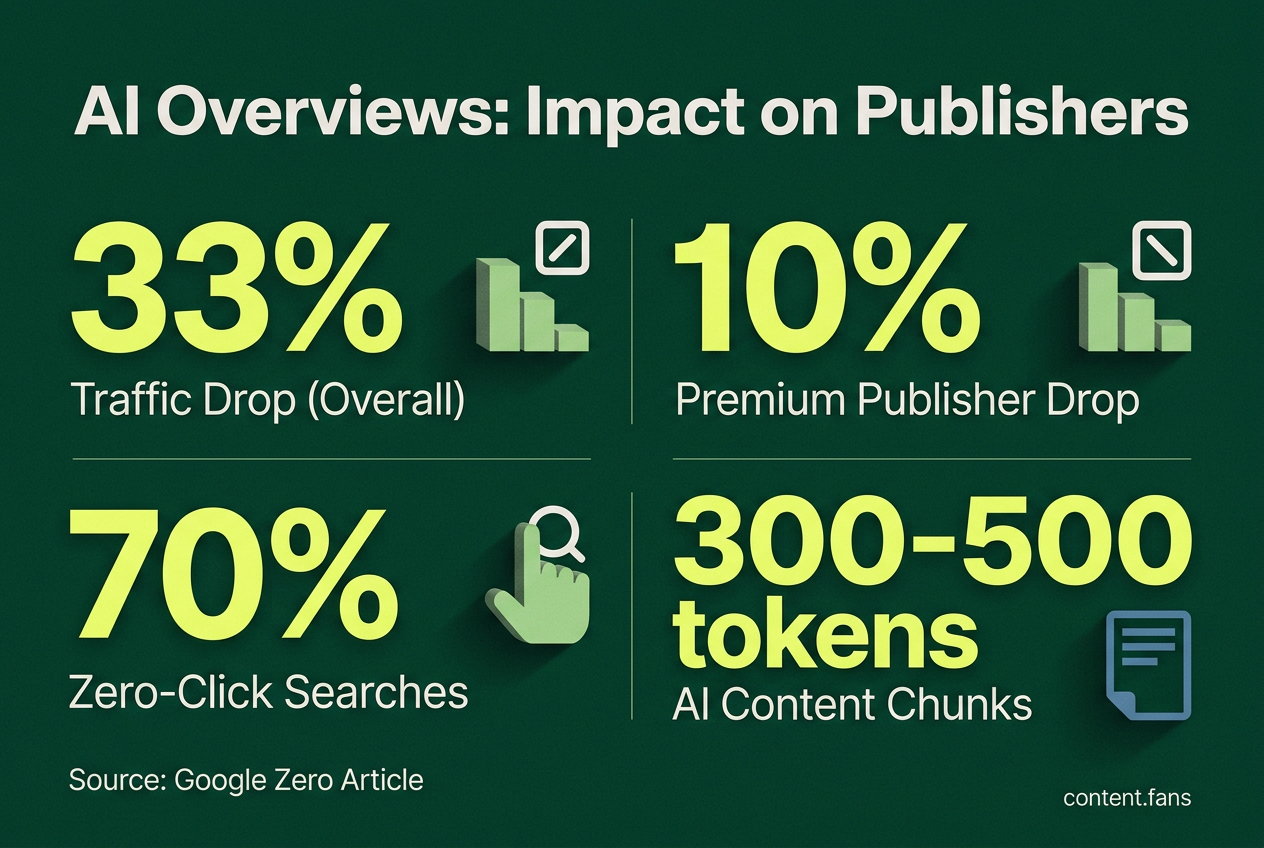
Publishers are losing significant traffic because Google's AI Overviews answer user questions directly on the search results page. This eliminates the need for users to click through to websites, especially for informational queries. Content that is easily summarized, like definitions or simple explainers, is most affected by this change.
How to Build a Defensible Content Strategy
To counteract traffic volatility, leading analysts recommend building content "moats" - defensible assets that algorithms cannot easily replace. Key strategies include:
- Original Research: Publishing proprietary data, surveys, and firsthand reporting that cannot be replicated.
- Owned Audiences: Cultivating direct relationships through email newsletters, SMS lists, and private communities on platforms like Slack or Discord.
- Commerce Integration: Developing robust review sections or transaction-focused pages tied directly to affiliate or e-commerce programs.
- Unique Expertise: Auditing all content to ensure it offers a unique perspective or expert analysis that provides value beyond a simple summary.
Technical SEO for the AI Search Era
Adapting also requires technical adjustments to optimize for how AI models parse information. This new discipline, known as Generative Engine Optimization (GEO), focuses on structure. Because AI often processes content in 300-500 token chunks, using clear H2 and H3 headings is crucial for getting sourced. Furthermore, adopting a pillar-cluster model - where a comprehensive pillar page is supported by numerous linked, in-depth articles - helps establish clear topical authority for a subject, making your site the definitive source in Google's eyes.
Monetizing Beyond Pageviews
As pageview-based ad revenue becomes less reliable, publishers are aggressively diversifying their monetization strategies. Commerce and affiliate models are now among the fastest-growing revenue streams, particularly when integrated with newsletters targeting an engaged, opted-in audience. A new, promising model involves licensing original research and premium data directly to AI companies for use in their models, with platforms like Microsoft's Publisher Content Marketplace creating a new market for high-quality content.
The Path Forward in the Google Zero Era
The era of Google Zero presents a formidable challenge, but it also clarifies the path forward. The most resilient publishers will be those who pair a GEO-friendly technical architecture with a content strategy centered on unique, defensible assets and direct audience relationships. While the transition away from reliance on search referrals may be difficult, a clear playbook for survival and growth is emerging.
What exactly is "Google Zero" and how big is the traffic drop?
Google Zero describes the point where referral traffic from Google Search falls so low that it no longer drives sustainable revenue.
Between November 2024 and November 2025, sites in the Chartbeat network lost 33 % of Google traffic worldwide and 38 % in the U.S.
Some publishers report CTR drops of up to 89 % once an AI Overview appears, and zero-click searches now account for 69 % of all queries.
Why are AI Overviews the main cause of the decline?
Since their full U.S. rollout in May 2024, AI Overviews answer queries directly on the results page, removing the need to click.
Studies show organic CTR on informational keywords collapses by ~61 % when an overview is present, and even position-one pages lose 30 % or more clicks.
Expansion is accelerating - some verticals show 400-500 % year-over-year growth in overview prevalence.
Which publisher content is most at risk?
Evergreen, easily summarized pages - explainers, definitions, top-ten lists - are routinely swallowed by AI Overviews.
Conversely, transactional pages, proprietary reviews, interactive tools and original data still force users to visit the site.
Publishers whose archives are heavy on generic SEO content face the steepest falls, while those with unique assets retain visits.
What concrete steps build a defensible content moat?
- Owned audiences: move readers to email, SMS or private communities you control.
- Original research: publish surveys, benchmarks or data sets that can't be summarized in two sentences.
- Product-linked content: build reviews, comparison widgets and deal pages that require on-site action.
- Topic clusters: cover every sub-topic around a pillar page so Google sees you as the canonical source.
- Structured snippets: break articles into 300-500 token chunks with clear H2/H3 labels so AI citations still point to you.
How fast are publishers shifting revenue models?
According to industry reports, commerce, events and licensing are now among the top growth areas, while programmatic ad priority has declined for many publishers.
Publishers using bundled offers (newsletter + premium data + affiliate deals) report 15-25 % higher ARPU and lower churn.
Microsoft's new Publisher Content Marketplace already lets outlets license original research to AI engines for recurring fees, turning content moats into direct revenue.