
Anthropic launches Claude Platform on AWS with full feature parity
Serge Bulaev
Anthropic has made its Claude Platform on AWS available, allowing developers to use the Claude Messages API with their AWS accounts. The platform may offer all the same features and pricing as Anthropic 's direct API, but data appears to be processed outside AWS, unlike Amazon Bedrock. Both services use the same Claude models, but new features might appear on the Claude Platform faster than Bedrock. Companies concerned about strict data rules may still need Bedrock. Analysts suggest AWS might be trying to attract both fast-moving teams and highly regulated users with these options.

The Claude Platform on AWS is now generally available from Anthropic, providing developers with native Claude Messages API access via their AWS accounts. This launch offers full feature parity, including support for beta headers like anthropic-beta, with pricing via AWS Marketplace on a consumption basis.
The key advantage for AWS customers is immediate access to every feature from Anthropic's direct API, while maintaining integrated AWS billing, IAM, and CloudTrail for governance.
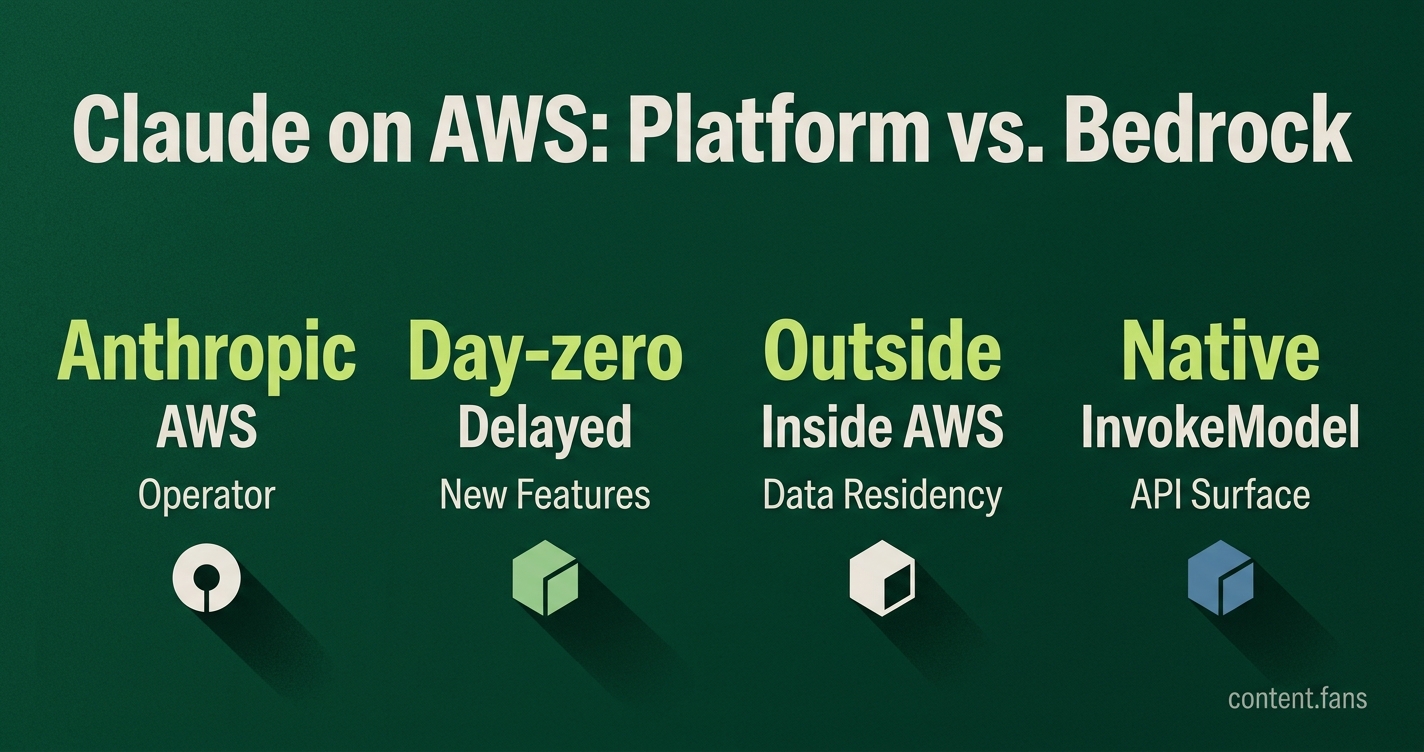
What the GA release actually delivers
The Claude Platform on AWS is an Anthropic-operated service that provides the native Claude API through AWS accounts. It offers immediate access to all new Anthropic features, including betas, while using AWS for authentication and billing, though data processing occurs outside the AWS network boundary.
While operated by Anthropic, the platform's endpoints are secured with AWS SigV4 authentication. A YouTube announcement on launch day demonstrated this full feature parity with the native Claude API, showing real-time responses from models like Opus 4.7 and Sonnet 4.6. This gives enterprises immediate access to:
- Managed Agents beta
- Code execution sandbox
- Skills and web fetch utilities
- Batch processing, prompt caching, and the Claude Console
It is important to note that API requests are processed at Anthropic facilities, meaning they exit the AWS network. This differs from Amazon Bedrock, where all inference and data remain inside the AWS boundary, as detailed in the AWS docs comparison.
Claude Platform vs Amazon Bedrock
Both the Claude Platform and Amazon Bedrock provide access to the same family of Claude models, but they differ significantly in feature velocity and data governance:
| Dimension | Claude Platform on AWS | Claude on Bedrock |
|---|---|---|
| Operator | Anthropic | AWS |
| API surface | /v1/messages with beta headers |
Bedrock InvokeModel |
| Day-zero access to new features | Yes | Reportedly weeks to months later |
| Data residency | Outside AWS boundary | Inside AWS boundary |
| Compliance focus | Industry standard compliance | Enhanced compliance options |
Pricing is available through the AWS Marketplace as Claude Consumption Units, though specific pricing comparisons across channels have not been confirmed.
Early enterprise considerations
- Governance Verification: Begin with a non-production agent to confirm that all API calls are correctly logged in AWS CloudTrail.
- Latency Testing: Benchmark performance. Independent tests have shown the native API can respond faster than Bedrock in certain environments.
- Compliance Mapping: Evaluate your regulatory requirements. Amazon Bedrock may be the preferred choice for workloads that require enhanced compliance certifications.
This dual-offering strategy from AWS appears designed to serve two key markets: agile development teams seeking rapid feature access and enterprises in highly regulated industries. For organizations already invested in the AWS ecosystem, the Claude Platform removes adoption barriers, enabling experimentation with the latest AI capabilities without waiting for them to be ported to Bedrock.
Now that the platform is generally available, the focus will be on the speed at which advanced features, such as 1-million-token context windows and vision capabilities, move from preview to general availability.