
Sierra raises $950M, powers 40% of Fortune 50 voice agents
Serge Bulaev
Sierra may be becoming a key player in the voice AI market after raising $950 million and now serving 40 percent of Fortune 50 companies. The company's revenue recently grew to over $165 million, but the wider market is still considered early stage. Research suggests many big companies are just starting to use voice agents, with only about two-thirds of Fortune 500 firms having these systems. While Sierra's growth suggests full adoption may be beginning, experts say challenges like regulation and security remain. The new funding might help Sierra improve its platform as more businesses consider voice agents for customer service.

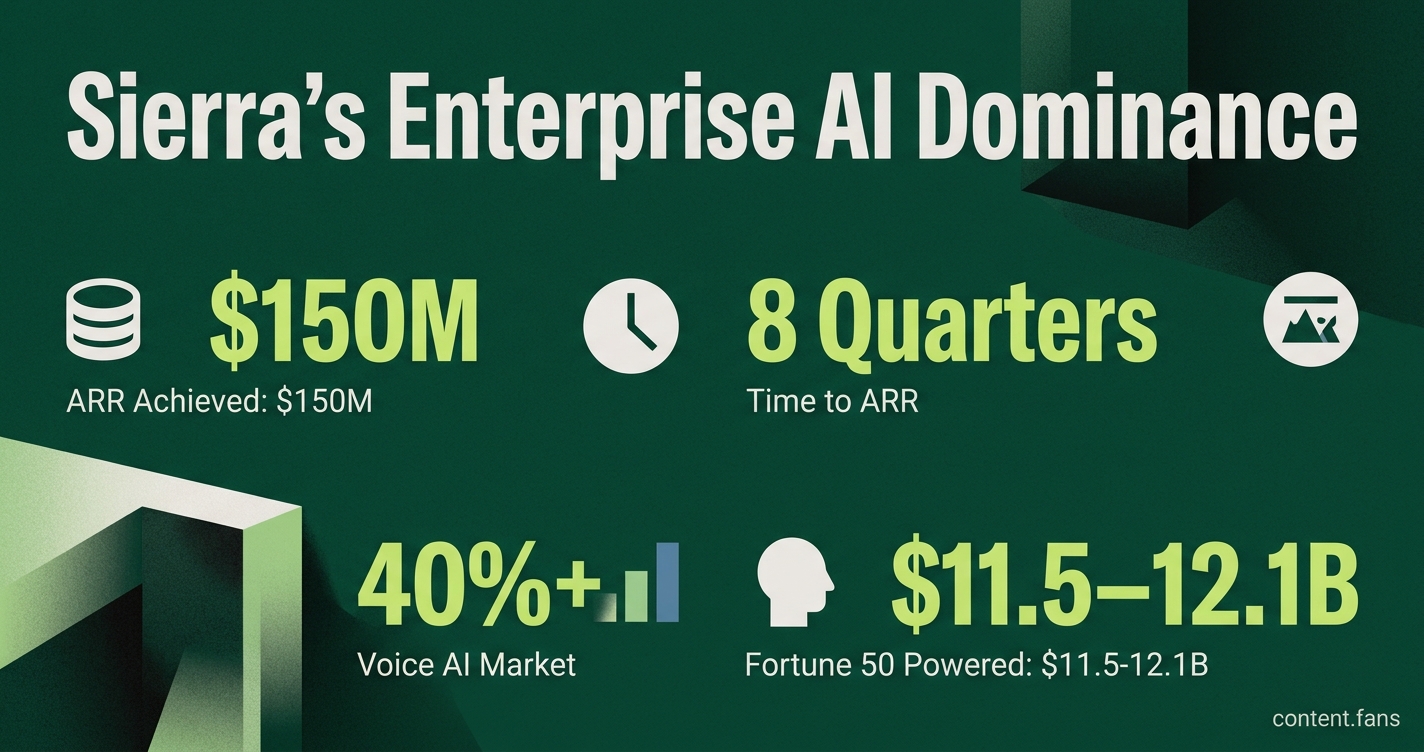
In a major signal of enterprise AI momentum, Sierra announced it has raised funding in a Series E round and now powers AI agents for a significant portion of Fortune 50 companies. Founder Bret Taylor shared the milestones, which include reaching $150M ARR within eight quarters, at industry events. The financing was led by major investors according to industry reports.
These figures provide critical insight into enterprise AI agent adoption and clarify Sierra's position in a market that analysts still characterize as being in its early stages.
Funding details and enterprise traction
Sierra's Series E funding round brings significant capital and enterprise traction. The investment underscores substantial enterprise adoption, with 40%+ of Fortune 50 companies now using Sierra's AI agent platform (multi-channel, including voice).
- Amount raised: Substantial Series E funding
- Reported post-money valuation: Multi-billion dollar valuation
- Lead investors: Major institutional investors
- Cash on hand after the round: Significant capital for expansion
Founder Bret Taylor confirmed that a significant portion of Fortune 50 companies are running production systems on Sierra's platform. This deep enterprise penetration is reflected in the company's rapid revenue growth, reaching $150M ARR within eight quarters. While these metrics indicate a shift from pilot programs to full-scale deployments, Taylor maintains the broader market is still in its infancy, comparing its maturity to the "pre-broadband internet" era.
Voice AI market context
Industry analysis reveals a market expanding rapidly but unevenly. The global voice AI market is estimated at $11.5-12.1B in 2026, and contact centers are expected to achieve significant savings through conversational AI according to industry reports. Further, analysts forecast that a growing portion of enterprise software will feature embedded task-specific agents, as noted in industry trend guides. Despite this growth, with many Fortune 500 firms still developing production voice systems, significant room for market expansion remains.
As deployments scale, technical priorities are evolving. Key trends include a growing demand for on-premises or edge processing to meet privacy regulations, multilingual support to access new markets, and emotion detection capabilities, which can significantly reduce call escalations according to industry reports. Sierra's product roadmap, particularly its upcoming Ghostwriter module, is strategically aligned with these demands, focusing on autonomous workflow execution and innovative outcomes-based pricing models.
Early innings despite headline numbers
Taylor's "pre-broadband" analogy is supported by research showing varied AI adoption success rates across enterprises. Studies vary: 5% scaled profit (MIT), 74-92% positive ROI (Google Cloud, MIT Sloan), 82% positive (YouTube study). No consensus on lagging adoption rates. Consequently, this funding round is less a celebration of current success and more a strategic investment to scale infrastructure, expand geographic reach, and enhance quality assurance to capture the vast majority of enterprises that have not yet fully adopted voice AI.
Industry experts caution that significant hurdles remain, including navigating regulatory complexity, mitigating algorithmic bias, and ensuring robust data security. Nevertheless, this substantial capital infusion gives Sierra the necessary runway to mature its platform and address these challenges, positioning it as a compelling alternative to traditional customer service solutions.