
Top Creators Pass $1 Billion in Earnings for First Time in 2026
Serge Bulaev
Top creators may have earned over $1 billion for the first time between March 2025 and March 2026, according to Forbes. This increase suggests that creators now run their channels like small businesses with multiple sources of income and staff. Experts say that having several income streams, like ads, products, and memberships, might help creators earn much more than relying on just one. Analyst reports suggest the creator economy could keep growing quickly, but there may be risks like depending on algorithms and creator burnout. Overall, creators now appear to operate more like small media and retail businesses than in the past.

The creator economy has reached a landmark achievement, as top creators passed $1 billion in collective annual earnings for the first time, a new Forbes report confirms. This milestone signifies a major shift in the industry, highlighting how elite online personalities now operate as sophisticated small businesses with diverse revenue streams, professional staff, and distinct product lines.
Crossing the Billion-Dollar Line
Forbes' 2026 Top Creators list reveals the 50 highest-earning personalities brought in a combined $1.02 billion between March 2025 and March 2026. This record total represents a 20% increase from 2025, underscoring the rapid professionalization and economic power of the creator industry.
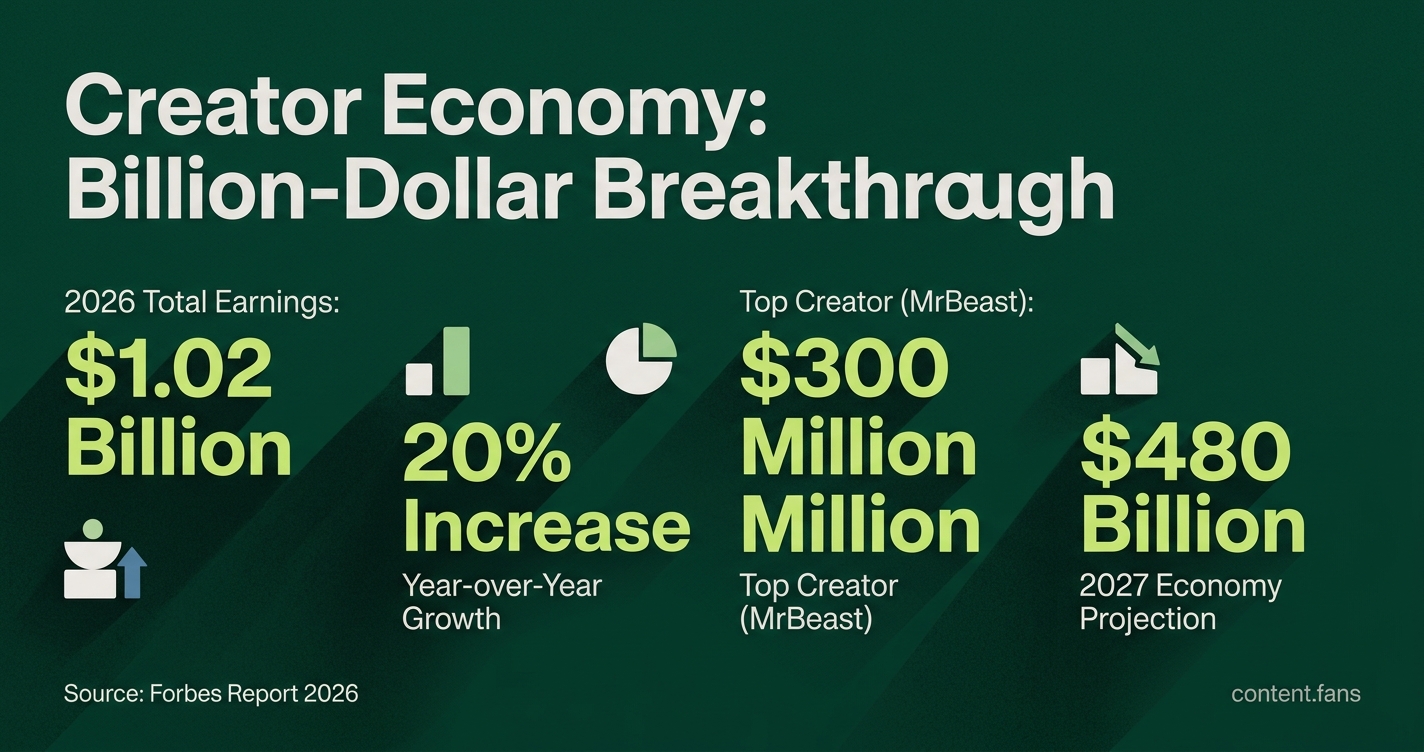
The ranking estimates gross earnings, excluding equity, using self-reported data, brand disclosures, and figures from analytics firm Influential. YouTuber MrBeast led with an estimated $300 million, followed by filmmaker Dhar Mann at $65 million. The complete methodology and earnings table are available in the magazine's June 2026 issue (Forbes).
Small-Business Structures Behind Creator Paydays
Top creators achieve these figures by structuring their operations like modern enterprises, stacking revenue from ads, sponsorships, subscriptions, and direct product sales. Industry reports suggest creators with multiple income streams earn significantly more annually than their single-stream counterparts. Common and effective tactics include:
- Digital courses or templates that carry high margins
- Paid membership communities for steady monthly cash flow
- Performance-based brand deals tied to measurable sales
- Merchandise and consumer goods sold through owned storefronts
Reflecting this complexity, many top-tier channels now employ full-time production crews, editors, and e-commerce managers, mirroring the operational structure of traditional small businesses.
Growth Picture 2022-2026
The year-over-year growth in creator income has been substantial. Collective earnings for the top 50 creators scaled from $570 million in 2022 to $853 million in 2025, before crossing the billion-dollar mark in 2026, according to a Forbes press release. This rapid ascent suggests that sophisticated, diversified monetization strategies - not just audience size - are the primary drivers of revenue growth.
What Analysts See Ahead
Market projections point to continued, albeit uneven, expansion. One forecast from Goldman Sachs Research estimates the broader creator economy could reach $480 billion by 2027. Industry analysts project significant continued growth through the early 2030s, driven by owned community platforms. Key factors shaping near-term performance include:
- Platform Dependence: Reliance on opaque platform algorithms continues to be a primary revenue risk.
- Creator Burnout: The pressure to constantly produce content is pushing creators toward sustainable, membership-based models.
- Sponsorship Evolution: Brands are increasingly demanding performance-based deals with clear ROI over flat-fee sponsorships.
- AI Integration: AI-powered tools for editing, analytics, and workflow management are becoming key to reducing operational costs.
These trends confirm the evolution of the professional creator into a hybrid media-retail startup, where success hinges on balancing broad audience reach with a resilient, diversified portfolio of owned income channels.
How much did the top 50 creators earn collectively in 2026?
According to Forbes' 2026 Top Creators list, the 50 highest-earning creators collectively made $1.02 billion - the first time the ranking has crossed the billion-dollar threshold. This represents a 20% jump from 2025's $853 million and a substantial increase from the inaugural 2022 total of $570 million. Forbes measured gross earnings between March 2025 and March 2026, counting earnings rather than equity in companies.
Who were the top individual earners on the 2026 list?
The rankings reveal significant income concentration at the top:
| Rank | Creator | Earnings |
|---|---|---|
| 1 | MrBeast | $300 million |
| 2 | Dhar Mann | $65 million |
| 3 | Steven Bartlett | $52 million |
This means the #1 earner alone accounted for nearly 30% of the entire group's collective earnings, illustrating how the creator economy produces outsized returns for its biggest stars.
Why do top creators now resemble small businesses?
The most successful creators in 2026 operate with sophisticated business structures that mirror traditional small enterprises through:
- Diversified revenue streams - combining ads, brand deals, product lines, subscriptions, events, licensing, and equity deals rather than relying on platform payouts alone
- Recurring revenue models - memberships and subscriptions providing predictable cash flow
- Owned audience channels - email lists, communities, and direct storefronts reducing dependence on algorithmic platforms
- Professional operations - teams handling analytics, legal, product development, and fulfillment
Industry reports indicate that creators using multiple monetization methods generate significantly more annual revenue than those depending on a single income stream.
What monetization strategies are proving most effective in 2026?
The strongest-performing creator businesses in 2026 employ hybrid models combining multiple approaches:
| Strategy | Why It Works |
|---|---|
| Digital products | Low startup cost, scalable, high margins |
| Subscriptions/memberships | Predictable recurring revenue, strong retention |
| Performance-based sponsorships | Brands increasingly prefer base fee + bonus structures tied to actual conversions |
| Owned commerce | Direct product sales through personal storefronts |
The shift is pronounced: creators are moving away from flat-fee sponsorship dependence toward diversified revenue portfolios that include media ventures, software tools, and community-based offerings.
What does future growth look like for the creator economy?
Forecasts for 2026-2027 vary considerably but point to continued expansion:
- Goldman Sachs projects the creator economy could reach $480 billion by 2027, up from approximately $250 billion currently
- Industry analysts forecast significant growth through the coming decade
- Global creator numbers are expected to grow substantially over the next five years
However, the growth profile is shifting. Future success depends less on pure audience reach and more on sustainable business fundamentals: owned communities, AI-assisted operations, and diversified income streams that reduce platform dependency. Key challenges include burnout, attention scarcity, and operational complexity as creators professionalize their operations.