
Tokenmaxxing: How AI Token Economics Drives Up Costs for Companies
Serge Bulaev
"Tokenmaxxing" means using as many AI tokens as possible to get the most out of generative AI for the lowest cost. Each token pays for a small amount of computer use, and when companies use millions or billions, the cost becomes important. Prices for tokens can vary a lot depending on the model and whether answers are reused, so picking the right model is a big way to save money. Some companies and developers spend huge amounts on tokens, and cheaper prices may lead to more use. Tracking token usage and costs is important, and there are also legal and accounting questions when tokens are sold or traded.

Tokenmaxxing is a key strategy in AI token economics, helping companies control generative AI costs by optimizing their use of AI tokens. These tokens, which meter compute time, become a major financial line item as usage scales into the billions, making cost management essential. As every prompt has a price, what feels intangible quickly becomes a significant factor in financial planning.
What a token buys: compute priced in fractions of a cent
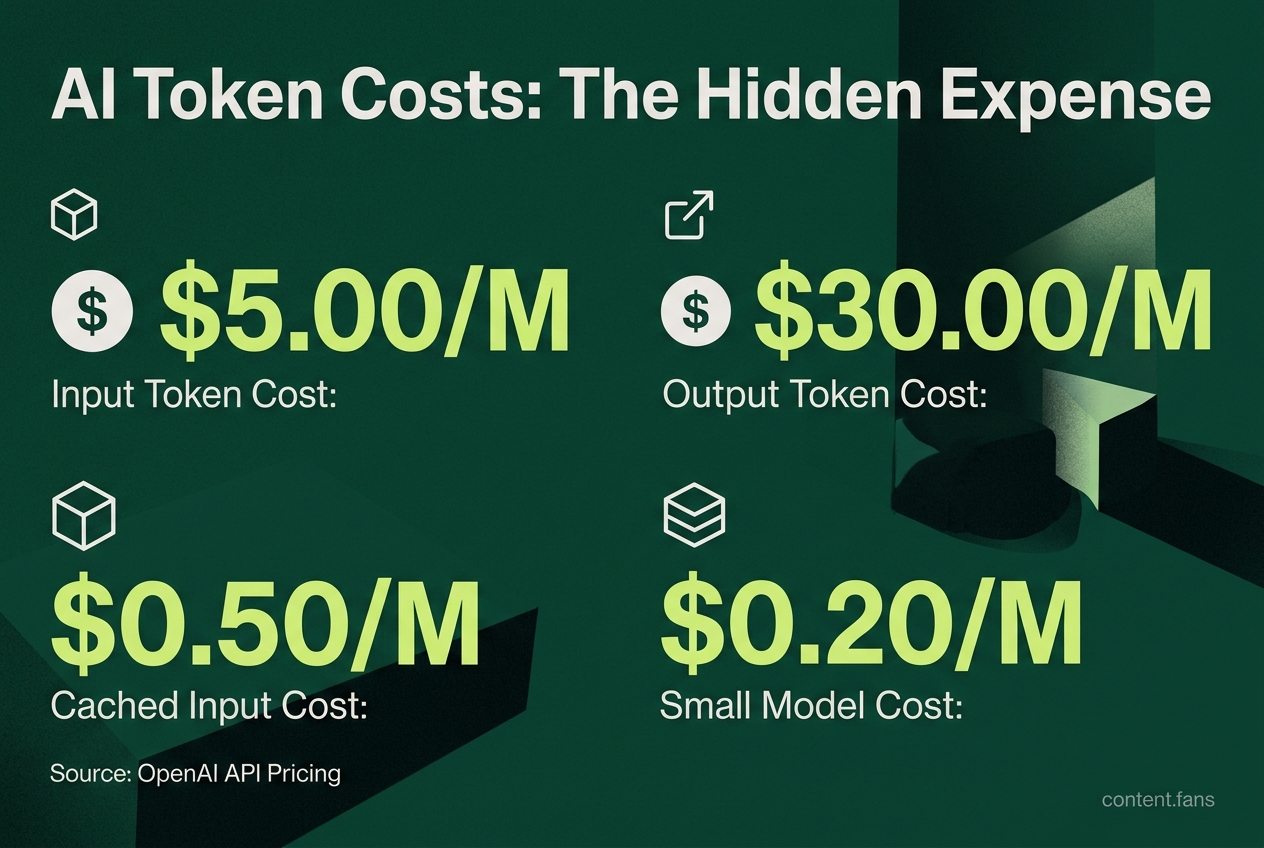
An AI token represents a small fraction of compute time, with prices varying significantly by model and usage type. According to OpenAI API Pricing, a flagship model's input can cost $5.00 per million tokens, while its output is far pricier at $30.00 per million. This spread encourages shorter answers and prompt reuse. Caching repeated inputs dramatically cuts costs to $0.50 per million. Meanwhile, smaller models can be as cheap as $0.20 per million, making model selection a primary cost lever.
Tokenmaxxing is the practice of strategically managing AI token consumption to achieve maximum performance from generative AI models at the lowest possible cost. It involves careful model selection, prompt optimization, and leveraging pricing tiers, such as caching, to reduce expenses as AI usage scales.
Real usage numbers: from solo hackers to telecom giants
Token consumption varies dramatically from individual developers to enterprise giants, illustrating the financial impact of AI at scale. According to industry reports, notable examples include:
- Independent developers spending significant amounts on AI tokens monthly as they scale their applications.
- Major platform companies consuming massive token volumes across their user bases.
- Large enterprises seeing substantial growth in daily token consumption as they optimize their AI implementations.
These patterns show how accessible pricing can drive higher usage through more complex prompts and agentic workflows. Consequently, engineering teams now monitor cost-per-inference as closely as they do performance latency.
When tokens look like investments
The line between a service credit and a financial investment can blur when companies pre-purchase large blocks of tokens, sometimes through SAFE-styled agreements. While standard usage credits are typically treated as prepaid expenses, the situation becomes complex if tokens are marketed with profit-sharing potential, convertibility to equity, or are tradeable. Accountants generally treat token purchases in one of three ways:
- Expensed as consumed for pay-as-you-go usage.
- Recorded as a prepaid asset when purchased in bulk.
- Booked as a liability or equity-like instrument if tied to future company performance.
Legal teams caution that tokens with no expiration date, resale potential, or bundled revenue sharing face heightened scrutiny under securities law. Furthermore, providers selling into Europe must also comply with the EU AI Act's rules on general-purpose models.
Cost levers every finance team watches
Effectively managing token expenditures requires continuous monitoring, as a single user prompt can trigger multiple tool calls and agent interactions, multiplying costs. Observability platforms are essential for tracking the five key metrics that directly impact spending:
- Model Tier: The cost difference between flagship and smaller "nano" models.
- Prompt Length: The number of input tokens used.
- Output Length: The number of tokens generated by the model.
- Cache Hit Rate: The percentage of prompts served from the cheaper cache.
- Reasoning or Tool-Use Depth: The complexity and number of chained AI calls.
By monitoring these levers, organizations can transform tokenmaxxing from a reactive trend into a disciplined financial strategy.
What exactly is Tokenmaxxing and why are companies spending millions?
Tokenmaxxing is the deliberate strategy of maximizing upfront token purchases to lock in lower per-unit pricing or to secure scarce compute windows. Early buyers hope to front-load costs before prices rise or capacity tightens. The practice has quickly moved from speculative to mainstream: significant investments now buy substantial token volumes at the standard tier listed on OpenAI's pricing page. Many companies are reportedly making large upfront token purchases rather than paying per-use.
How do token prices scale across different models and caching?
Prices span three orders of magnitude across different model tiers. Flagship models cost $5.00 input / $30.00 output per 1 M tokens, while nano-class models drop to $0.20 input / $1.25 output. Most overlooked lever is cached input: when prompts repeat, the same tokens drop to $0.50 per 1 M tokens, a 10× discount. Industry case studies show enterprises dramatically scaling token usage while cutting total costs through aggressive caching and tier-shifting strategies.
Which real-world workloads actually consume trillions of tokens?
According to industry reports, high-volume token consumption patterns include:
- Major platform companies: consuming massive token volumes monthly across their services
- Large tech companies: experiencing significant year-over-year growth in API token usage
- Enterprise AI pipelines: startups and established companies logging substantial token usage
- Individual developers: heavy users consuming significant token volumes for complex projects
These patterns confirm that programming, super-agent, and multi-step reasoning workloads are among the primary drivers of high token consumption, as highlighted in industry studies.
How should CFOs classify token purchases on the balance sheet?
Most pure usage tokens are treated as prepaid cloud expenses or contract assets, expensed as consumed. Issues arise when tokens are bundled with equity rights, revenue-sharing, or guaranteed resale: under U.S. GAAP and IFRS the substance test may force classification as intangible asset, derivative, or even investment security. Token-linked SAFEs carry additional risk: if marketed as profit-linked credits rather than simple service credits, the instrument could cross the line into security territory, requiring full securities-law compliance.
What are the practical steps for staying compliant when token holdings scale?
- Document intent: usage credit vs investment
- Limit transferability: avoid secondary markets to reduce securities-law exposure
- Set expiration/refund clauses: aligns accounting with prepaid expense rules
- Separate equity SAFEs from token credits: prevents hybrid instruments that regulators dislike
- Model cost in cash-flow forecasts: treat token burn as variable OpEx and cache aggressively to hit the $0.50 / 1 M cached token tier when possible