
CIOs Get 6-Layer Framework for Enterprise AI Strategy
Serge Bulaev
CIOs are being given a six-layer framework to help add AI into their companies. This framework includes setting business goals first, building strong data systems, and making sure different systems can work together. It also suggests careful checks for governance and risk, clear operating models, and ongoing management of AI systems. A step-by-step rollout from human-only execution to more automated tasks may lower risks and build trust. Only a small number of companies appear to have strong governance for autonomous agents, so early attention to monitoring may be needed.

As AI integration shifts from experimental curiosity to a board-level mandate, CIOs require a repeatable playbook for success. This 6-layer framework for enterprise AI strategy provides a structured path for scaling from isolated pilots to compliant, production-grade systems. Techment reports that prioritizing enterprise objectives is critical for avoiding stalled projects, while Coworker emphasizes that successful deployments depend on governed corporate data, not ad-hoc files. This framework bridges vision, data, engineering, and governance to drive reliable adoption.
A modular six-layer framework
This framework offers a structured, repeatable methodology for Chief Information Officers and Chief Data Officers to guide AI initiatives. It breaks down the complex process of enterprise AI adoption into distinct, manageable layers, from initial business strategy and data readiness to lifecycle management and ongoing governance.
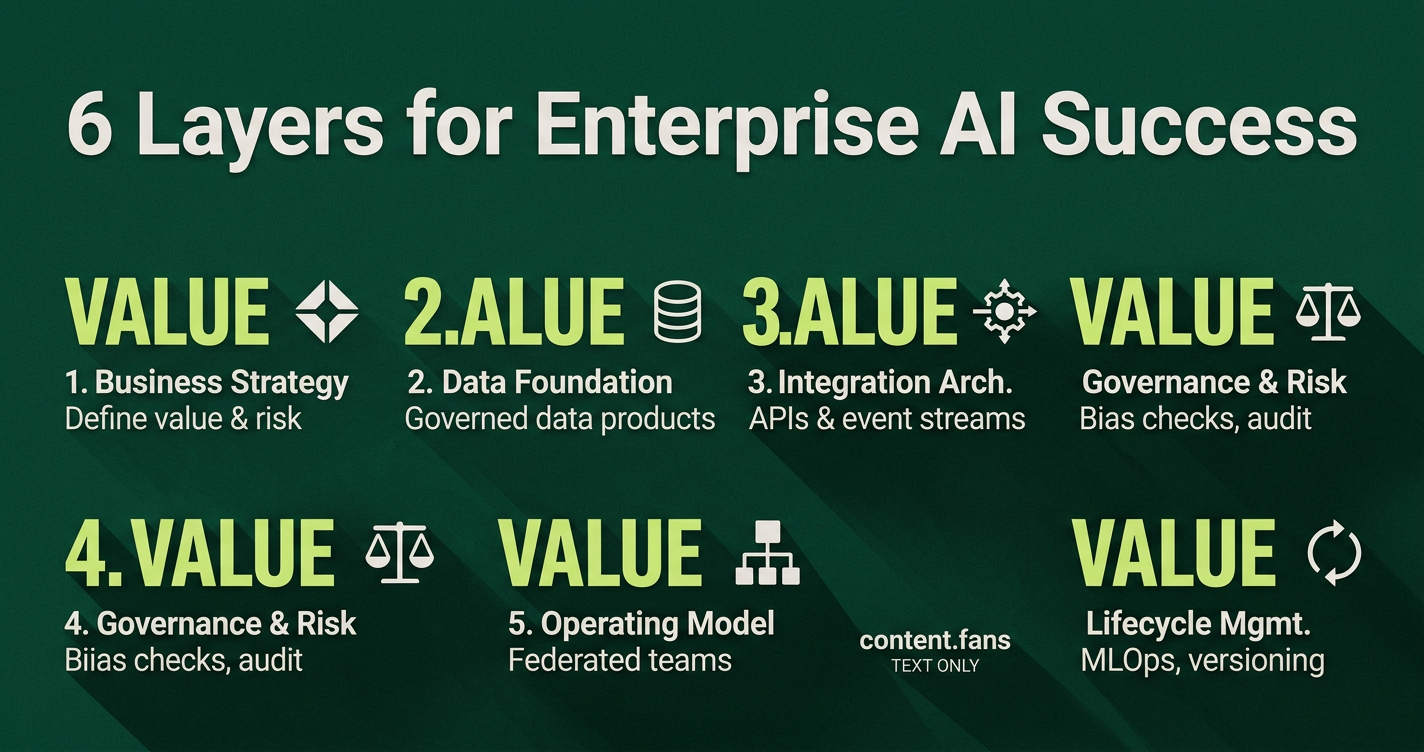
- Business Strategy and Portfolio: Define target processes, identify value pools, and establish risk tiers before committing resources to development.
- Data Foundation: Establish governed data products with clear lineage and strict access controls. As Sema4.ai notes, regulated data often necessitates deployment in a private VPC.
- Integration Architecture: Expose enterprise systems through well-defined APIs and event streams. AgileSoftLabs recommends a dedicated orchestration layer to effectively mediate AI agent actions.
- Governance and Risk: Embed identity management, audit trails, bias checks, and approval gates at every stage of the AI lifecycle, following best practices outlined by sources like OneReach.
- Operating Model: Implement a federated model where business-aligned product teams develop use cases, while a central AI Center of Excellence sets standards, a structure described by Techment.
- Lifecycle Management: Adopt robust MLOps practices for model versioning, continuous evaluation, secure rollbacks, and ongoing improvement, as highlighted by Everworker.
Phased rollout reduces operational shock
Leading experts converge on a phased, three-stage deployment cadence to minimize operational disruption and build user trust:
- Shadow Mode: The AI system generates recommendations, but humans retain full control of execution. AgileSoftLabs identifies this as the safest initial step.
- Assisted Mode: The AI takes action, but only after receiving explicit approval from a human operator.
- Controlled Autonomy: The AI operates independently within predefined boundaries, supported by robust guardrails, continuous monitoring, and instant-rollback capabilities.
This progressive sequence is proven to build user confidence and mitigate operational risk before transitioning to more advanced automation.
KPI compass for adoption and control
To ensure a holistic view of performance, experts like StackAI and Samta AI emphasize multi-dimensional measurement. A comprehensive KPI dashboard should track the following dimensions:
| Dimension | Example metric |
|---|---|
| Adoption | Weekly active users, activation rate |
| Value | Cycle time reduction, cost-to-serve change |
| Platform | p95 latency, unit cost per inference |
| Quality | Accuracy score, hallucination frequency |
| Governance | Compliance audit pass rate, policy violation count |
Given that many companies still lack mature governance for autonomous agents according to industry reports, CIOs should prioritize monitoring coverage and human override rates from the outset.
Quick checklist for CIOs and CDOs
Addressing these key questions helps organizations move beyond "pilot purgatory" - a term coined by CDW - and achieve reliable, compliant AI at enterprise scale.
- Have business KPIs been defined and explicitly linked to each AI use case?
- Are data quality rules and access control policies fully implemented and operational?
- Have standard integration patterns for APIs and event streams been formally approved?
- Is comprehensive monitoring for identity, audit trails, and model drift active?
- Is there a documented rollout plan that follows the shadow-assisted-autonomy sequence?
FAQ: 6-Layer Enterprise AI Strategy Framework
3. What is the 6-layer framework and how does it move AI from pilot to production?
The framework is a repeatable playbook that combines technical patterns with organizational processes:
- Discovery - identify decision points that can be AI-augmented
- Design - map value, build ROI models, set KPIs
- Engineering - package models with APIs, event streams, CI/CD
- Assurance - run shadow → assisted → controlled-autonomy rollouts
- Governance - embed policy gates, audit trails, RACI matrix
- Operations - monitor latency, drift, cost, adoption, compliance
Progressive rollout patterns (shadow, canary, progressive) are baked into Layer 4 so operational risk drops significantly compared with "big-bang" releases.
4. Which KPIs prove the AI is actually being used and delivering value?
Track four metric families on a single dashboard:
- Adoption - WAU, activation rate, 4-week retention, task coverage
- Value - cycle-time reduction, cost-to-serve, promotion rate (pilots → prod)
- Platform - p95 latency, cost per inference, hallucination frequency, model drift
- Governance - compliance audit pass rate, policy violations, human override rate
Enterprises that achieve strong task coverage and low override rates typically see substantially higher ROI versus peers who only count "number of pilots."
5. How do we fix the data problem that kills most pilots?
Treat data as Layer 0:
- Stand up governed data products with domain owners, quality SLAs, lineage
- Automate schema and drift checks before every training run
- Expose data only through APIs and event streams - no direct DB access
- Monitor real-time freshness; many stalled projects trace back to stale or siloed feeds
Teams that lock in these controls significantly improve their pilot-to-production promotion rate.
6. Who owns what? RACI seems missing in many scaled programs.
A federated operating model is recommended:
| Role | Discovery | Design | Engineering | Assurance | Governance | Operations |
|---|---|---|---|---|---|---|
| Business Domain Owner | A | A | C | C | C | A |
| Data Product Owner | C | R | R | C | R | R |
| AI Platform Team | C | C | A | R | C | R |
| Security / Compliance | I | C | C | A | A | C |
(A = Accountable, R = Responsible, C = Consulted, I = Informed)
Clarifying this once, in writing, removes the typical ownership delays after pilots succeed.
7. What templates and tools ship with the framework to speed up teams?
Ready-to-use artifacts include:
- Value-mapping canvas - links decisions to KPIs and risk tiers
- ROI calculator - auto-pulls labor cost, error rate, volume to show pay-back period
- SLA & monitoring templates - latency, drift, hallucination, audit logs pre-wired
- RACI matrices - editable Confluence/Excel sheets for each layer
- MLOps blueprints - CI/CD, model registry, rollback run-books
Teams adopting the templates significantly reduce delivery time from pilot to production while passing internal audit on the first try.
8. How does the framework keep us compliant when regulations keep changing?
Layer 5 bakes in "compliance by design":
- Map use cases to NIST AI RMF or ISO/IEC 42001 controls from day one
- Auto-generate evidence packs: data lineage, model cards, prompt versions, human approvals
- Policy engine blocks release if any control is red - no manual override
- Quarterly governance sprint updates controls when new laws drop
Organizations using this gate report strong compliance outcomes over consecutive audit cycles.