
Retailers Push Congress to Extend AGOA for 15 Years
Serge Bulaev
Retailers are asking Congress to extend the African Growth and Opportunity Act (AGOA) for 15 years to provide more certainty for investments and supply chains in Africa. They argue that shorter extensions may discourage investment and training, while a longer one could help build stronger business ties. Some challenges for retailers in Africa appear to include poor transport, customs delays, and limited access to affordable funding. Experts suggest that pairing AGOA renewal with technical assistance and infrastructure improvements might help African factories grow and become more reliable suppliers. These changes may encourage more companies to source products from different African countries.

U.S. retailers are urging Congress to extend the African Growth and Opportunity Act (AGOA) for 15 years, arguing long-term stability is vital for African supply chains and investments. As Congress considers the future of the trade pact beyond its current expiration, business groups emphasize that longer guarantees are essential for financing factories and training workers.
Why do retailers want Congress to extend AGOA for 15 years instead of the current shorter-term patches?
A long-term extension provides the policy certainty necessary for businesses to make significant, multi-year investments in factory upgrades, workforce training, and logistics. With substantial lead times from site visit to first shipment, shorter renewals make Africa a less viable sourcing option for retailers.
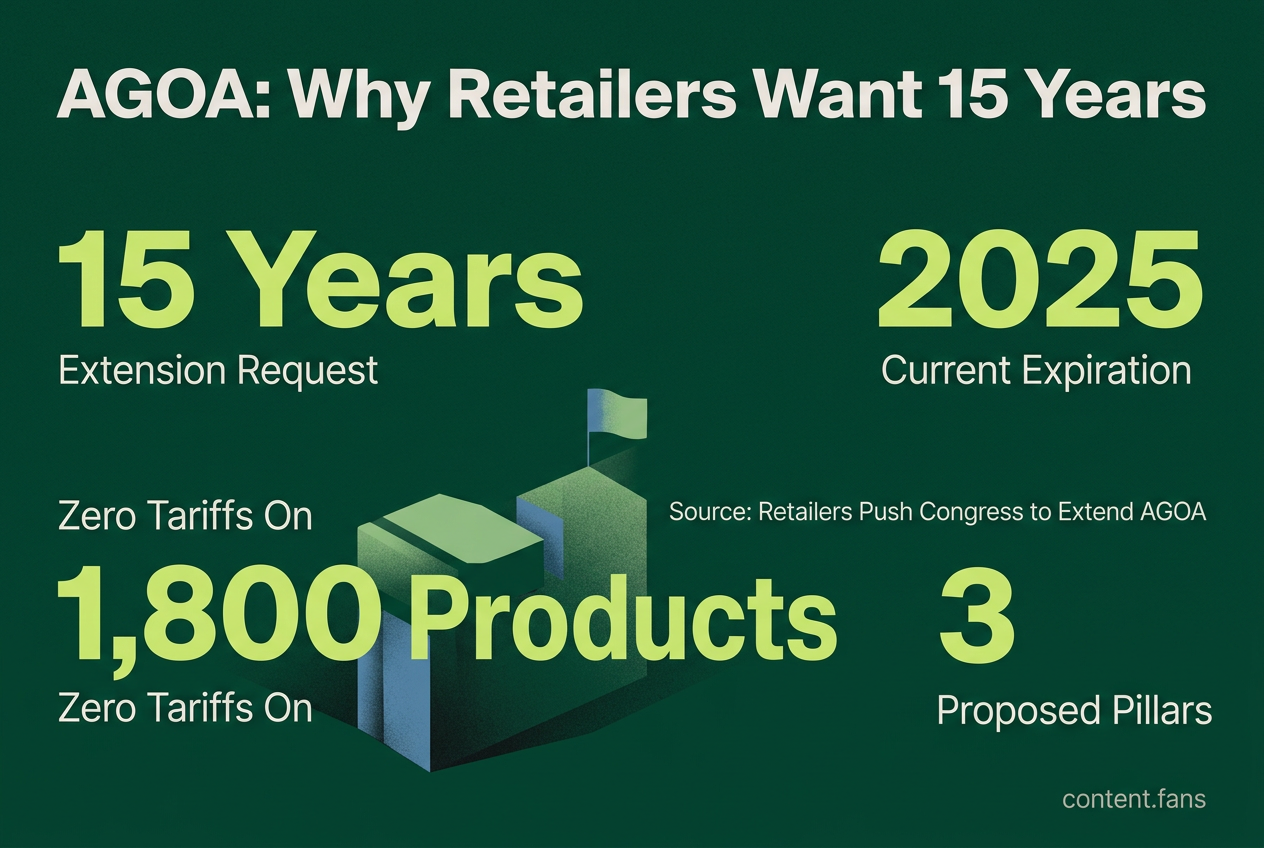
Retailers argue that policy certainty is the missing ingredient for transforming Africa into a reliable sourcing hub. Without a long-term outlook, firms cannot justify the costs of upgrading factories or developing logistics. Available sources do not support a congressional stop-gap extension through December 31, 2026; they indicate a one-year extension and continued uncertainty after AGOA's 2025 expiration, and industry groups are advocating for legislative action to provide greater certainty.
What non-tariff barriers do U.S. buyers actually face when sourcing from Africa?
While AGOA offers zero tariffs on roughly 1,800 product lines, significant operational hurdles remain before goods reach U.S. ports. According to industry reports, these non-tariff barriers can add substantial costs to landed prices, offsetting the duty advantage. Key challenges include:
- Infrastructure: Inland transport costs in many African countries significantly exceed global benchmarks, creating additional expense burdens for exporters.
- Logistics: Port dwell times in some West African hubs can be substantially longer than competing Asian ports.
- Regulation: According to U.S. Chamber comments, opaque labeling rules, multiple customs inspections, and fragmented standards increase compliance costs and rejection rates.
- Trade Finance: Limited access to credit insurance for African SMEs, as noted by UNCTAD, often forces U.S. buyers to self-fund working capital.
How might the proposed 15-year extension be paired with capacity-building measures?
Advocates propose a three-pillar support package to accompany a long-term AGOA renewal, turning market access into predictable orders. This aligns with the USTR 2024 Biennial Report's call for enhanced trade-capacity programs. Policy advisers and groups like the Center for Global Development highlight several key initiatives:
- Technical Assistance: Joint USTR and USAID grants for compliance audits, traceability software, and AGOA utilization strategies.
- Workforce Development: Consortia linking U.S. retailers with African vocational schools to co-design curricula for manufacturing and food safety standards.
- Infrastructure Funds: Public-private financing vehicles, potentially routed through the U.S. Development Finance Corporation, to fund cold-chain warehouses, logistics parks, and renewable power for industrial zones.
Where do the current Congressional negotiations stand?
Congress is currently pursuing multiple paths regarding AGOA's future. The supplied sources show AGOA was extended, but they do not substantiate specific details about recent congressional actions or exact timelines. Separately, according to industry reports, various legislative proposals are under consideration with different extension periods. Many bipartisan leaders on key committees favor an "extend and reform" strategy, suggesting openness to a longer timeline paired with stricter eligibility rules. Echoing retailer concerns, the Quincy Institute warns that "short renewals create uncertainty and discourage trade and investment."
Which African sectors stand to gain the most if the extension and capacity plan move forward?
With a long-term AGOA extension and targeted capacity building, several key sectors are poised for significant growth:
- Apparel & Textiles: AGOA is an important duty-free trade program for apparel and textiles in eligible sub-Saharan African countries, including Lesotho, Kenya, and Madagascar. A stable policy horizon could substantially increase output and enable a shift to higher-value items like performance outerwear.
- Agro-processing: Producers of products like Ghanaian cocoa butter and Kenyan macadamia nuts face food-safety (SPS) hurdles. Technical assistance grants could help overcome these barriers, potentially increasing export volumes significantly within several years.
- Critical Minerals & Battery Precursors: Producers of cobalt, manganese, and graphite in the Democratic Republic of the Congo and Mozambique require traceability infrastructure to meet new U.S. due-diligence rules. Public-private investment could help build the necessary systems.