
OpenAI unveils 'Guaranteed Capacity' for enterprises, locks in compute for 1 - 3 years
Serge Bulaev
OpenAI has announced a 'Guaranteed Capacity' program for enterprises, which may let large customers reserve discounted access to its models for one, two, or three years. The offer is similar to contracts cloud buyers already use and may help businesses plan budgets and secure enough computing power for critical workloads. Details like minimum spend and discount percentages are still unknown and might only be shared with customers after negotiations. The program is available until the reserved compute is taken, and OpenAI appears to be limiting supply to balance demand and infrastructure. This move suggests OpenAI wants to offer stability for enterprises while learning more about selling compute directly.

OpenAI has introduced 'Guaranteed Capacity,' a program designed to give enterprises predictable, long-term access to its AI models. The offering allows qualified customers to reserve discounted compute capacity for one, two, or three years, addressing key enterprise demands for budget stability and performance predictability (CNBC report). This initiative mirrors the reserved instance contracts common in cloud computing, enabling businesses to adopt OpenAI's services using familiar procurement models.
Mechanics and Limits of Guaranteed Capacity
The program functions as a flexible capacity pool. Enterprises commit to a specific spend level, not raw GPU hours, and can apply that commitment across various OpenAI products and supported cloud partners as their needs change (The Deep View). While exact discount rates are not public, longer commitment terms correlate with steeper price reductions.
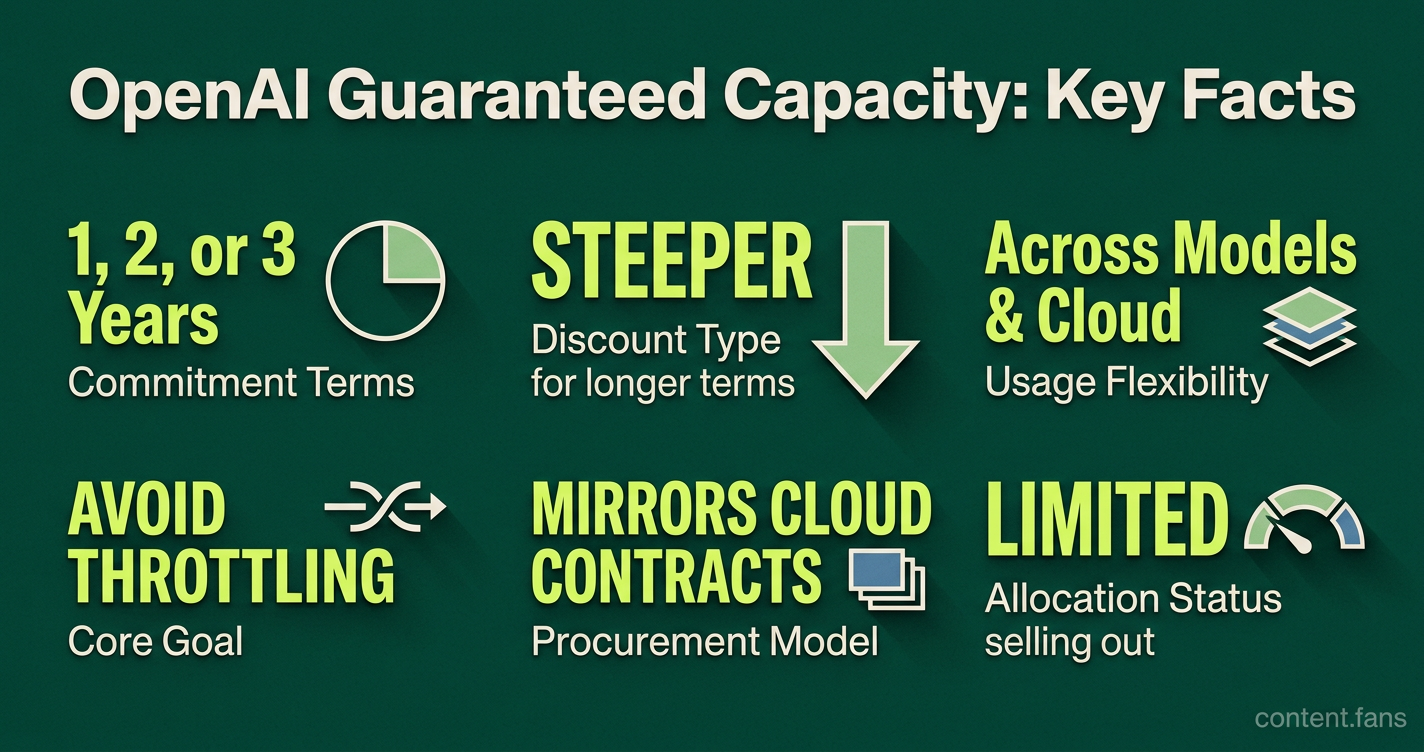
OpenAI's Guaranteed Capacity is a program allowing enterprises to pre-purchase dedicated access to its AI models for a fixed term. By committing to a one, two, or three-year spend, businesses secure discounted rates and predictable performance, avoiding potential throttling during periods of high public demand.
Key details confirmed so far include:
- Commitment Terms: 1, 2, or 3-year terms, with longer deals receiving larger discounts.
- Limited Allocation: Sales are expected to continue until the current allocation sells out; OpenAI says it may offer the program again in the future (CNBC report).
- Flexible Usage: The committed spend can be applied across various models and some supported cloud providers (The Deep View).
- Core Goal: Enable businesses to run mission-critical workloads without performance throttling from demand spikes (Tekedia).
Budget Planning Advantages
The program's structure is designed for straightforward financial planning, mirroring the multi-year hardware leases familiar to most finance departments. For companies planning large-scale AI agent or copilot deployments, predictable unit costs are essential for building accurate ROI models (Tekedia). This approach also aligns with enterprise procurement, where custom rates are often negotiated based on a minimum annual spend.
Early Access Window
OpenAI is offering Guaranteed Capacity with a limited initial supply, stating it will be available only "until the current allocation is exhausted." This scarcity model allows the company to balance immediate revenue with long-term infrastructure stability. Industry observers suggest the program may serve as a pilot for a broader "AI cloud" strategy, where OpenAI would sell compute resources more directly to customers (Reuters).
Competitive Context
While major cloud providers have not issued direct responses, they offer comparable discount models for AI hardware. Analysts predict competitors will leverage their unique strengths: Google may bundle Gemini with Workspace integration, while AWS focuses on its broad model selection. Microsoft, as OpenAI's key infrastructure partner, will likely highlight the governance and security benefits of using OpenAI models within the Azure ecosystem (Dust).
What Is Still Unknown
Several key details remain undisclosed, including minimum spend requirements, specific service-level agreements (SLAs), and the exact discount percentages for each commitment tier. This information is expected to be available only to prospective customers during direct negotiations. By keeping the offering scarce, OpenAI reinforces its value for enterprises that require guaranteed performance and cannot risk service disruptions.