
Token Costs Now Rival Payroll, Forcing New Budgeting Dilemmas
Serge Bulaev
Token costs for companies using AI may now be as high as paying employees, leading to new budgeting challenges. Even though the price per token has dropped, total spending on tokens appears to be rising sharply. Some reports suggest digital labor costs can sometimes outpace payroll if not monitored. Experts recommend tracking token use like labor and matching tasks to the cheapest model to avoid overspending. It seems that organizations may need to update their budgeting and hiring plans because AI costs are now close to or equal to human labor costs.

The rising tide of token costs is creating a paradigm shift in corporate budgeting, as AI expenses now rival employee payroll in some scenarios. While per-token pricing has plummeted, Deloitte reports cite a 20%+ increase in IT budgets due to AI tokens, presenting a new dilemma where digital labor can be as expensive as human talent. This shift from fixed seat licenses to variable consumption pricing is making AI the fastest-growing expense category and challenging traditional forecasting models, as a TechCrunch investigation found.
Token Spend Versus Payroll
The direct comparison of token costs to payroll is no longer hypothetical. In high-usage scenarios, monthly AI token consumption for a single employee can equal or exceed their salary. This crossover point forces finance and HR leaders to reclassify AI spend as a workforce expense, not just an IT fee.
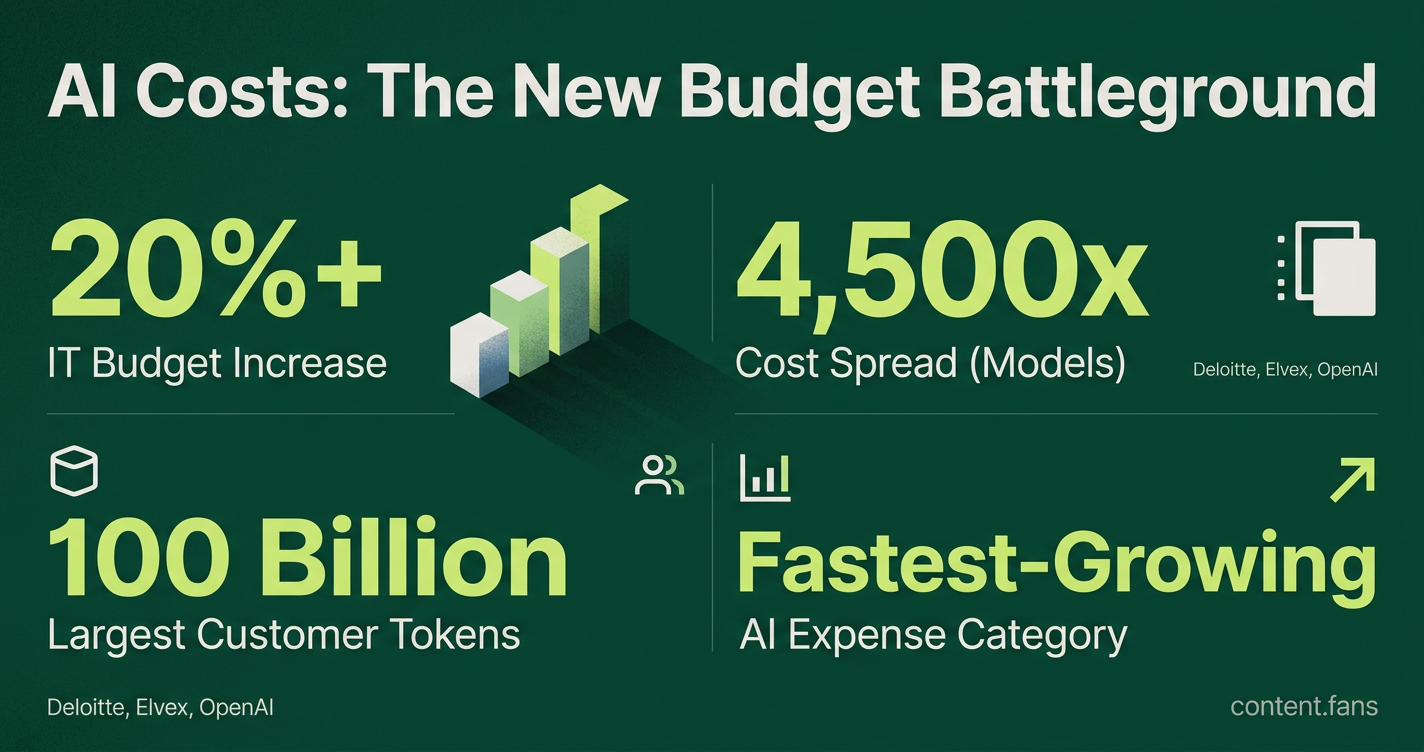
Evidence of this crossover is mounting. OpenAI's largest customer consumed 100 billion tokens in a month, demonstrating the scale at which organizations are now operating. Major companies like Uber and Microsoft have faced significant budget challenges with their AI providers, with costs reportedly reaching levels that exceed individual monthly pay in some cases. As a result, HR leaders and CFOs are now collaborating to decide which tasks to migrate based on clear inputs, measurable outputs, and high human labor costs.
Building Visibility and Governance
To control runaway expenses, companies need robust visibility and governance. Visibility tools like LiteLLM routers or Helicone dashboards provide real-time attribution, linking token costs directly to business outcomes. A critical strategy is to avoid "token maxing" - the organizational habit of defaulting to the most powerful and expensive AI model for simple tasks. Elvex warns of a 4,500x cost spread between the cheapest and priciest models, underscoring the need for intelligent routing that matches task complexity with inference cost.
This allows finance teams to track a more meaningful KPI: cost per resolution. While sources confirm that AI agents can improve productivity and reduce costs compared to human workers, organizations are developing granular metrics that empower managers to decide when higher token spend adds value and when human judgment is essential.
An Early Playbook for the Human-Token Workforce
As AI costs sit "approximately on par with labor costs," according to CFO panels quoted by CNBC, a new playbook is emerging for managing a hybrid human-agent workforce. This forces leadership to weigh technology against headcount in each budget cycle. Key strategies include:
- Reframe AI Spend: Treat AI consumption as a variable labor cost within workforce planning, not a static IT expense.
- Implement Universal Metering: Track every AI inference and link it directly to a business outcome to measure ROI accurately.
- Optimize for Cost-Effectiveness: Actively route tasks to the cheapest capable model to prevent 'token maxing' and control expenditures.
- Conduct Quarterly Reviews: Reassess the human-agent balance quarterly as AI capabilities improve and prices change, altering the financial breakeven point.
Deloitte Insights advises that traditional total cost of ownership models are insufficient, as they fail to account for the volatility of agentic workflows. By tracking salaries and tokens in a unified dashboard, organizations can finally test where digital labor expands capacity versus where it merely duplicates human work, shaping everything from hiring plans to performance reviews.
Will AI token budgets really appear next to payroll lines in 2026 forecasts?
Yes. CFOs already move the AI compute line-item out of IT and into workforce planning, because token costs now equal or exceed individual salaries in agent-heavy teams. Major enterprises report significant monthly per-engineer token costs that can match or exceed payroll for the same seat. Finance teams that still hide this spend inside "software" miss the fastest-growing cost category in the enterprise.
How do you set a departmental token allowance without throttling innovation?
Start with "token metering" infrastructure: route every model call through a gateway that tags cost to the requesting team in real time. LiteLLM, Helicone or an in-house proxy lets you cap monthly tokens per product line the same way you cap headcount. Early adopters saw significant bill reductions after adding a router that drops expensive frontier models for cheaper ones when the task is classified as low-stakes retrieval.
Which tasks should move from humans to agents first?
Apply three filters: clear inputs, measurable outputs, high human-labor price. The dominant migration tasks are coding agents, developer-led workflows, and context engineering for software development because they satisfy all three rules. Organizations are moving various automated checks and processes to agents at substantially lower costs than equivalent human resources.
What ROI math convinces a skeptical CFO to keep the token line?
Replace traditional subscription cost models with cost-per-resolution:
ROI = (labor value saved + revenue lift) - (token cost + engineering + human verification)
While sources confirm that AI agents can improve productivity and reduce costs compared to human workers, organizations should frame every future request in unit-outcome math to demonstrate clear value to leadership.
Who owns the decision when tokens and headcount compete for the same dollar?
Elevate it to CFO + CHRO joint stewardship. The rule emerging in organizational charts: "no agent gets hired until finance and HR both sign the human-token ratio." Review this ratio quarterly, because per-token prices continue to fall and agent capability rises, flipping the breakeven point every few months.