
Tiger Data unveils Ghost: Postgres for AI agents with unlimited databases
Serge Bulaev
Tiger Data has released Ghost, a new service built on PostgreSQL for AI agents that may need many quick, disposable databases. Ghost appears to let agents create, copy, and remove databases very fast, which could help with experiments and saving costs. The service keeps support for PostgreSQL extensions but changes how agents find and use databases through a tool called Model Context Protocol (MCP). Some reports suggest this approach could make testing and setup much faster, possibly reducing hours of work to just minutes. There is uncertainty about how these new features will affect everyday use and pricing, but Ghost may attract attention as more AI tools need flexible data solutions.

Tiger Data's Ghost delivers a specialized Postgres for AI agents, meeting the growing need for fast, disposable data sandboxes. This service empowers agentic workflows by allowing AI to instantly create, query, and discard unlimited databases, significantly impacting developer experimentation and cost control.
Ghost in Practice: Agent-First Postgres Workflows
Ghost is a PostgreSQL-based service designed for AI agents, featuring an orchestration layer for rapidly creating, forking, and discarding unlimited, isolated databases. It streamlines experimentation for agentic applications while maintaining full compatibility with the core Postgres engine and popular extensions.
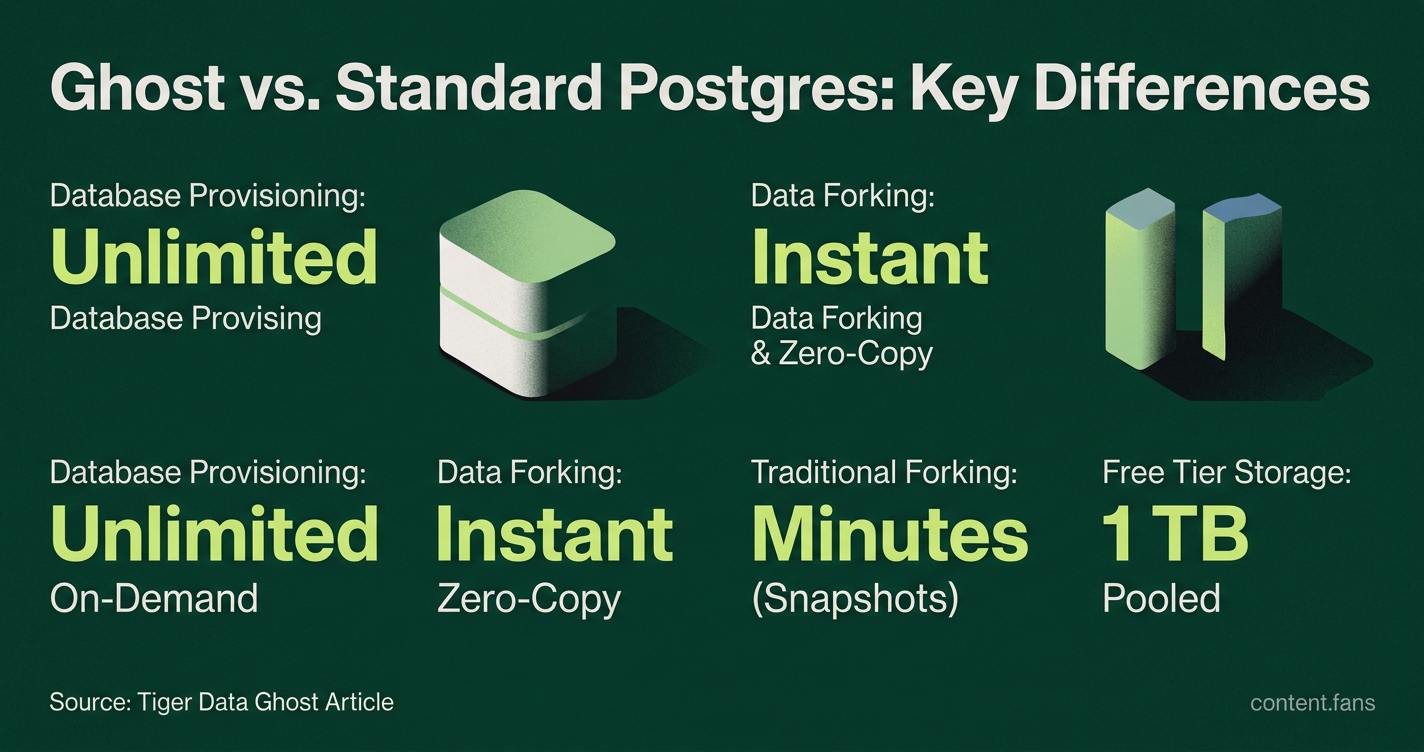
While Ghost retains the core PostgreSQL engine, it adds an agent-first service layer. Tiger Data says Ghost is "built on PostgreSQL but reimagines how databases are provisioned and consumed by AI systems." Instead of manual setup, provisioning occurs via a CLI or MCP server, enabling a single agent to create hundreds of isolated databases for A/B tests, RAG trials, or temporary ETL jobs.
The service's zero-copy forking allows agents to clone entire datasets in seconds, a process that takes minutes with traditional snapshots. This efficiency reportedly "collapses a half-day of work into ninety seconds."
Ghost maintains compatibility with essential Postgres extensions like pgvector, PostGIS, and TimescaleDB. The primary shift is in the workflow: agents discover and interact with databases through the Model Context Protocol (MCP), which exposes capabilities and actions, rather than relying on connection strings. This gives agents a clear catalog of available functions, as noted by analysts at BCG.
How Ghost Compares to Standard Postgres
Ghost introduces several key distinctions from a standard PostgreSQL setup:
* Provisioning: Offers unlimited, on-demand ephemeral databases, eliminating the need for manually configured clusters.
* Forking: Features instant, zero-copy forking, designed specifically for rapid, multi-variant experimentation.
* Pricing: The free tier includes 1 TB of pooled storage with no per-database charges, challenging traditional instance-based billing models.
Market Trends and Pricing Implications
Ghost enters a market already shifting toward flexible, usage-based data services. For example, Supabase's postgres.new offers "more databases for cheaper" by allowing users to instantly create unlimited Postgres instances. This trend reflects a move away from per-instance billing to models based on actual storage and compute consumption.
The demand for AI-ready data infrastructure is surging, with industry reports indicating significant growth in global storage capacity. As agentic AI tooling becomes more prevalent, services like Ghost that prioritize rapid, low-cost prototyping over long-term durability are positioned to attract significant market attention.
What exactly is Ghost?
Ghost is a fully-managed Postgres service re-imagined for autonomous AI agents. It gives every agent the ability to create, fork, and destroy databases on demand, all while remaining 100 % compatible with the PostgreSQL extensions you already rely on such as pgvector for embeddings or PostGIS for geospatial queries. Think of it as Postgres wrapped in an orchestration layer that speaks the new MCP protocol - the emerging USB-C standard for AI tooling.
How is Ghost different from running my own Postgres cluster?
Traditional Postgres is durable and versatile; Ghost is ephemeral and agent-native. The comparison matrix below distills the gap:
| Dimension | Ghost | Traditional Postgres |
|---|---|---|
| Provisioning | Unlimited instances created in < 90 seconds via CLI or MCP | Manual infra or IaC scripts |
| Forking | Instant, zero-copy forks for parallel experiments | Snapshots/backups handled externally |
| Agent Integration | MCP-native - the model itself can query and migrate | External drivers, bespoke glue code |
| Best Fit | Sandbox testing, rapid prototype loops, per-agent memory | Long-lived OLTP or production data |
In short, Ghost collapses "a half-day of environment setup into ninety seconds", letting agents treat databases the way developers treat branches.
Why does the free tier remove cost-per-database pricing?
The free tier offers unlimited databases plus 1 TB of storage because Tiger Data argues that per-database pricing kills agent creativity. Industry evidence supports this: when Supabase introduced unlimited in-browser Postgres instances, usage spiked as teams spun up isolated sandboxes for every pull request. Industry reports indicate significant growth in global storage capacity, so vendors increasingly monetize compute & storage consumption rather than instance counts. Ghost simply front-loads that trend.
What does "native MCP integration" give my Claude Code workflow?
MCP (Model Context Protocol) turns database access into a discoverable capability. Inside Claude Code:
- No custom connectors - the agent sees "create database", "migrate schema", "run vector search" as first-class tools
- Security & governance - credentials live on Ghost's MCP server, not in every prompt
- Faster loops - a16z reports 60 - 80 % reductions in integration time when MCP replaces bespoke APIs
Essentially, your coding agent can now ask "Show me the customer table and generate embeddings for reviews" and Ghost answers in one round-trip.
When should I pick Ghost vs keep using ordinary Postgres?
Choose Ghost when:
- You need ephemeral, forkable environments for agents or branch-based experiments
- Cost of abandoned experiments must trend toward zero
Stick with traditional Postgres when:
- You require a single, durable source of truth that outlives any one agent
- You already have mature CI/CD and security controls that tie to a long-lived instance
You can even use both - prototype in Ghost, then pg_dump | psql into your managed Postgres for production.