
Thought Leadership Generates $184 Million Revenue, 156% ROI for Businesses
Serge Bulaev
Recent studies suggest that executive thought leadership may help companies earn significant revenue and a strong return on investment. Reports say that large businesses might see up to $184 million in annual revenue and a 156% ROI linked to thought leadership activities. Surveys also suggest most professionals credit thought leadership with winning new business, keeping customers, or growing market share. Consistent, authentic content appears more effective than high volume, and using AI may be helpful if executives keep final control. Tracking results in several business areas may help show the value of thought leadership alongside other marketing efforts.

Executive thought leadership now drives measurable revenue and a significant ROI, shifting from a brand-building exercise to a quantifiable business driver. As companies scrutinize marketing spend, new data provides clear answers on the financial return of executive content and which strategies create that value.
What is the quantifiable business impact of executive thought leadership?
Executive thought leadership delivers substantial, measurable financial returns. A Forbes article reported that IBM-linked research found an average of $184 million in annual revenue influenced per company and a conservative 156% ROI. Separately, The Harris Poll reports that Fortune 100 leaders estimate $3.6 million in incremental annual value from their programs.
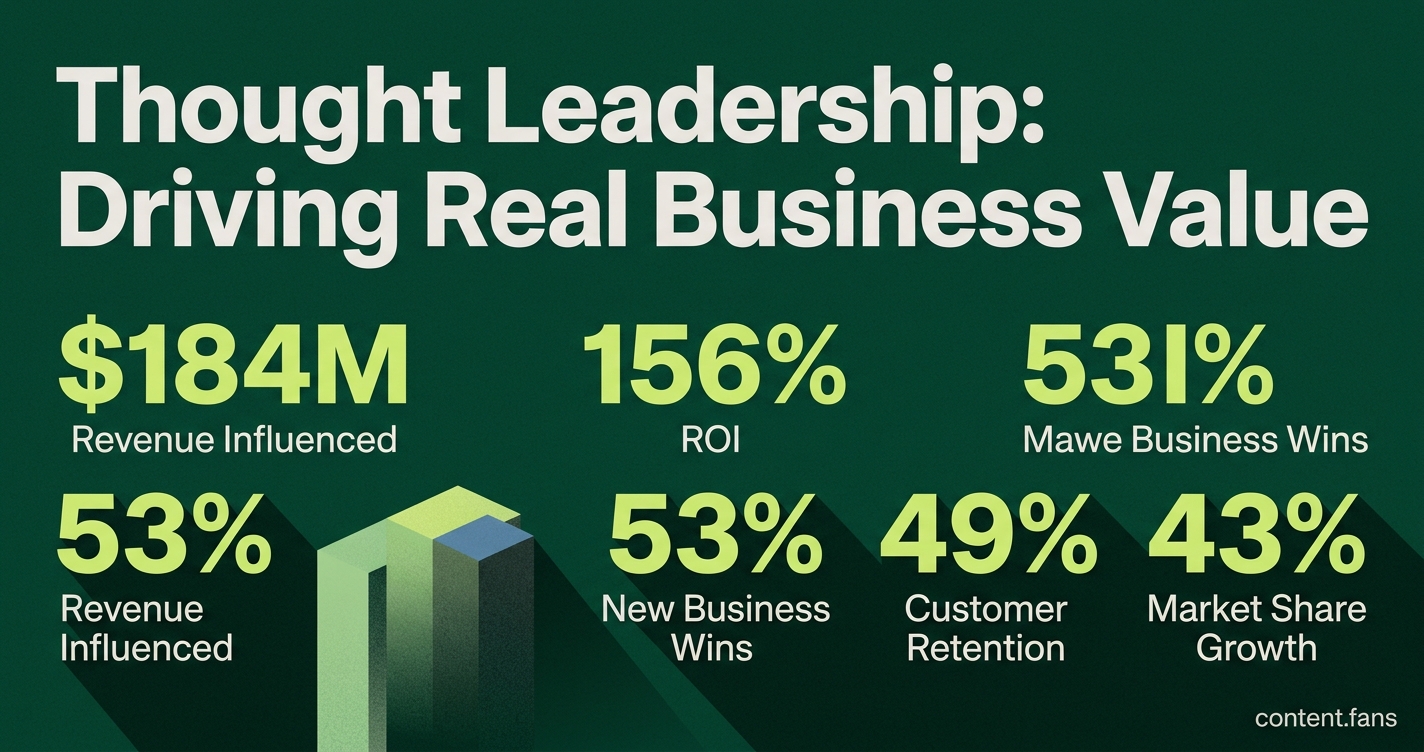
Recent studies quantify the significant financial impact of executive thought leadership. Analysis shows it can influence up to $184 million in annual revenue for large businesses and deliver a 156% ROI. This demonstrates a clear shift from a brand metric to a measurable, revenue-generating activity.
This impact extends across the business, with studies showing 53% of professionals credit thought leadership for new business wins, 49% for improved customer retention, and 43% for market share growth. The vast majority of organizations report measurable outcomes from their thought leadership efforts.
Which metrics actually demonstrate thought leadership ROI?
To prove its value, measurement must connect thought leadership to business-linked outcomes, moving beyond vanity metrics like likes and follower counts. CFO-ready dashboards track value across five core areas:
- Pipeline Influence: Track the volume and quality of leads and opportunities that consumed executive content.
- Revenue Impact: Attribute closed-won deals with specific content touchpoints.
- Deal Acceleration: Measure reduced sales cycle times for accounts that engaged with content.
- Retention & Expansion: Correlate content engagement with renewal rates and expansion ARR.
- Executive Authority: Monitor analyst mentions, senior-level audience growth, and inbound speaking invitations.
How should teams build a strategic executive content system?
Effective executive brand building operates as a business function with defined outcomes, not a side project. Implementation requires a strategic framework built on three layers:
| Layer | Core Practice |
|---|---|
| Positioning | Define a clear point of view tied to stakeholder priorities and business goals. |
| Content System | Build content around 3-5 durable pillars based on genuine expertise. |
| Distribution & Measurement | Prioritize channels like LinkedIn and podcasts; track pipeline influence, not vanity metrics. |
This approach emphasizes consistency over volume. A single, powerful weekly insight is more effective than sporadic generic content. Best practices include capturing ideas as they occur, batching content production, and ensuring the final product maintains the executive's authentic voice.
What is AI's role in creating thought leadership?
In modern workflows, AI serves as an accelerator, not a substitute, for executive authority. The technology excels at research, brainstorming, and repurposing content for different platforms. However, distinctive human judgment has become more valuable, not less.
As Forbes notes, leaders must "inject your own expertise into the outline." The risk of AI-driven commoditization means one original idea outweighs many generic takes. Successful workflows combine a human creative spark with AI augmentation, but the executive retains final control over the point of view.
What are the common pitfalls that undermine thought leadership?
Common pitfalls that erode an executive brand's value and credibility include:
- Generic Content: Publishing motivational posts that lack genuine expertise or specific insight.
- Inconsistent Cadence: A publishing schedule that appears opportunistic rather than committed.
- Outsourced Voice: Messaging that fails to reflect the actual leader's voice and perspective.
- Poor Measurement: Focusing on vanity metrics that mask a lack of real business impact.
The most damaging pattern is treating thought leadership as promotion rather than perspective-sharing. Audiences expect to learn from authentic decision narratives and market observations, not thinly veiled product pitches.