
OpenAI Unveils "Persistent AI Coworkers" as Third Era of AI
Serge Bulaev
OpenAI is developing "persistent AI coworkers" that may work with people over long periods and remember shared project details. These AI agents could help with tasks like sales prep, status updates, and customer support by holding context and resuming work after breaks. The system appears to use different memory layers for various kinds of data, and needs careful rules to manage what it remembers and forgets. There may be risks like privacy issues and errors, so teams are advised to monitor their use and start with less risky jobs before expanding.

The development of persistent AI coworkers signifies a major leap from concept to product, ushering in what many are calling AI's third era. This evolution moves beyond single-turn chatbots toward long-term AI teammates that maintain shared context. Industry experts describe these agents as "a persistent coworker that gets work done with you, collaboratively and over time." This guide analyzes the capabilities, integration patterns, use cases, and governance essential for enterprise leaders to navigate this new landscape.
What makes a coworker persistent
A persistent AI coworker is defined by its ability to maintain memory and context across multiple interactions and work sessions. Unlike traditional AI tools that reset, these agents remember project details, resume tasks after pauses, and coordinate work over extended periods, acting as continuous, collaborative partners.
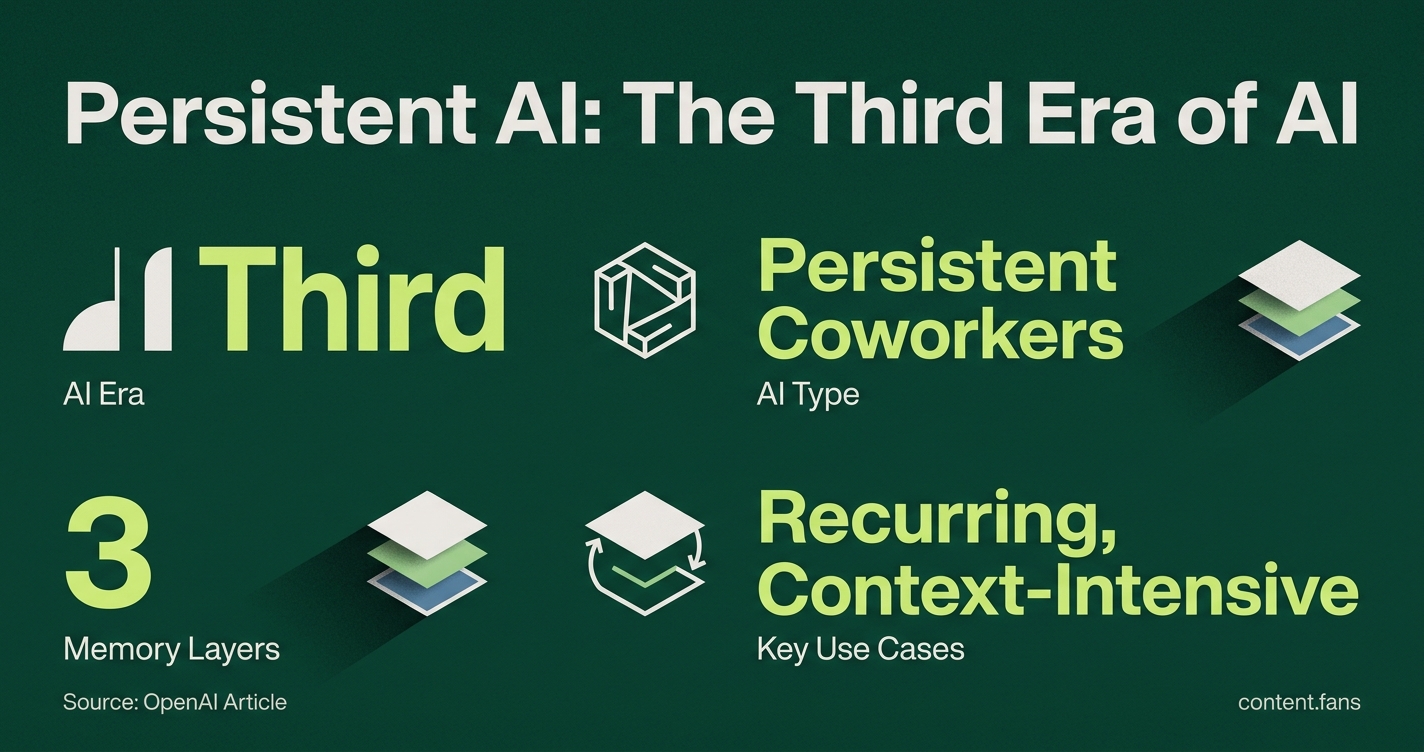
This persistence is enabled by a sophisticated memory architecture. AI providers are working to integrate their various services into unified systems that can dynamically select the best interface for a task. To support this, engineers must build a memory layer capable of storing:
- Stable facts: Core information like brand voice or coding standards.
- Episodic data: Time-bound context, such as current sprint goals.
- Short-term working context: Immediate data related to an active task or ticket.
Each layer requires distinct data retention and deletion policies to prevent context from becoming stale or bloated, a key principle in agentic memory safety.
Integration and orchestration patterns
Integrating these agents requires a robust orchestration stack to route user intent to the correct models, tools, and approval workflows. Critical components include identity mapping for app permissions, a router to select the right AI mode, and state storage with lifecycle management for updating or forgetting information. Crucially, human-in-the-loop checkpoints are necessary before any irreversible actions. Industry experts advise that teams design for evolving model capabilities, meaning the orchestration layer must be adaptable and not hard-coded to a single prompt structure.
Use cases and UX checkpoints
The highest-value enterprise applications for persistent AI involve recurring, context-intensive work. Key examples include:
* Sales Meeting Prep: Consolidating CRM data and web research into dynamic briefing documents.
* Status Reporting: Automating weekly progress updates by drawing from project management tools.
* Support Triage: Proposing responses by using ticket context and customer interaction history.
An effective user experience embeds the AI coworker within existing collaboration hubs like Slack, using a single, persistent thread for each project. This allows users to brief the agent once and then delegate smaller tasks, building trust through source-linked evidence and required approvals for external-facing actions.
Governance and monitoring essentials
The use of long-running memory introduces significant risks, including privacy violations and compounded hallucinations. Research highlights key failure modes like Memory Poisoning and Semantic Drift. Enterprises must implement strong governance controls to mitigate these challenges.
| Risk | Control | Practical mechanism |
|---|---|---|
| Data leakage | Memory isolation | App-level ACLs and separate vector stores |
| Persisted hallucination | Provenance tracking | Store citations; allow rollback |
| Stale context | Decay or forgetting | Time-based eviction rules |
Comprehensive operational monitoring is non-negotiable. Logs should track every tool call, memory write, and human intervention. Setting up alerts for repeated errors or proximity to high-risk actions is essential for maintaining control and security.
To ensure a successful rollout, teams should begin with low-risk, internal workflows like generating daily digests. As approval gates and audit trails prove effective, they can gradually expand the agent's responsibilities to higher-impact domains, building a reliable and secure AI-powered workforce.