
Enterprise Buyers Evaluate LLM Providers on Price, Governance, Performance
Serge Bulaev
Procurement leaders may need to treat choosing LLMs as a mix of financial, legal, and technical decisions, not just buying software.

Enterprise buyers evaluating LLM providers face a rapidly evolving market where Anthropic and OpenAI continuously release cheaper, more powerful models. This dynamic environment requires procurement leaders to reassess cost, governance, and technical fit in near real time. A strategic guide is essential: treat LLM selection as a multidisciplinary project involving finance, legal, and engineering, not a simple software purchase.
Pricing model comparison
Evaluating LLM pricing requires a detailed comparison of token-based costs for both inputs and outputs across various model tiers. Major vendors offer different rate cards, where low input token costs can be offset by higher output costs. Enterprises must also analyze terms for batching, caching, and volume commitments.
LLM pricing models are complex, with significant differences between providers. For instance, a budget-tier model from one vendor might cost a fraction of a competitor's, as detailed in DataCamp's comparison. This gap often narrows for flagship models, where expensive output token pricing can become the primary cost driver and swing total spend by significant percentages.
Key negotiation levers for enterprise contracts include:
- Leverage annual volume commitments to secure tiered discounts and service credits.
- Route high-volume "workhorse" traffic to the cheapest viable model, reserving premium models for complex reasoning.
- Negotiate for cached-input multipliers and batch processing discounts.
- Request a blended rate across model families for mixed workloads (e.g., coding, chat, and retrieval).
- Demand explicit output-token concessions, which can significantly impact total cost, especially with long-form content generation.
Technical evaluation pilot
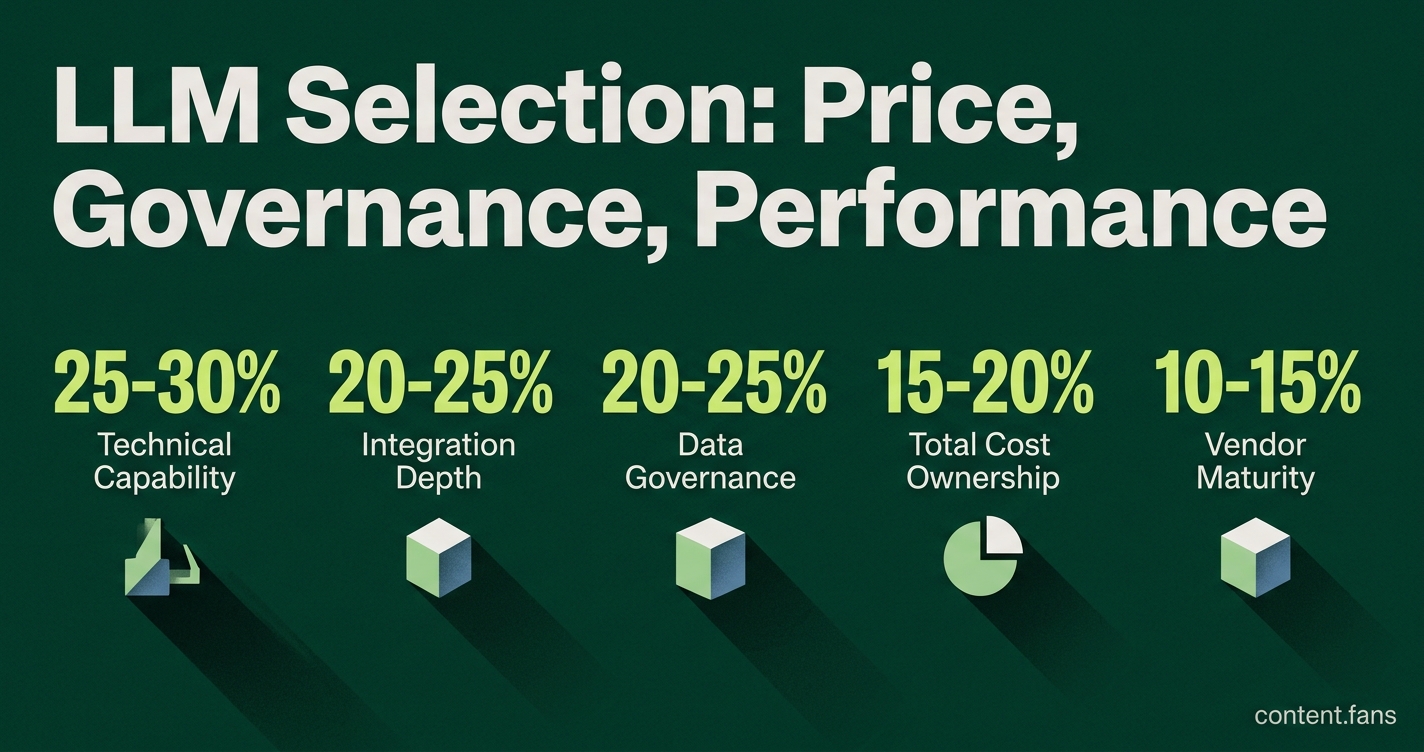
A time-boxed pilot using your organization's own data is crucial for an accurate technical evaluation. Key metrics to measure include task accuracy, latency, and the model's effective context window. Enterprise evaluation frameworks recommend a weighted scoring system:
1. Technical Capability: 25-30%
2. Integration Depth: 20-25%
3. Data Governance & Compliance: 20-25%
4. Three-Year Total Cost of Ownership (TCO): 15-20%
5. Vendor Maturity & Support: 10-15%
How Enterprise Buyers Should Evaluate LLM Providers - Pricing, SLAs, and Data Policies (scorecard)
| Criterion | Questions to ask | Evidence to request |
|---|---|---|
| Pricing/TCO | Input vs output token ladders? Batch terms? Seat plus usage crossover? | Full rate card, sample invoice on forecast volume |
| SLAs | Uptime, latency, escalation path? | Draft SLA with penalties for misses |
| Data policies | "No training" default, retention, residency? | DPA, sub-processor list, region map |
| Integration | SSO, SCIM, webhooks, RAG connectors? | API docs, SDK versioning policy |
| Security & compliance | SOC 2 Type II, ISO 27001/42001, private networking? | Latest attestation, pen-test summary |
Contract clauses to lock in
Industry guidance and government directives highlight essential clauses that enterprises must secure in their contracts:
- Data Usage: A default "no training" policy on customer data without explicit, auditable opt-in.
- Model Governance: Rights for change notification and the ability to pin models to a specific version.
- IP Indemnity: Vendor indemnification that covers intellectual property claims related to both prompts and model outputs.
- Exit Rights: Clear terms for termination assistance, including secure data export and certified deletion.
- Price Protection: Most-favored-customer pricing guarantees for future model releases.
Ongoing vendor governance
Establish a cross-functional governance team with designated owners from procurement, security, model risk, and data science. This team should implement continuous monitoring of model updates and perform regression testing after any vendor-side change to prevent silent degradation in performance, accuracy, or tone.
The buyer's competitive edge is forged by combining rigorous pricing analytics with deep due diligence on data governance, technical performance, and contractual controls. In the current landscape, success belongs to teams that negotiate with evidence, not assumptions.
How do OpenAI and Anthropic pricing models differ for enterprise buyers?
OpenAI and Anthropic now use similar enterprise pricing mechanics - subscription tiers for seat-based products plus separate token-based API billing - but their price ladders differ significantly. OpenAI tends to be cheaper at the low end, with aggressive input pricing on budget tiers, while Anthropic typically sits higher on workhorse tiers but can match or undercut OpenAI on flagship tiers depending on the model family and launch cycle.
For seat-based products, both vendors charge enterprises model usage on top of base subscription fees, which reduces the value of running excessive volumes through pure subscriptions and pushes buyers toward usage governance and cost controls.
What negotiation strategies work best for LLM contracts?
The most effective enterprise negotiations focus on annual commitments, volume, and bundled services rather than sticker price alone. Key levers include:
- Commit to forecasted monthly volume in exchange for tiered pricing, batch/caching discounts, and service credits for overages
- Separate "workhorse" and "premium" workloads - route high-volume, lower-complexity traffic to cheaper models and reserve premium tiers for complex tasks
- Push for cached-input and batch terms - these are public concession tools that vendors expect enterprises to negotiate
- Ask for output-token concessions - since output can dominate total spend, discounts here matter materially
- Request blended rates across product families if using multiple model classes
- Demand credits tied to evaluations, pilots, and migration support - vendors often trade margin for adoption
A strong procurement posture includes asking for price-protection clauses and most-favored-customer concessions on future model launches, given the dynamic pricing environment.
What technical criteria should enterprises prioritize when evaluating LLM vendors?
Technical evaluation should center on model quality on your own workloads, not marketing benchmarks. The strongest frameworks recommend proof via pilot tests on representative data with these specific checks:
| Technical Check | Why It Matters |
|---|---|
| Task accuracy on real business inputs | Models that demo well often fail on enterprise workflows |
| Context handling | Effective context window and performance degradation as prompts grow |
| Latency and throughput | Time-to-first-token and tokens-per-second in your production region |
| Structured output reliability | Consistent JSON or machine-readable formats for integration |
| Tool use / agentic behavior | Safe, deterministic calling of internal APIs and databases |
| Safety and refusal behavior | Hallucination rate and prompt-injection resilience on your data |
Integration criteria are equally critical - verify SSO/SAML/OIDC support, SCIM provisioning, REST API completeness, RAG compatibility, and observability hooks for logs and traces. Integration friction is often the main driver of rollout delay and hidden cost.
What data governance and contract terms are essential in LLM procurement?
Enterprise buyers need both technical controls and contractual protections covering:
- Data residency and regional processing guarantees - where data is processed contractually
- "No training by default" - verified opt-out mechanisms if training is optional
- Retention controls - ability to set prompt and completion retention to zero or minimize it
- Audit logging - what is logged, retention periods, and customer accessibility
- Sub-processor transparency - current lists with change-notification terms
- Data portability and exit rights - export formats for prompts, evaluations, and configurations
- DPA and liability terms - controller/processor roles, international transfer mechanisms, and breach responsibilities
Government guidance provides templates requiring explicit contractual requirements in all LLM solicitations, including Acceptable Use Policies, model/system/data cards, and mechanisms for end-user feedback on biased outputs.
How can enterprises reduce variability and bias in vendor selection?
A standardized scoring matrix can reduce procurement variability and anchor decisions in business value rather than vendor relationships or demo performance. Recommended weighting:
- Technical capability: 25-30%
- Integration: 20-25%
- Data governance/compliance: 20-25%
- Total cost of ownership: 15-20%
- Vendor maturity/support: 10-15%
The selection process should follow a time-boxed pilot structure: define several high-value workloads, score vendors on weighted criteria, run pilots with representative data measuring accuracy, latency, cost, and control requirements, and conduct legal/security review in parallel with technical evaluation - not after. This approach ensures the chosen vendor meets both technical and governance requirements before commitment.