
Teleport study finds AI control planes cut incident rates by 76%
Serge Bulaev
A recent study by Teleport suggests that unified AI control planes may greatly reduce security incidents, with incident rates dropping from 76% to 17% when least-privilege controls are used. This approach keeps authentication, policy, and enforcement in one place, which may speed up response times and make it easier to contain security problems. Early reports indicate that environments with these unified controls resolve incidents faster and reduce the risk of widespread damage. The evidence points to unified control planes becoming an expected standard for AI security, though results may vary by organization and setup.

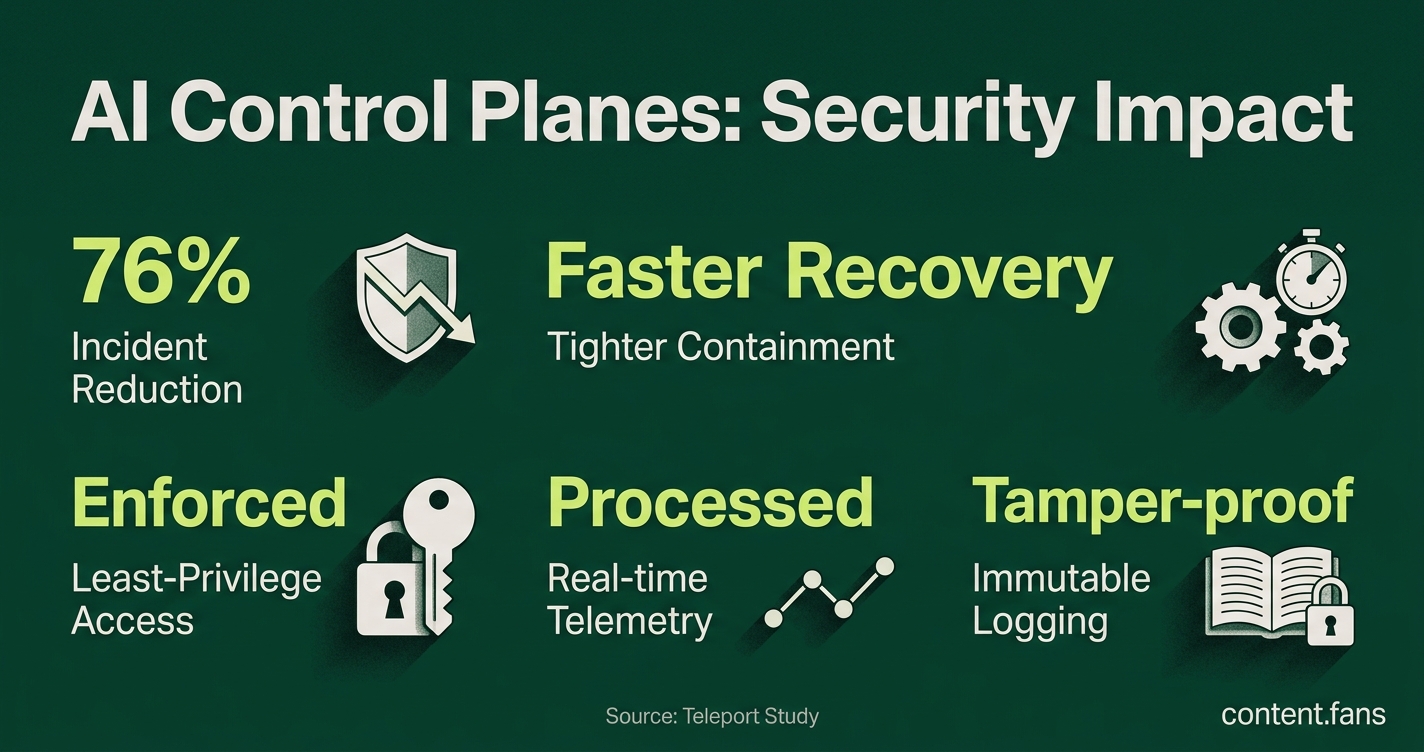
Implementing unified AI control planes can dramatically improve security, cutting incident rates by as much as 76%, according to a new Teleport study. By centralizing authentication, policy, and enforcement, these platforms offer tighter blast-radius containment and faster recovery. A 2026 Teleport study found that enterprises using least-privilege controls via a unified plane saw significant reductions in incident rates compared to those with broadly privileged AI systems, proving that "identity is the control plane for AI security". An effective AI control plane also injects user identity into requests and creates a secure audit trail, as noted by TrueFoundry.
This consolidated approach directly counters the delays caused by fragmented tooling. As Open Systems observes, overlapping control planes from multiple point solutions slow incident containment. A unified platform, however, can accelerate response time by eliminating handoffs. Radiant Security further notes that automation within a single platform processes telemetry in real time, improving mean-time-to-detect.
Core Components of an AI Control Plane
An AI control plane is a unified security layer that governs identity, data, and AI agent actions from a single point. It dramatically reduces security incidents by enforcing least-privilege access, evaluating every action against policy, and containing the blast radius of any potential compromise before it can spread.
Effective AI control plane architectures are built on five key pillars:
- Identity Integration: Connects with enterprise identity providers (e.g., Okta, Azure AD) to authenticate both the AI agent and its human user for every task.
- Centralized Policy Engine: A gateway that evaluates every tool invocation before it runs. It approves, denies, or escalates requests based on predefined rules, ensuring "nothing executes without evaluation."
- Data Protection Orchestration: Enforces policies that keep sensitive data within organizational boundaries and minimize data transfers during agent operations.
- Runtime Isolation: Executes agents in a sandboxed environment, separate from critical resources. This creates a secure execution boundary that limits lateral movement in the event of a compromise.
- Immutable Logging: Records every request, policy decision, and action outcome in a tamper-proof audit log for compliance and forensic investigation.
Key Governance and Policy Practices
Industry sources and early adopters are converging on a set of essential governance practices:
- Maintain a Complete Inventory: Keep a real-time inventory of all AI agents, models, associated credentials, and their owners.
- Enforce Least Privilege: Use role-based access control (RBAC) and tool allowlists to strictly limit what each agent is permitted to do.
- Mandate Human-in-the-Loop Approval: Require explicit human sign-off for high-impact actions, such as deploying patches or changing identity policies.
- Integrate with SOC Workflows: Ensure all AI agent activity is logged and fed into your existing Security Operations Center (SOC) for continuous monitoring and threat detection.
- Align with Industry Frameworks: Map governance controls to established standards like the NIST AI RMF or ISO/IEC 42001 for compliance and external assurance.
To implement these practices, many teams tier agent actions into categories like observation, low-risk automation, and high-impact execution. This allows them to automate safe, low-risk tasks while flagging sensitive operations for human review.
Measurable Impact on Incident Response
Early data shows that a unified control plane delivers significant improvements in incident response metrics. Because telemetry is consolidated and policies are automated, teams can detect and contain threats at machine speed.
Key performance indicators include:
- Faster Resolution: Managed security environments using integrated controls report significantly faster incident resolution according to industry reports.
- Reduced Dwell Time: Consolidated telemetry and automated response drastically shorten the time attackers can remain undetected in a network.
- Beating the Clock: With the fastest intrusions achieving data exfiltration in under 72 minutes, the machine-speed reaction of a control plane is no longer optional.
While methodologies vary, the data points to a clear conclusion: organizations with fewer privilege pathways, isolated execution boundaries, and automated policy checks experience shorter incidents and reduced damage. This positions the unified AI control plane as a foundational element for enterprise AI security.
Frequently Asked Questions
What is an AI control plane?
An AI control plane is a centralized security platform for managing AI agents, data access, and identity. It dramatically reduces security incidents by providing a single point of control to enforce least-privilege policies, monitor activity, and contain threats. Industry reports show this approach significantly reduces incidents in over-privileged environments.
How does an AI control plane make decisions?
A policy engine at the core of the control plane evaluates every agent action against a set of rules before execution. This "runtime gateway" confirms:
1. Authentication: Is the agent and its user properly authenticated?
2. Authorization: Is the requested tool or data within the agent's pre-approved scope?
3. Impact Assessment: Does the action fall below a risk threshold for automatic execution?
4. Escalation: If the action is high-risk, is a human approval workflow triggered?
This ensures "nothing executes without evaluation" while maintaining both speed and safety.
What are the core components of an AI control plane?
A complete AI control plane is built on five technical pillars:
* Identity Integration to authenticate users and agents.
* A Centralized Policy Engine to evaluate and approve actions.
* Data Protection Orchestration to secure sensitive information.
* Runtime Isolation to create a secure execution boundary.
* Immutable Logging for a tamper-proof audit trail.
How does an AI control plane improve incident response?
A unified control plane significantly accelerates incident response. By consolidating security telemetry, it improves Mean Time to Detect (MTTD). By automating containment actions, it can substantially improve Mean Time to Resolve (MTTR) according to industry reports. This machine-speed response is critical when attacks can achieve their goals in under 72 minutes.
How can a security team get started with an AI control plane?
Migrating to an AI control plane can be done incrementally:
1. Inventory: Start by discovering and cataloging all existing AI agents, models, and their permissions.
2. Assess: Map the current blast radius for each agent to identify areas of high risk.
3. Tier: Classify agent actions into low, medium, and high-risk tiers.
4. Pilot: Deploy a gateway in front of one non-critical service to validate policies and performance.
5. Expand: Gradually move more agents and services under the control plane's governance, refining policies based on learnings.