
TechEmpower 2026 Guide Updates AI Agent Best Practices
Serge Bulaev
The 2026 TechEmpower guide suggests best practices for using AI agents in production are moving from model tuning toward building strong system-level engineering. Teams that treat AI agents as important, distributed systems may see fewer problems and faster fixes. The guide recommends separating planning and execution, using strict safety checks, and always tracing actions. Reliable testing, risk checks, and human approvals for critical steps are highlighted. The sources also note that keeping observability strong and regularly testing for failures might help reduce incidents and improve user satisfaction.

The 2026 TEchempower guide signals a major shift in AI agent best practices, focusing on robust system-level engineering over model tuning. Teams that treat agents as safety-critical distributed systems report fewer rollbacks and smaller incident windows. This article outlines key reliability, testing, and operational tactics for SRE and platform teams.
Architecture patterns for controlled autonomy
To operate reliably, an agent must perform tasks consistently across all expected deployment conditions, not just within a single prompt. Teams accomplish this by strictly separating planning from execution, providing narrow, typed tools, and enforcing server-side validation for all external calls. Budgets for tokens, latency, and cost prevent infinite loops, while idempotent tools ensure deterministic recovery from failures.
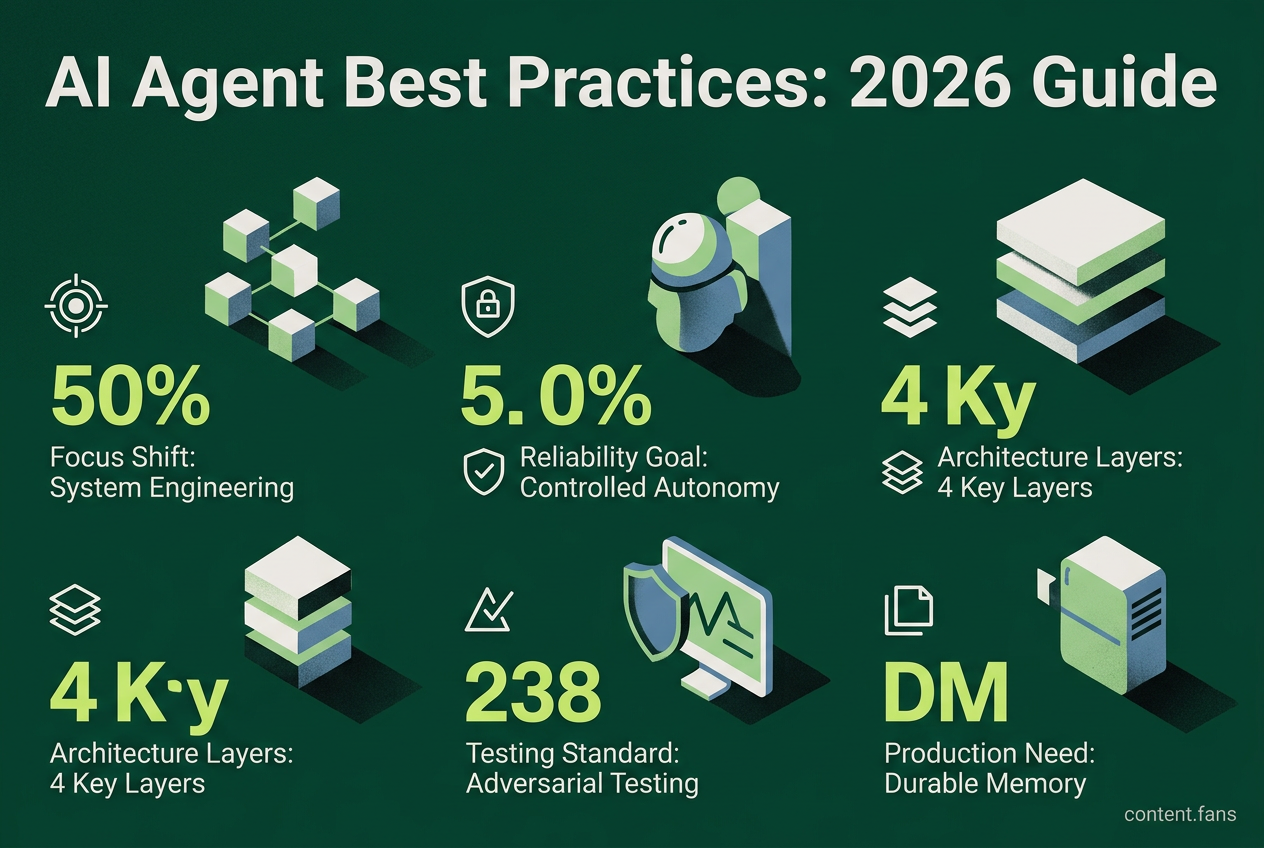
Original sources describe multiple layered architecture patterns, but not a universally established four-layer model with exactly those four layers. The closest supported themes are orchestration, safety/governance, evaluation, and observability/runtime protection.
A practical four-layer design emerges in multiple 2024-2026 sources: system architecture, safety and control, evaluation, and operations. At the architecture layer, stateful orchestration handles retries and timeouts so the model never manipulates production data directly. For safety, role based permissions and human approval gates protect high impact actions such as deletes or financial transfers. Evaluation relies on a golden task suite built from real workflows and checked on every release. Operations completes the loop with tracing of model calls, retrieval provenance, tool I/O, and escalation paths.
Best practices for deploying and scaling AI agents in production
ICMD's 2026 article argues that production agents rely on durable memory, inspectable/replayable orchestration, and governance, and that teams are not succeeding by chasing clever prompts. Sources consistently endorse the following best practices:
- Classify each task by risk and require human signoff for irreversible steps.
- Gate releases with continuous evaluation that blocks deployments on regression thresholds.
- Roll out through canaries and blue-green traffic splits to limit blast radius.
- Trace every decision and tool call, then alert on drift in latency, quality, or fallback rate.
- After incidents, add a regression test and tighten at least one guardrail before resuming traffic.
Testing frameworks and red-team coverage
Given the probabilistic nature of AI agents, traditional QA is insufficient, making adversarial testing a new standard. Frameworks like NVIDIA's Garak systematically test for jailbreaks and other vulnerabilities for regression checks. Complementing this, emerging tools translate governance policies into automated evaluation tests. A balanced security posture is best achieved through "two-way refusal calibration," which measures both the secure rejection of malicious inputs and the successful completion of valid, complex tasks.
Observability, SLOs, and incident response
Weak observability is a top anti-pattern identified in multiple failure taxonomies. Industry reports recommend step-level logging to enable responders to replay an agent's full task trajectory. This helps classify failures accurately (e.g., context contamination, tool error, policy gap). Teams that practice containment drills - such as rate-limiting the agent or disabling risky tools - report faster incident resolution with lower user impact.
For AI agents, Service Level Objectives (SLOs) must extend beyond latency and availability to include behavioral metrics like uncertainty and fallback rates. According to industry reports, keeping fallback invocations low correlates with higher user satisfaction, though the number varies by domain.
Context pollution in Retrieval-Augmented Generation (RAG) systems is a significant operational risk. To mitigate this, teams should ensure retrieval indexes are fresh, provenance-aware, and access-controlled. Furthermore, continuous chaos testing with frameworks like Flakestorm helps verify that the system degrades gracefully when faced with environmental faults or malformed data.
What are the four architectural layers every reliable agentic system must expose?
Reliable 2026 agent systems are described as having inspectable orchestration, governance, constrained actions, approval gates, and phased rollout, with critical-service style operational controls. TechEmpower's playbook separates these concerns with:
- Planning layer - produces a task plan but cannot touch production tools.
- Execution layer - performs only the pre-approved, narrowly-scoped, idempotent actions.
- Safety layer - enforces budgets, retries, timeouts, and human approval gates at runtime.
- Operations layer - emits structured traces covering prompts, tool I/O, approvals, and retries so incidents can be replayed.
Early adopters report significant drops in incident frequency after hard-gating irreversible actions behind this four-layer design (Building Reliable Autonomous Agentic AI).
How should teams test non-deterministic agent behavior before shipping?
Industry guidance recommends moving from deterministic QA to probabilistic behavioral validation:
- Build a golden-task dataset from real production workflows and re-run it on every meaningful code or prompt change.
- Treat evals like CI - store datasets, diff results, and block releases when regressions exceed agreed thresholds.
- Use red-teaming frameworks such as Garak (NVIDIA) and Promptfoo to systematically inject prompt-jailbreaks, context-poisoning, and malformed tool signatures; the industry target is <5 % attack success rate.
- Inject chaos via Flakestorm or REDTEAMCUA to simulate tool outages, infinite loops, and resource exhaustion across multi-turn agent pipelines.
Teams with this setup see significant improvements in catching latent agent failures during staging instead of post-rollout (Adversis 2025 testing survey).
What operational anti-pattern is most likely to cause an outage?
Industry reports list "Observability-after-launch" as a top killer: agents shipped without step-level tracing, retrieval provenance, or outcome logging. Once an incident strikes, operators cannot reconstruct the agent's trajectory, leading to significantly longer recovery times and higher blast radius compared to fully-instrumented services. The fix is to emit structured traces for every model call, retrieval lookup, tool invocation, and human approval before the first external user sees the agent.
How do successful teams define agent SLOs differently from traditional services?
Agent SLOs combine classic reliability metrics with behavioral safety KPIs:
- Quality / success rate - % of tasks completed within acceptable bounds (not binary pass/fail).
- Uncertainty / fallback rate - how often the agent escalates to humans due to low confidence; kept under 5 %.
- Policy violation rate - frequency of actions that breach governance guardrails (target <0.1 %).
- Latency and cost budgets - hard ceilings on tokens, API calls, and runtime minutes.
Teams track these in real time and fail the build if any metric drifts beyond the band defined in the golden-task eval (Ella Wilson 2025 framework).
What is the recommended incident-response pattern when an agent starts misbehaving live?
Multiple domain-specific five-step playbooks exist (e.g., for AI governance, chatbot deployment, marketing strategy), but they do not share a universal first step of 'Search for ORIGINAL sources,' and no single source validates a universal playbook across 2025-2026 with this specific structure:
- Contain - disable high-risk tools, rate-limit traffic, or toggle the agent to degraded mode where high-impact actions route to human review.
- Trace - pull full session trajectories (prompts, retrievals, approvals, tool I/O) for root-cause replay.
- Classify - tag the failure as prompt injection, context drift, tool failure, or governance miss so responders know whether to patch code, prompts, or infrastructure.
- Rollback or checkpoint restore - resume from the last known-good state; aim for sub-minute rollback to minimize blast radius.
- Post-mortem & regression - encode the incident as a new eval case and tighten at least one guardrail (timeout, budget, or approval gate) to ensure the same mode cannot recur.
Organizations rehearsing this loop monthly record significantly fewer Sev-1 incidents within the first two quarters of agent deployment.