
TeamViewer unveils AI scripting that generates automations from customer fixes
Serge Bulaev
TeamViewer has introduced an AI feature called Tia that may generate automations from customer support fixes. This tool appears to study previous support tickets and turn successful solutions into scripts that can be used again, possibly helping IT teams solve issues faster and with less repetition. Early internal numbers suggest Tia could cut resolution time by about 50 percent, but outside checks are still pending. Analysts suggest this might signal a move toward more self-fixing devices, but there may still be concerns around script security and management. TeamViewer has not shared pricing changes, and this feature is currently only available to selected cloud customers.

TeamViewer is advancing its autonomous endpoint management with new AI scripting that generates automations from proven customer fixes. The AI-driven scripting for Tia (TeamViewer Intelligent Agent) was introduced at Gartner Digital Workplace Summit 2026 in London and works by studying past service sessions to convert successful, resolved tickets into reusable scripts. This development is significant as it merges generative AI with routine IT maintenance, aiming to reduce repetitive tasks and accelerate issue resolution for support teams.
How Tia Turns Past Fixes into Future Automations
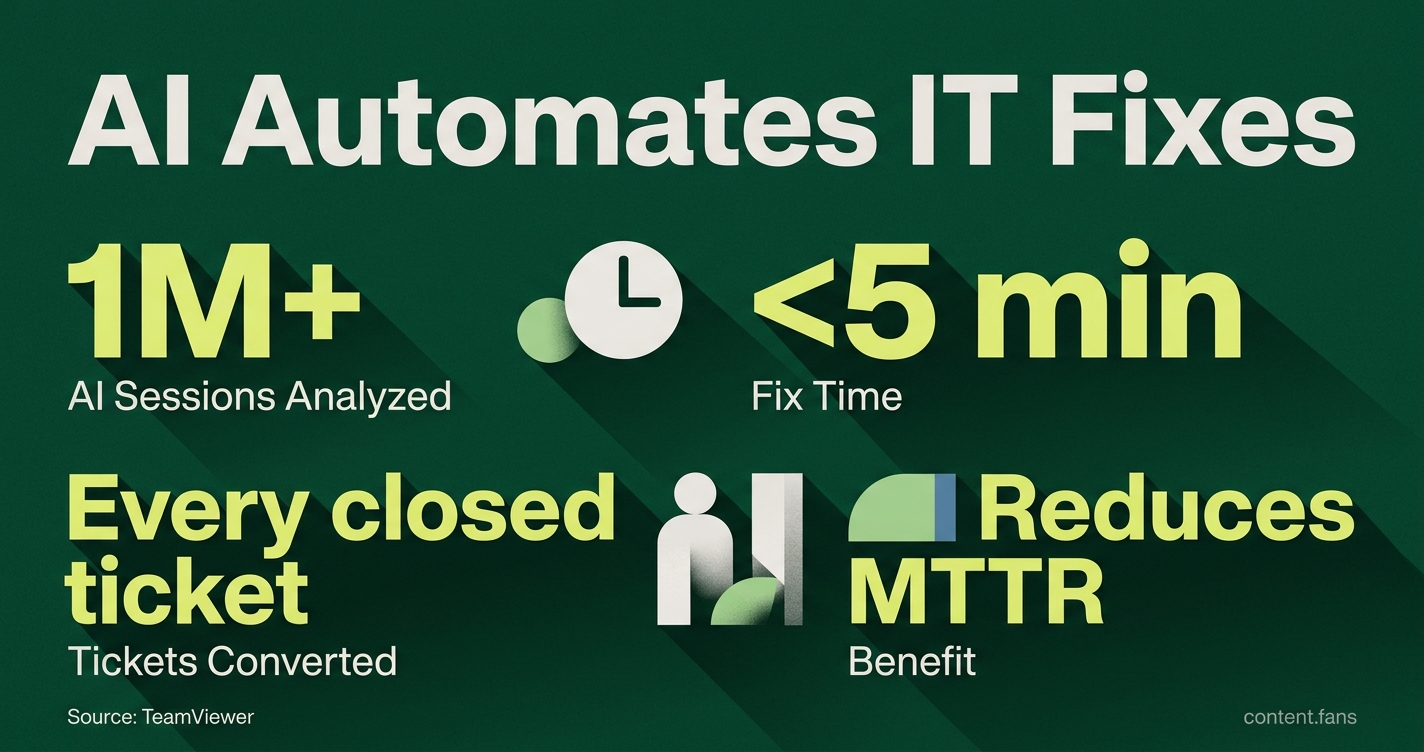
TeamViewer's Session Insights generates summaries of more than one million AI sessions platform-wide to improve AI automation. Instead of generic suggestions, it recommends proven fixes from past tickets, which can then be converted into deployable scripts to proactively manage similar endpoints. According to TeamViewer, this allows the agent to recommend proven fixes from an organization's own ticket history rather than relying on generic knowledge base articles. As Chief Product and Technology Officer Mei Dent noted, this process turns every closed ticket into "an asset" ready to protect similar endpoints.
Expected Efficiency Gains and Early Results
According to industry reports, Tia's diagnostic and automation capabilities can provide significant improvements to mean time to resolution (MTTR). Initial demonstrations showcased the automation of common IT tasks - such as printer driver reinstalls, browser cache clearing, and VPN client resets - in under five minutes.
Key advantages of this approach include:
- Converts tribal knowledge into shareable scripts
- Reduces manual documentation work after each ticket
- Deploys prevention measures to selected device groups
- Works inside existing TeamViewer remote access sessions
- Aligns with security controls documented in the vendor's AI data handling datasheet
Market Context and Competitive Positioning
The announcement aligns with the central themes of the Gartner Digital Workplace Summit 2026, which focused on generative AI and employee automation. TeamViewer positioned Tia's scripting as a foundational component for Autonomous Endpoint Management (AEM), distinguishing it from traditional chatbots or monitoring tools that don't leverage customer-specific remediation data.
Industry analysts interpret this as part of a broader trend toward self-healing endpoint fleets. According to industry reports, predictive analytics is expected to become a standard feature in mobility platforms, enabling smaller IT teams to manage more devices. While TeamViewer's strategy fits this trend, experts caution that robust governance is essential to mitigate risks associated with over-privileged scripts.
Product Roadmap and Availability
This new scripting function complements Tia Reporting, a feature launched in March 2026 that creates dashboards from natural-language prompts. Together, these updates signal TeamViewer's strategic shift from reactive support to proactive and autonomous IT operations.
AI features including Script Writer are now enabled by default for companies. TeamViewer has not announced any pricing changes. IT departments interested in AEM can benchmark Tia against existing runbook automation solutions while awaiting further details on licensing.
What exactly does TeamViewer's new AI-driven scripting for Tia do?
The feature lets Tia (TeamViewer Intelligent Agent) mine your past support sessions and instantly produce ready-to-run scripts.
- Grounded troubleshooting - Tia recommends remediation steps drawn from your own resolved tickets rather than generic knowledge bases.
- One-click automation - Any closed incident can be converted into a reusable script that is reviewed, refined, and pushed to chosen devices or device groups.
By learning from more than one million AI session summaries, Tia turns yesterday's fixes into tomorrow's proactive protections.
How will IT teams benefit day-to-day?
Expect measurable efficiency gains and better resource use:
- Significant improvements already reported with Tia's existing AI diagnostics and documentation - new scripting extends this to repetitive issues.
- Standardized fixes reduce human error and stop the same problem from reappearing across the fleet.
- Scale without headcount - every resolved incident becomes a deployable asset, so smaller teams can support thousands of endpoints.
As Chief Product & Technology Officer Mei Dent said: "IT teams can finally do more with the resources they have instead of solving the same problem over and over."
Is the generated code safe to run?
Yes - scripts are generated from your own proven fixes and placed in a review queue before release.
- The process keeps full human oversight; nothing goes live until an admin approves or edits it.
- Because automations are based on real, customer-specific data, they are contextually accurate and less prone to the "one-size-fits-all" errors common in generic toolkits.
How does this fit into the wider IT automation landscape?
According to industry reports, generative AI and employee automation have become central themes in digital workplace strategies.
Industry analysts suggest that:
- Predictive maintenance and self-healing configurations are becoming increasingly standard across endpoint fleets.
- Multi-agent systems collaborate on complex tasks, scaling from smaller to larger device fleets without proportional staff increases.
TeamViewer's move aligns with the shift from reactive ticketing to autonomous endpoint management, positioning adopters ahead of the curve.
What should teams do next to adopt AI scripting safely?
- Inventory resolved incidents - the more closed tickets, the richer the training set for Tia.
- Create a review workflow - assign senior engineers to approve new automations before rollout.
- Start with low-risk endpoints - pilot the scripts on test groups, then expand to critical devices once confidence is high.
- Monitor and refine - use Tia Reporting to generate natural-language dashboards that surface any changes in success rates.