
NewLimit Raises $435M Series C for Human Longevity Trials
Serge Bulaev
NewLimit, a South San Francisco startup, raised $435 million in Series C funding, bringing its total funding to about $682 million and valuing the company at $3.1 billion. This funding suggests NewLimit may soon begin human trials for its epigenetic-reprogramming therapies, which aim to restore youthful cell function. The company plans to use the money for its first human liver trial, which might start next year if manufacturing and hiring go as planned. Investors appear interested even though the science is still emerging, and success in early trials could help similar approaches. It is not yet certain if this will lead to the first approved epigenetic reprogramming drug in humans.

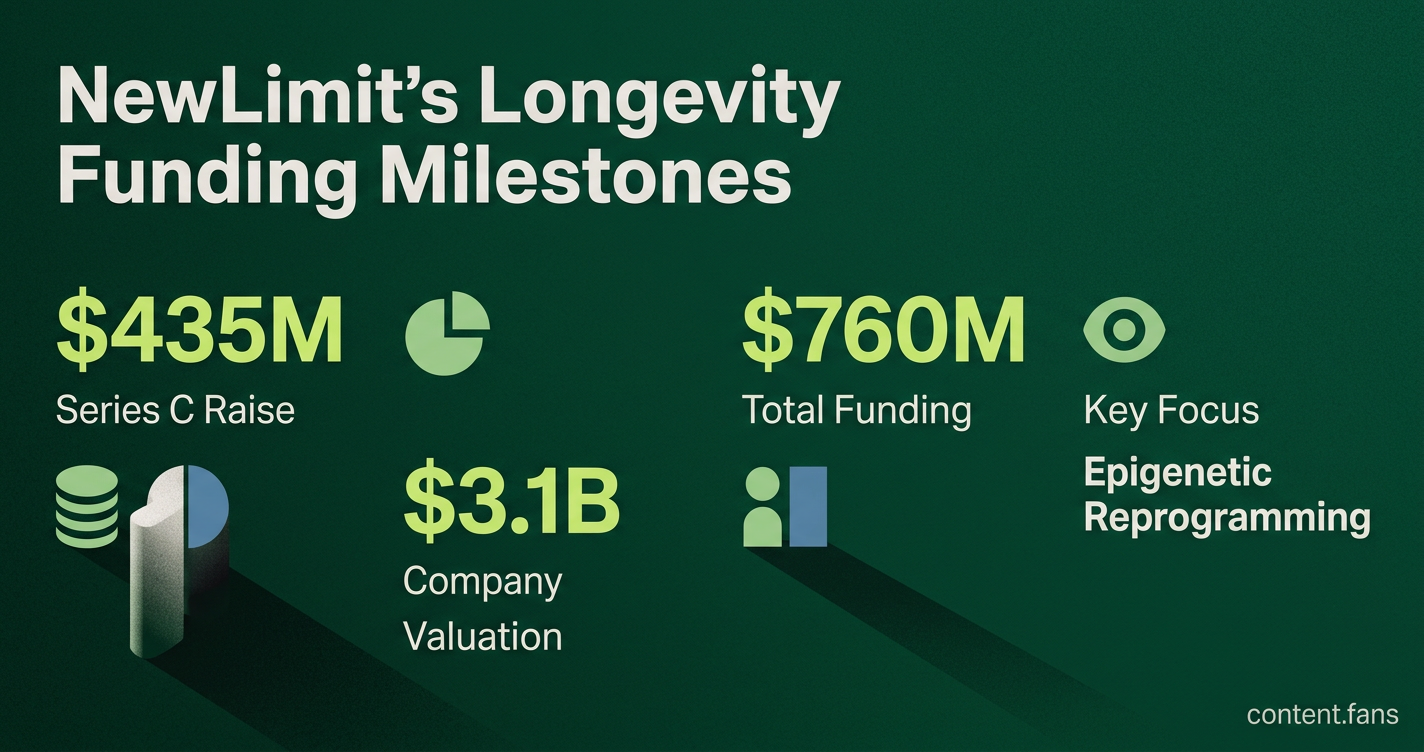
Longevity biotech firm NewLimit has raised $435M in a Series C funding round to advance its human longevity trials, a major development for its epigenetic reprogramming platform. The financing, announced in early June 2026, boosts the company's valuation to $3.1 billion and brings its total funding to approximately $760 million, according to reports.
This substantial capital injection signals that NewLimit's pipeline is progressing toward human clinical trials - the most complex and expensive stage of therapeutic development.
Who backed the Series C
The funding round was led by Founders Fund, with participation from previous investors. The syndicate expanded to include new investors Thrive Capital, Greenoaks, and Quiet Capital, with continued support from existing backers Kleiner Perkins, Valor Equity Partners, and Abstract Ventures. NewLimit also announced participation from Eli Lilly Ventures and Human Capital, a blend of investors that suggests a strategy targeting both private funding and a potential future public offering.
NewLimit will use the funding to advance its epigenetic reprogramming therapy development, with plans to move toward clinical trials. The capital is also designated for scaling up manufacturing capabilities and expanding its discovery platform to address additional age-related conditions, ensuring a clear runway for key milestones.
Why NewLimit says it needs the money
NewLimit's pipeline features therapeutic programs centered on partial epigenetic reprogramming. NewLimit is developing an epigenetic reprogramming medicine for hepatocytes but is not yet in large-scale manufacturing or a human trial. The company's approach focuses on rejuvenating cellular function through chromatin-level editing.
The company has made progress in preclinical development, with studies showing promising results in laboratory models. However, the transition to human trials represents a significant next step that requires substantial capital investment.
How the strategy compares inside longevity biotech
While positioned among well-funded peers like Altos Labs and Retro Biosciences, NewLimit stands out with its focus on epigenetic reprogramming approaches. The company's core strategy relies on its proprietary machine-learning model, Ambrosia, which analyzes single-cell genomics data to identify transcription factors capable of resetting age-related epigenetic markers.
Despite the emerging nature of the science, investors are confident. Kleiner Perkins partner Ilya Fushman noted the funding "extends the runway required to answer key clinical questions." Successful safety trials could significantly de-risk similar reprogramming approaches targeting other cell types.
Read-through for manufacturing and talent
Developing these therapies at scale requires specialized manufacturing and talent. The new capital will likely fund the expansion of NewLimit's South San Francisco facility, potentially adding manufacturing suites or enabling partnerships with contract development and manufacturing organizations (CDMOs).
Talent acquisition is also a key focus. After growing its headcount significantly with hires in computational biology and process development, the company plans to continue expanding its team, according to industry reports. Observers anticipate potential U.S.-based clinical trials, which the FDA will monitor closely due to the novelty of epigenetic editing.
This funding round represents a significant investment in the longevity space. NewLimit's success in translating this capital into approved epigenetic reprogramming therapies will depend on overcoming challenges in manufacturing, clinical trial development, and proving the therapy is well-tolerated in humans.
What is NewLimit and what does the company actually do?
NewLimit is a South San Francisco-based longevity biotech company founded in 2021 by Brian Armstrong, Blake Byers and Jacob Kimmel. The firm develops epigenetic-reprogramming medicines that aim to restore youthful function to aged cells without changing their identity. Its platform blends machine-learning models (code-named Ambrosia), single-cell genomics and targeted chromatin editing to extend human healthspan. Current pipeline programs focus on liver, immune/T-cell and vascular endothelial biology.
How big is the Series C round and who led it?
On June 2, 2026 the company closed a $435 million Series C led by Founders Fund. The syndicate includes Thrive Capital, Greenoaks, Quiet Capital, Kleiner Perkins, Valor, Eli Lilly Ventures, Nat Friedman & Daniel Gross and several prior investors. The round lifts total funding to approximately $760 million since inception and values NewLimit at roughly $3.1 billion post-money.
Why did NewLimit raise significant funding right now?
According to industry reports, proceeds are earmarked for key priorities including advancing human clinical trial development for liver-reprogramming candidates, scaling manufacturing capabilities to produce clinical-grade material, and expanding the discovery platform into additional therapeutic areas covering vascular biology. The company cites preclinical data showing restored liver function in aged mice as supporting the move toward clinical development.
What clinical milestones can investors expect next?
The company is working toward clinical trial initiation, though specific timelines for regulatory filings and trial starts have not been publicly confirmed. Development priorities include advancing liver-focused programs as well as immune/T-cell and endothelial programs through preclinical development toward potential clinical testing.
How does NewLimit differ from other longevity companies?
Unlike consumer-oriented "anti-aging" brands, NewLimit is strictly a drug-development company. Its approach centers on Ambrosia, a machine-learning model that analyzes extensive single-cell epigenetic data to predict transcription-factor combinations that may rejuvenate cells while preserving identity. The firm works with primary human hepatocytes and mouse models, providing translational data for its reprogramming approaches.