
PhoenixAI raises $80M Series B for Agentic AI Database
Serge Bulaev
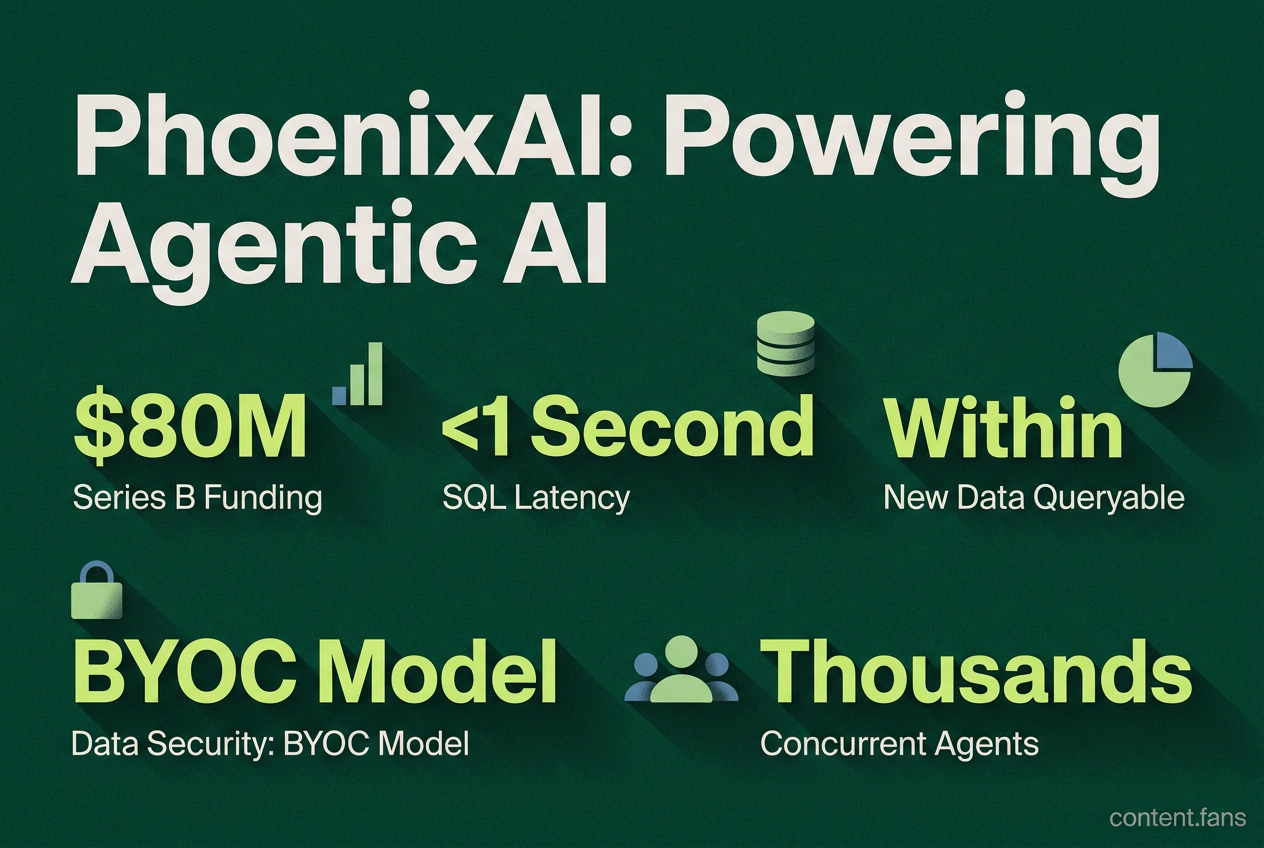
PhoenixAI has raised $80 million in a Series B funding round, bringing its total outside investment to about $105 million. The money is meant for further research and development of its Agentic AI Database, which is designed for fast, real-time analytics by autonomous agents. Analysts suggest this funding shows growing investor interest in tools that support the increasing use of AI agents in businesses. The company may compete with other big data platforms but appears to focus on features for agent-specific workloads. A general public release date is not yet announced, and private testing is ongoing.

PhoenixAI has secured a significant Series B investment to accelerate development of its Agentic AI Database, a platform designed for real-time analytics by autonomous AI agents. The funding round, led by Sky9 Capital and detailed in a June 11, 2026 filing, represents a substantial capital raise for the Menlo Park startup. Proceeds are earmarked for R&D and go-to-market initiatives.
Industry analysts position the funding as a significant 2026 infrastructure investment, comparable to recent financing for database platforms in the space. The move signals a growing concentration of capital toward platforms capable of managing the explosive growth of token usage within enterprise-level agentic AI systems.
How the Agentic AI Database Works
The PhoenixAI Agentic AI Database is a real-time analytical engine designed for high-concurrency workloads from autonomous agents. It unifies streaming data from sources like Kafka with historical data from Iceberg lakehouses, allowing agents to query fresh, complete information through a single, low-latency SQL interface.
The database architecture uniquely merges live streaming inputs from systems like Kafka with historical data stored in Apache Iceberg data lakehouses into a single query path. Its column-oriented execution engine uses SIMD instructions to maintain SQL latency below one second, even under load from thousands of concurrent agents. This "no-pipeline" approach makes new data queryable within seconds of arrival, eliminating the need for slow and fragile batch ETL processes.
For security, PhoenixAI employs a Bring Your Own Cloud (BYOC) model, ensuring sensitive row-level data never leaves the customer's Virtual Private Cloud (VPC). The PhoenixAI product documentation also confirms that per-cluster KMS keys are used to encrypt all chat history generated by Agent Fawkes, its built-in assistant for writing and debugging SQL.
Early Enterprise Patterns
PhoenixAI is positioned to resolve the "architectural impasse" that occurs when swarms of AI agents overwhelm legacy data warehouses. Key enterprise adoption patterns include:
- Real-Time Decisioning: Sub-second query responses enable planning agents to avoid hallucinations and act on current data, not stale recommendations.
- High-Concurrency Dashboards: Customer-facing analytical dashboards can sustain tens of thousands of queries per second (QPS) without experiencing latency spikes.
- Legacy System Integration: The database acts as a smart overlay for existing ERP systems like Oracle and SAP, allowing agents to perform complex joins on live data without data migration.
- Enterprise-Grade Governance: Built-in governance features help organizations meet compliance requirements.
Competitive Lens and Market Context
In the real-time analytics market, SiliconAngle places PhoenixAI alongside established incumbents such as Snowflake, ClickHouse, Apache Druid, and Google BigQuery. While these platforms serve general AI workloads, PhoenixAI differentiates itself with optimizers specifically designed for agentic tasks, such as dynamically choosing join strategies at runtime.
Market analysis suggests that agentic workloads represent a growing segment of the database market. Furthermore, broader spending on agentic AI is forecast to reach significant levels by 2030, according to industry reports. This substantial funding round suggests investors are confident that a specialized agent database like PhoenixAI can capture a significant portion of this expanding market.
What Happens Next
Looking ahead, PhoenixAI intends to hire more MPP engine engineers in both Menlo Park and Singapore and expand its "Anywhere" self-hosted deployment option for customers in highly regulated industries. The company is also collaborating with developers of popular orchestration frameworks like LangGraph and AutoGen to ensure seamless integration via standard tool-calling APIs.
A public general availability (GA) release date has not yet been announced, and early customers in the private preview program are currently under non-disclosure agreements. The company indicates that the Series B proceeds provide sufficient runway for continued operations based on current financial projections.
What exactly is the Agentic AI Database and how does it work?
The Agentic AI Database is a real-time analytical engine that unifies live streaming data (from Kafka) and historical lakehouse data (like Apache Iceberg) inside a single SQL-native layer. Instead of forcing teams to build brittle ETL pipelines, the platform ingests freshly arriving events and makes them queryable within seconds, delivering sub-second SQL responses even when thousands of autonomous agents hit it concurrently. This eliminates the latency gap that usually causes AI agents to act on stale snapshots instead of "what is true right now."
Why did PhoenixAI just raise funding and how will the money be used?
PhoenixAI announced a Series B on June 11, 2026, led by Sky9 Capital, to power its Agentic AI Database. The funding reflects investor conviction that the new Agentic AI Database category is moving from early adopter to mainstream demand. Industry reports suggest the agentic market represents a significant growth opportunity in the coming years.
How do enterprises actually deploy PhoenixAI today?
Two dominant patterns have emerged:
1. Smart layer on top of legacy ERP - Oracle and SAP remain the systems of record, but PhoenixAI sits above them, allowing agent swarms to query and act on fresh data without rewriting downstream code.
2. Customer-facing analytics at massive concurrency - dashboards that used to handle limited concurrent queries now sustain tens of thousands of concurrent queries thanks to the engine's SIMD-accelerated, MPP architecture.
Both deployment modes run in BYOC (Bring Your Own Cloud), ensuring compliance and per-cluster KMS encryption.
Who are PhoenixAI's closest competitors?
PhoenixAI is sandwiched between two competitive layers:
- Legacy data-warehouse incumbents - Snowflake, ClickHouse, Apache Druid, and Google BigQuery were identified as the closest database alternatives.
- Agent orchestration stacks - Microsoft AutoGen/Copilot Studio, LangGraph, CrewAI, Aisera, and Kore.ai handle the workflow layer that ultimately queries PhoenixAI's data layer.
The company's differentiation lies in tuning every knob for agentic workloads: high fan-out queries, extremely fresh data, and sub-second SLAs.
What measurable business outcomes are customers seeing?
Early adopters running large agent fleets report significant improvements:
- Substantial reduction in "agent hallucination" events after switching from nightly batch feeds to PhoenixAI's second-level freshness.
- Significantly faster time-to-action for automated workflows that previously waited on hourly or daily ETL windows.
Because PhoenixAI skips the traditional aggregation pipeline, total cost of ownership also drops: enterprise customers have eliminated multiple separate pre-compute jobs after migrating to the new engine.