
Knight Foundation expands AI funding for local news, content integrity
Serge Bulaev
The Knight Foundation is increasing funding for AI projects to help local newsrooms and improve the quality of online information. Their spending focuses on both keeping newsrooms sustainable and making sure information is trustworthy. The Foundation has spent over $107 million on issues like disinformation and algorithm bias since 2016 and launched new proposals like "Better Feeds" to change how news is ranked and shared online. Some people support these efforts, saying they could increase content quality, while others worry they might limit certain voices and reduce transparency. Overall, the Foundation's actions may signal a move toward more curated news systems guided by research and philanthropy, rather than just market forces.

The John S. and James L. Knight Foundation is expanding its AI funding to support local news and enhance content integrity, placing it at the forefront of a shift in how information is created and discovered. This report examines the Foundation's key funding, proposals, and debates in recent years, analyzing how these decisions are reshaping the landscape of online information discovery.
Two funding streams, one goal
The Knight Foundation is investing in artificial intelligence through two main channels: one to help local newsrooms become more sustainable and another to improve the integrity of online information. This dual focus aims to address both the business and ethical challenges of the digital age.
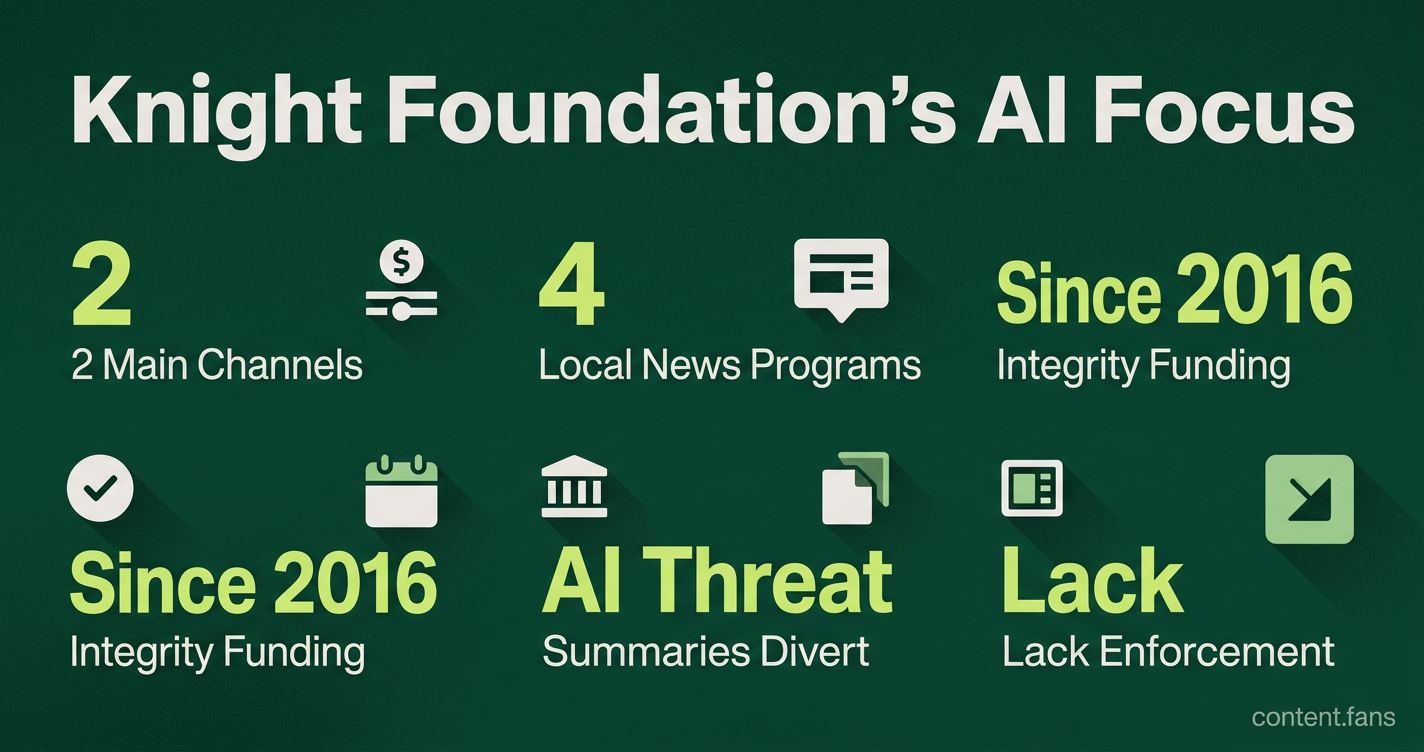
In 2024, the Knight Foundation launched a significant initiative to support local news organizations in harnessing AI. It funded four programs: AP (AI tools in newsrooms), Brown Institute (audience revenue strategies), NYC Media Lab (AI research), and Partnership on AI (ethical concerns). The focus was on 'driving success,' 'audience revenue,' and 'ethical concerns' (Partnership on AI announcement). On the information integrity front, Knight has directed substantial funding since 2016 into research on disinformation and algorithmic bias. This funding supported many publications and, as critics point out, led to a network that has "testified before Congress multiple times," signaling influence beyond grant distribution.
Recent research initiatives
Knight-affiliated fellows highlighted the threat of AI-generated summaries in search results, which can divert traffic from original publishers. Recent discussions point to a future where these summaries replace traditional links, suggesting provenance signals could become more critical than headline rankings, especially if AI models train on non-consensually obtained data.
Additionally, Knight-backed researchers identify a "scraping burden" - the massive data appetite of large language models. They argue that proposed voluntary standards like llms.txt lack enforcement, giving publishers little real control over how their content is used to train AI.
Pushback and political overtones
Critics in political and advocacy circles have accused Knight-linked disinformation work of supporting censorship efforts, but the evidence provided does not show that Knight itself is documented as a 'key part' of a censorship-industrial complex or that it funded NewsGuard as a blacklisting project. Knight staff defend their actions, arguing that trust-and-safety tools are vital for combating the rapid spread of false narratives by generative AI. These competing perspectives remain unresolved by any external audit.
Snapshot of recent impact
A sample of the Foundation's AI-related actions:
• Significant funding to deploy AI in local newsrooms
• Challenge programs on news and information quality
• Ongoing investments in mis- and disinformation research
Collectively, these actions signal a strategic shift away from open discovery systems. The new model favors curated, civility-focused information ecosystems guided by philanthropic research rather than by market dynamics alone.
How much has the Knight Foundation invested in AI and misinformation research since 2016?
The Knight Foundation has committed substantial funding to research and initiatives focused on disinformation, algorithmic bias, and trust and safety in recent years. This funding has supported many publications across numerous journals and media outlets, and Congressional testimony has occurred multiple times.
What is the "AI for Local News" initiative?
The Knight Foundation launched a significant program to support local news organizations in harnessing AI. It funded four programs: AP (AI tools in newsrooms), Brown Institute (audience revenue strategies), NYC Media Lab (AI research), and Partnership on AI (ethical concerns). The focus was on 'driving success,' 'audience revenue,' and 'ethical concerns.'
How does the Knight Foundation approach social media and information integrity?
The Knight Foundation's initiatives have focused on 'AI for Local News' (funding ethical challenges via Partnership on AI) and 'Generative AI for Cities' (funding city governments). The Foundation supports research into improving information quality and addressing the challenges posed by AI-generated content.
Why does the Foundation view generative AI as a threat to democratic discourse?
Knight leaders argue that generative AI has accelerated the creation and spread of mis- and disinformation, making it harder for voters to reach fact-based decisions. To counter this risk, the Foundation has announced challenge programs to support projects that strengthen news quality and information integrity in the generative-AI era.
What criticisms have been raised against the Knight Foundation's approach?
Groups such as the Foundation for Freedom Online contend that Knight has become involved in funding what they characterize as censorship infrastructure. Critics assert the Foundation uses the pretext of fighting disinformation to justify content moderation approaches that may impact conservative publishers, though the specific mechanisms and scope of these claims remain disputed.