
TCI Fund cuts Microsoft stake over AI, OpenAI concentration risks
Serge Bulaev
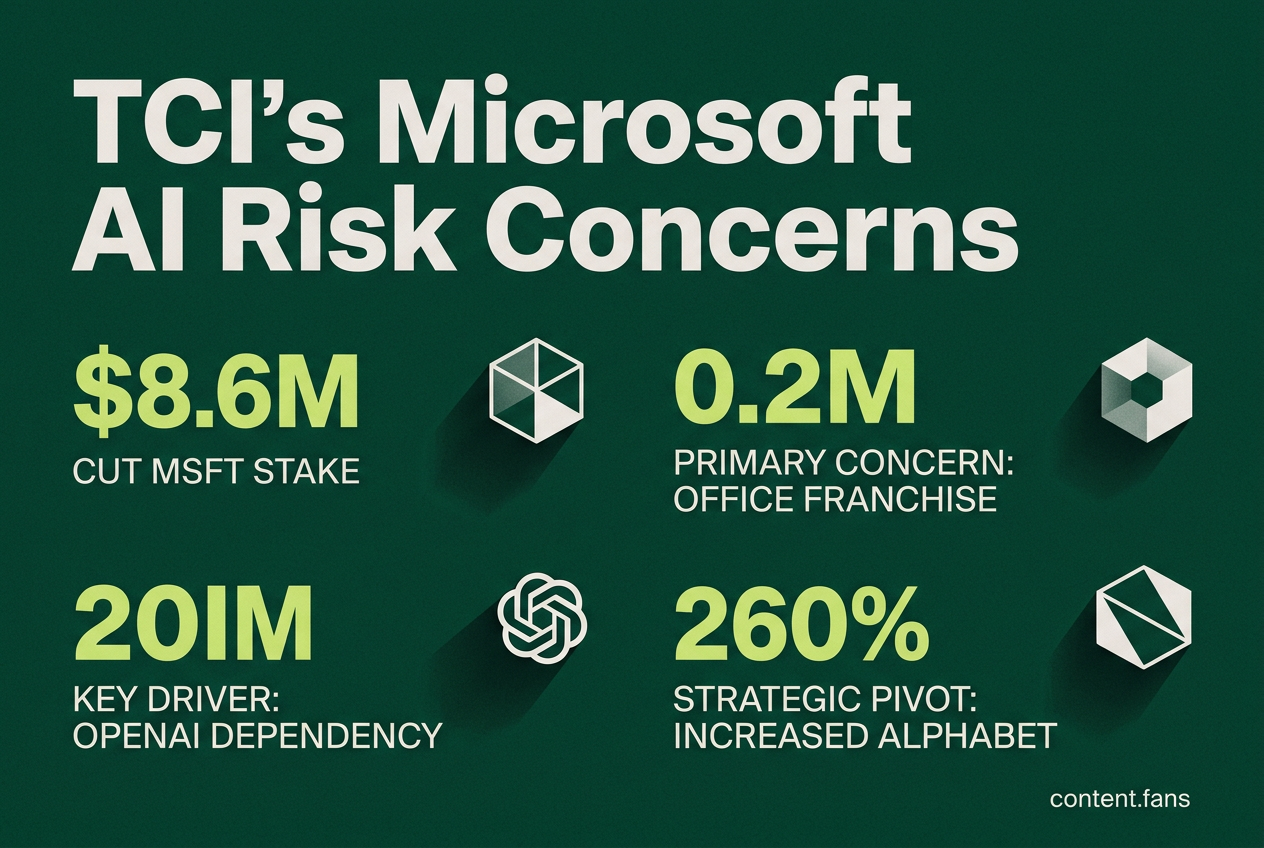
TCI Fund Management reduced its stake in Microsoft, citing uncertainty about the company's competitive position in AI and high reliance on OpenAI for cloud business. The fund warned that rapid AI development could hurt Microsoft's core products like Office and pointed out risks if OpenAI changes its cloud provider or faces financial issues. Analysts note Microsoft's strong dependance on one customer for future revenue may be risky. The move suggests some big investors may not see AI spending as a guaranteed growth area. The TCI exit does not prove Microsoft's AI plans are flawed, but it shows investor confidence might depend on how well Microsoft manages these risks.

The decision by TCI Fund Management to cut its Microsoft stake signals growing investor concern over the tech giant's AI strategy and OpenAI concentration risks. The major hedge fund's move to trim its position from a significant portion to a much smaller allocation of its portfolio provides a stark case study on how elite investors are evaluating AI risk in big tech.
Disclosed in its recent investor letter, the reduction came after a multi-year holding period that generated substantial gains. While Microsoft's share price saw limited movement on the news, the move raises a critical question: how much AI-related uncertainty can even a mega-cap company sustain before long-term investors exit?
Investor exit reframes AI risk
TCI's letter pinpointed "uncertainty over Microsoft's competitive position" as the key driver for the sale. The fund expressed concern that rapid advancements in generative AI could disrupt the highly profitable Office franchise, which remains a core cash generator for Microsoft. While risks in the Azure cloud business were also noted, productivity software was the primary concern. In a strategic pivot, TCI increased its stake in Alphabet, a move analysts suggest reflects a belief that Google is better positioned to monetize AI.
TCI Fund Management reduced its Microsoft stake due to significant concerns surrounding the company's AI strategy. The fund cited uncertainty over the long-term viability of the Office franchise in the face of generative AI and concerns about Azure revenue concentration risks.
Analysis - What Major Investor Exits Signal About AI Risk in Big Tech
The source of this uncertainty stems from Microsoft's heavy dependence on its partnership with OpenAI. Industry reports suggest that a significant portion of Microsoft's cloud infrastructure investments and future revenue expectations are tied to this single partnership. This level of customer concentration is highly unusual for a company of Microsoft's scale.
This imbalance creates a dual-sided risk for Microsoft. First, if OpenAI were to diversify its cloud providers, a substantial portion of Microsoft's expected revenue could be at risk. Second, if OpenAI encounters financial difficulties, Microsoft could face payment delays or be forced into unfavorable contract renegotiations. This dependency has led analysts to question whether the massive capital expenditures on GPU infrastructure for AI will deliver returns without a more diversified customer base.
Valuation signal, disclosure ripple
Although TCI secured substantial gains on its investment, the fund chose to exit while Microsoft's stock had already declined year-to-date. This combination of locking in profits while identifying new downside risks may prompt other major investors to re-evaluate their positions. The sale is being interpreted as a significant signal that even bullish long-term investors are beginning to question whether AI spending guarantees future growth.
This move has also amplified calls for greater transparency from cloud providers. The argument that Microsoft is now heavily dependent on OpenAI could lead regulators and auditors to demand stricter disclosure rules for material customer concentration in cloud contracts. If such changes are implemented, other hyperscalers with large-scale AI partnerships could face similar scrutiny.
Early takeaways without a wrap
While TCI's exit does not definitively prove Microsoft's AI strategy is flawed, it highlights the key metrics investors are watching. These include the resilience of legacy software margins against AI disruption, the concentration of cloud revenue, and the speed at which Microsoft can convert AI features into profitable products. Future actions from other institutional investors will reveal whether confidence in Microsoft's ability to manage these risks is growing or waning.
Why did TCI Fund Management slash its Microsoft stake significantly?
TCI concerned about AI disrupting Office workflows and Azure risks; no OpenAI concentration figure cited. In the fund's investor letter, Sir Christopher Hohn explained the move by pointing to uncertainty over whether entrenched Office workflows can survive AI-driven alternatives, while also flagging concerns about cloud revenue concentration. After many years and substantial gains, TCI judged the risk-reward profile had shifted.
How material is significant customer concentration for a cloud giant?
It is extremely unusual for a single customer to account for such a large portion of a cloud provider's future revenue commitments. Industry reports suggest Microsoft has substantial revenue tied to its OpenAI partnership. The concentration means OpenAI's compute needs, pricing negotiations, or even a strategic pivot to rival clouds such as AWS could materially impact Azure growth. Non-OpenAI business continues to grow at a healthy pace, but the absolute dollars tied to one partner represent an unprecedented level of dependency.
Could AI really displace the Office franchise?
Current trends show vendor-switching rates may increase significantly thanks to generative AI, according to McKinsey. New AI-native productivity tools can replicate Office functions with natural-language onboarding, cutting both switching costs and pricing power. Adobe, often cited as a parallel incumbent, has seen its stock decline from recent highs partly because AI features are compute-heavy yet difficult to monetize effectively. If similar economics hit Office, Microsoft's most profitable division could face margin compression or volume losses.
How did markets react to the TCI exit?
Microsoft shares saw limited movement on the day of the announcement, but the move rippled far beyond the immediate price action. Industry observers called it a significant signal that major investors are reassessing AI investments and incumbent advantages. The exit came amid broader market volatility and intensified scrutiny on whether AI capital expenditures will translate to incremental revenue. Peer funds are now reassessing the disclosure gaps around large customer dependencies.
Will investors demand new disclosure norms?
Pressure is mounting. With substantial revenue reportedly tied to the OpenAI partnership, traditional risk sections may appear understated. Watchdogs and analysts are asking for segment-level Azure churn, renewal rates, and AI-specific sensitivity analysis. If Microsoft or other hyperscalers cannot adequately quantify how much of future contracted revenue depends on key partnerships, valuation discounts could widen. The TCI decision may accelerate regulatory conversations on customer-concentration reporting thresholds.