
Sweet Proteins Expand Beyond Lab, Challenge Sugar Dominance
Serge Bulaev
Sweet proteins like brazzein, thaumatin, and sweelin are no longer just research projects; they are starting to be used in food, possibly challenging sugar and artificial sweeteners. These proteins can be very expensive compared to sugar, but their extreme sweetness may help close the price gap if production costs drop. Forecasts for market growth are mixed, and early trials by big food brands suggest some industry interest. If prices fall further and regulations stay friendly, sweet proteins might become more common in products, but this is still uncertain. Companies may try different strategies, such as mixing sweet proteins with sugar or other sweeteners, to help them gain acceptance.

Sweet proteins are transitioning from laboratory curiosities to commercial ingredients, with precision fermentation reshaping how sweetness is made and major food manufacturers now placing strategic bets on this technology. As the industry approaches critical tipping points in cost, scale, and consumer acceptance, stakeholders across the value chain face urgent decisions about positioning and partnership.
What exactly are sweet proteins and why do they matter for the food industry?
Sweet proteins are a class of naturally occurring proteins, such as thaumatin and brazzein, that provide intense sweetness with no calories. Found in tropical fruits, they are now produced via precision fermentation, offering a clean-label, protein-based alternative to sugar and artificial sweeteners for the food industry.
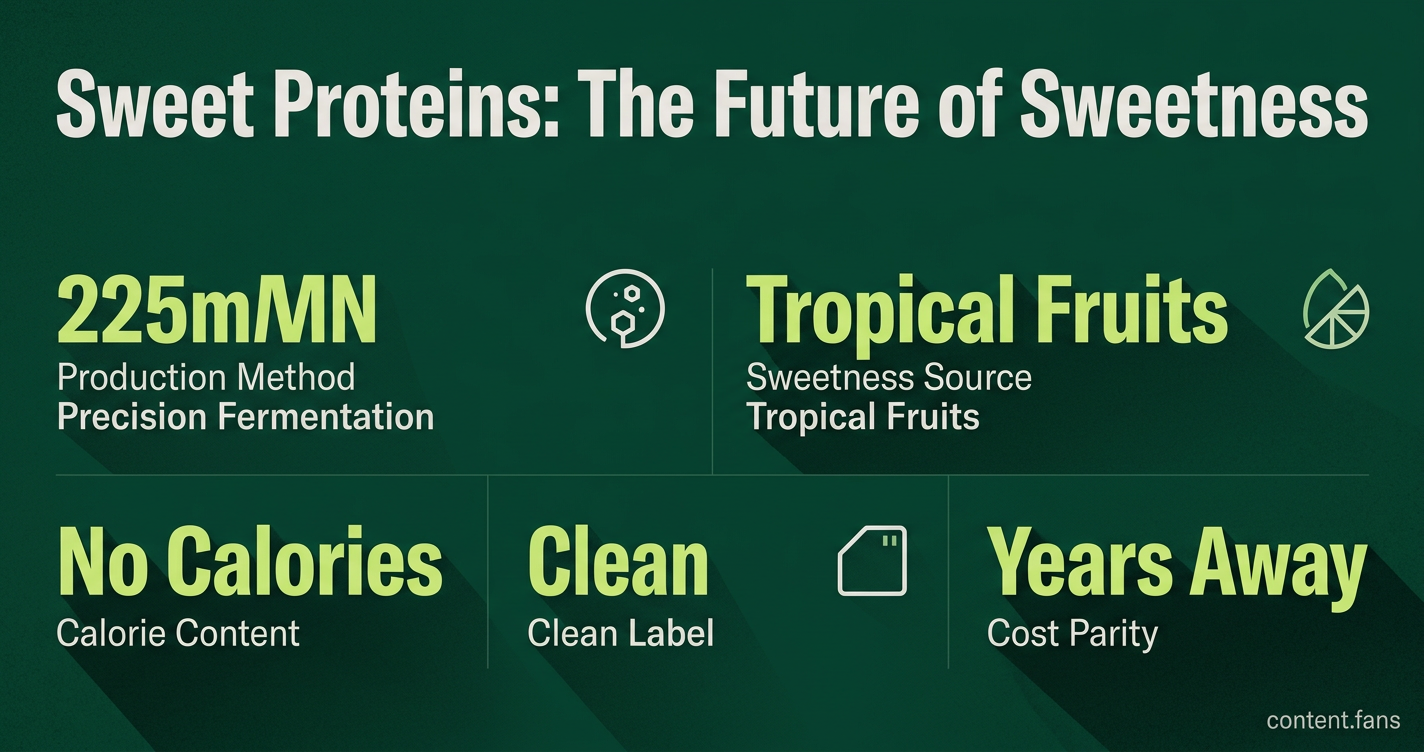
Sweet proteins represent a distinct category of naturally occurring proteins - including thaumatin, brazzein, and monellin - that deliver intense sweetness without sugar's metabolic footprint. Unlike artificial sweeteners synthesized through chemical processes, these proteins are found in tropical fruits and can now be produced through precision fermentation, offering a "clean label" alternative that resonates with health-conscious consumers.
Their significance lies in functional performance: these proteins are significantly sweeter than sucrose on a weight basis, enabling minimal usage rates. This extreme potency, combined with protein-based metabolism rather than carbohydrate processing, positions them as potential primary sweeteners rather than merely supporting ingredients - a shift that could fundamentally restructure global sweetener markets currently dominated by sugar and synthetic alternatives.
How close is the industry to achieving price parity with conventional sweeteners?
True price parity remains several years away, though the trajectory is accelerating. Current economics reveal the challenge: sweet proteins remain significantly more expensive than refined sugar and conventional artificial sweeteners, though their extreme potency means smaller quantities are needed.
However, cost-in-use calculations tell a more nuanced story. In premium beverage applications, the extreme potency of sweet proteins can achieve improved cost profiles against full-caloric sweeteners. Industry efforts are focused on reducing production costs through strain engineering, higher-density fermentation, and continuous processing improvements. The fermentation-derived segment is projected to grow substantially as downstream processing yields improve.
Which major food companies are driving adoption, and what signals does this send?
Several major food companies are exploring sweet protein applications, with ingredient companies actively investing in sustainable ingredient sourcing and product development utilizing sweet proteins. Various partnerships between ingredient suppliers and sweet protein developers are emerging to validate the technology for mainstream applications beyond niche health products.
Regulatory milestones are reinforcing this momentum, with multiple companies working toward regulatory approvals in key markets. These developments, combined with growing investment in production infrastructure, signal that the industry is moving from research phase toward commercial scaling.
What adoption scenarios should industry stakeholders prepare for?
Three distinct trajectories are emerging based on technology maturation and market dynamics:
| Scenario | Timeline | Characteristics | Market Implications |
|---|---|---|---|
| Conservative | Through 2030 | Sweet proteins remain premium ingredients for health-positioned products; limited to beverages and functional foods | Niche market growth; fermentation costs decline slowly |
| Moderate | 2028-2032 | Improved cost profiles achieved in premium applications; major CPG brands launch reformulated flagship products | Regional market expansion; bakery and confectionery categories begin adoption |
| Aggressive | 2030-2035 | Competitive cost positioning with sugar in select applications; regulatory harmonization enables global supply chains; consumer acceptance crosses mainstream threshold | Fermentation-derived proteins capture significant market share; displacement of artificial sweeteners in major categories |
The moderate scenario appears increasingly probable, supported by growing regulatory acceptance and continued investment in production capabilities across multiple regions with sugar reduction initiatives.
What strategic responses are recommended for different industry players?
For incumbent ingredient suppliers:
- Accelerate partnership strategies with precision fermentation startups rather than competing solely on extraction-based supply
- Invest in blended systems that combine sweet proteins with other natural sweeteners to create differentiated sugar reduction solutions
- Engage early in regulatory processes to help shape emerging standards for fermentation-derived ingredients
For food and beverage manufacturers:
- Pilot in premium categories first where improved cost profiles are more achievable and consumer willingness-to-pay supports positioning
- Develop co-manufacturing relationships to share scale-up risks before committing to dedicated production lines
- Invest in sensory research addressing lingering challenges with temporal profile and taste optimization
For emerging players:
- Prioritize regulatory approvals - securing GRAS or equivalent approvals across major markets before scaling
- Target capacity build-out in regions where fermentation infrastructure is advancing and regulatory pathways are developing
- Build consumer education capabilities emphasizing "protein sweetener" positioning over technical explanations of precision fermentation
The window for first-mover advantage in sweet proteins is narrowing. With growing industry interest and improving cost trajectories, the question is no longer whether sweet proteins will challenge sugar dominance, but which organizations will capture value as that transition accelerates.