
Databricks Raises $5B, Hits $190B Valuation With $7B Revenue Run Rate
Serge Bulaev
Databricks has raised $5 billion and now has a $190 billion valuation, with revenues reaching a $7 billion run rate. Its valuation went up about 42 percent in just six months, which investors say may be due to fast revenue growth. The company appears to be attracting large investments as it positions itself for big data and AI workloads, even as overall venture funding slows down. This funding might show strong interest in AI infrastructure and could mean Databricks is preparing for a public market entry or major research projects. Snowflake remains its main competitor, but Databricks is seen as a leader in the field, according to analysts.

Databricks has raised $5 billion at a $190 billion valuation and now reports a $7 billion revenue run rate, a move highlighting the immense capital flowing into foundational AI platforms. This latest financing reinforces the company's position as a core system for enterprise data engineering and machine learning workloads.
Industry observers note the company's substantial valuation increase in just six months due to its accelerating revenue growth. Many analysts suggest that few private tech companies in 2026 command comparable growth at this revenue scale, allowing Databricks to secure fresh equity while broader venture funding slows.
Fresh Capital Fuels Soaring Revenue Growth
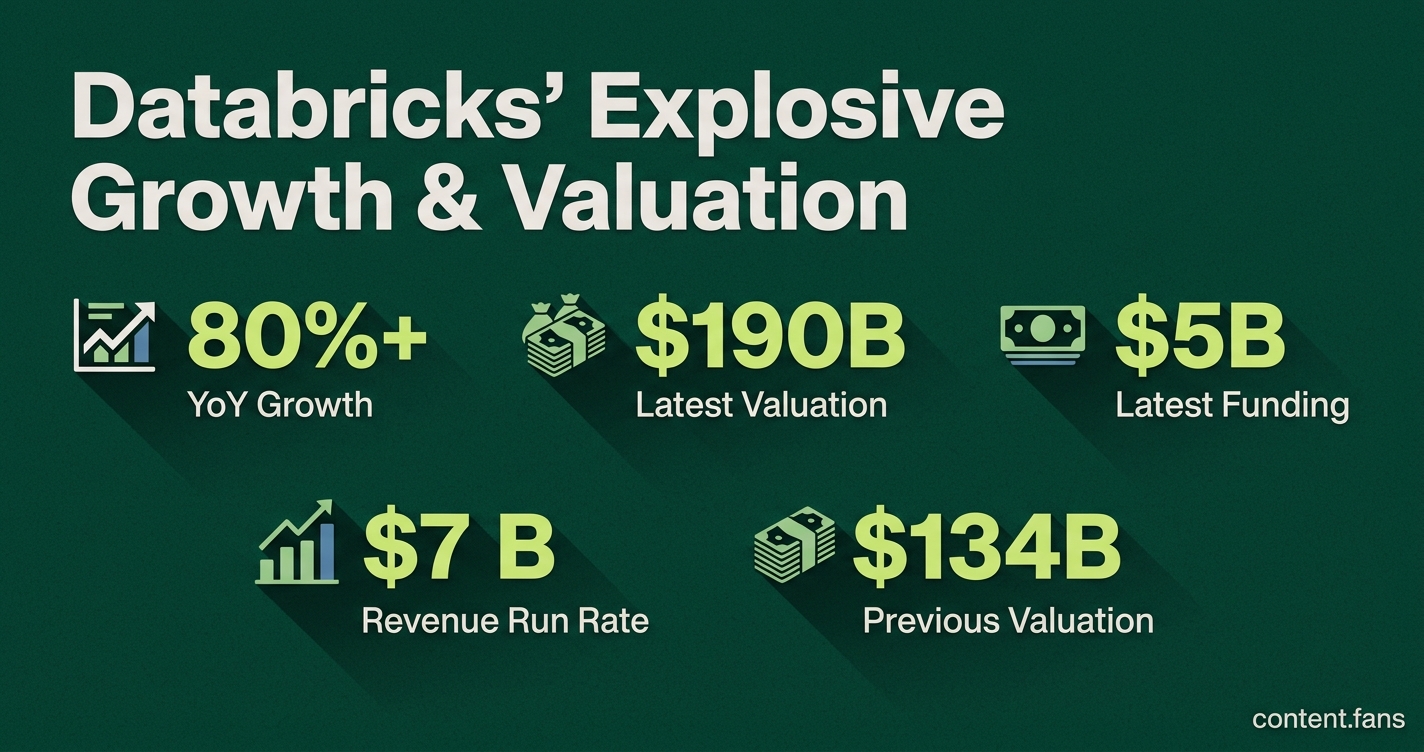
Databricks raised $5 billion, reaching a $190 billion valuation and a $7 billion revenue run rate with over 80% YoY growth. Led by Coatue with participation from Blackstone and T. Rowe Price, the funding underscores intense investor interest in the AI infrastructure leader's accelerating momentum.
According to CNBC, the August funding round was led by Coatue, with participation from Blackstone, MGX, T. Rowe Price, and Sixth Street Growth. Databricks confirmed its annualized revenue crossed $7 billion, growing over 80% year-over-year in Q2 - a marked acceleration from its $5.4 billion run rate and 65% growth reported in February.
Funding Timeline at a Glance
Confirmed milestones in the provided sources are Feb. 9, 2026: ~$5B equity plus ~$2B debt at a $134B valuation; Aug. 13, 2026: $5B strategic funding round closed at a $190B valuation. The July 16, 2026 term-sheet claim is not supported here.
The series of raises may indicate that Databricks is securing capital ahead of a potential public-market window or to bankroll heavy R&D across Unity AI Gateway, Genie, and Lakebase, projects named in its July statement.
Investor Rationale Inside the AI Infrastructure Boom
Large private funds are directing billions toward the software and hardware layers underpinning generative AI. This trend helps explain how Databricks can secure multi-billion dollar equity rounds twice in one year, even with cautious public markets. Goldman Sachs says private credit and infrastructure funds are helping fill financing gaps in data-center financing; the $5.3 trillion-by-2030 hyperscaler spending figure is not confirmed by the provided result.
Competitive Landscape: Snowflake Rivalry Remains Central
Snowflake remains Databricks' primary strategic competitor, focusing on SQL-heavy analytics, while Databricks excels in ELT, large-scale compute, and ML training pipelines. Other key rivals include Google BigQuery for serverless analytics, Amazon Redshift for AWS-native data warehousing, and Microsoft Fabric for enterprises invested in the Microsoft ecosystem. Niche competitors like Dremio and Starburst focus on open lakehouse architectures.
Industry recognition reinforces buyer confidence in the platform's comprehensive capabilities, spanning data storage, batch processing, streaming, and full-cycle ML management.
Why This $5B Databricks Round Matters
The rapid succession of multi-billion dollar raises, the substantial valuation increase, and the leap from a $5.4 billion to a $7 billion revenue run rate all underscore significant investor pursuit of foundational AI data platforms. This pattern signals sustained, high-value demand for unified analytics solutions that integrate compute, governance, and advanced ML tools, positioning Databricks as a prime vehicle for large, late-stage private capital.
What are the specific details of Databricks' latest funding round?
On August 13, 2026, Databricks completed a $5 billion funding round that valued the company at $190 billion, according to CNBC reports. This represents one of the largest private capital injections into enterprise AI infrastructure to date. The round was led by existing investor Coatue alongside Blackstone, MGX, T. Rowe Price, and Sixth Street Growth, signaling strong continued confidence from major institutional players.
How does this valuation compare to earlier financing milestones?
The $190 billion valuation reflects a substantial leap from just six months prior, when Databricks raised $5 billion at a $134 billion valuation in February 2026. This significant valuation increase in half a year underscores the rapid appreciation of AI infrastructure assets among private investors. The consecutive funding rounds - each totaling $5 billion in equity - highlight the massive capital requirements for scaling data and machine learning platforms at the highest level.
What is Databricks' current revenue run rate and growth trajectory?
Databricks has crossed a $7 billion revenue run rate, achieving more than 80% year-over-year growth in its second quarter. This acceleration follows the company's February 2026 milestone, when it reported surpassing a $5.4 billion revenue run rate with 65% year-over-year growth. The expansion from 65% to 80%+ growth suggests growing demand for unified analytics and AI infrastructure solutions across enterprise markets.
How will Databricks deploy this new capital?
The company intends to advance AI innovation across strategic product initiatives including the Unity AI Gateway, Genie, and Lakebase. This allocation aligns with broader market dynamics where private capital is becoming essential for funding compute-intensive AI infrastructure. The available Goldman Sachs source points to a growing role for private markets in data-center financing, but the $5.3 trillion by 2030 figure is not confirmed by the provided evidence.
How does Databricks position against competitors in the data platform market?
Snowflake represents Databricks' closest strategic competitor, particularly for SQL-heavy analytics and data sharing workloads. However, Databricks maintains differentiation through its dominance in large-scale compute, machine learning training, feature engineering, and hybrid data/AI pipelines. Other significant competitors include Google BigQuery, Amazon Redshift, and Microsoft Fabric, which compete primarily within their respective cloud ecosystems. Industry evaluations place Databricks highly among data science and machine learning platforms, reinforcing its central role in modern enterprise data infrastructure.