
Revid Launches AI Platform That Generates Full Short Films From Prompts
Serge Bulaev
Revid has launched a cloud platform that may create full short films from a single prompt, handling writing, voices, visuals, editing, and publishing without manual steps. The platform appears to focus on short videos, usually between 28 seconds and two minutes, for social media use. Analysts suggest it could help creators and marketers speed up video production, but it is not meant for long-form content. Some research suggests this technology might lower production costs and timelines, but there are open questions about jobs and rights. Experts indicate Revid does not replace human direction but seems to support a workflow where AI drafts are revised by people before final publishing.

Revid has launched its cloud-based AI platform that generates full short films from prompts, automating the entire workflow from scriptwriting to final publication. This end-to-end system is designed to help creators and marketers accelerate video production for social media, offering a streamlined alternative to traditional, multi-step processes.
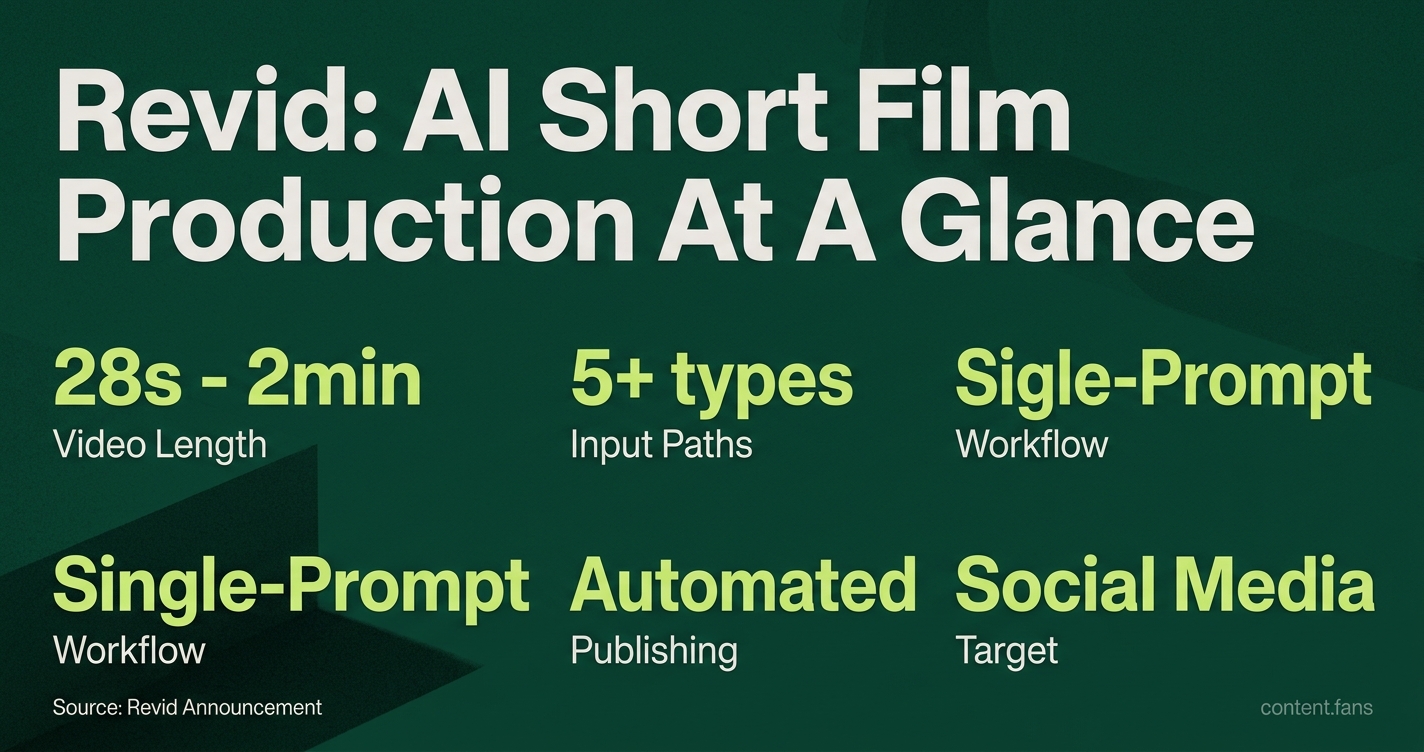
The company's announcement highlights that its platform can take a simple text idea and produce a social-ready short film, typically between 28 seconds and two minutes long, without manual intervention. A Newsfile release confirms these runtimes, positioning the tool squarely in the social video sweet spot. This update is significant because it integrates writing, voice generation, visuals, editing, and publishing into a single, cohesive pipeline, compressing production schedules for creators on tight deadlines.
Inside the Single-Prompt Workflow
Revid's AI platform generates complete short films from a single prompt by automating the entire production pipeline. It handles scriptwriting, visuals, voiceovers, and publishing for videos up to two minutes long, aiming to streamline content creation for social media marketing and independent creators.
The platform supports multiple distinct input paths, from script-to-video to article-to-video. After generation, every project opens in a full timeline editor, allowing users to swap clips, adjust pacing, or refine lines before rendering the final cut. Key accepted inputs include:
- Free-form prompts
- Finished scripts
- URLs or PDFs
- Audio files or music beds
- Product pages with metadata
Behind the scenes, Revid combines scriptwriting models, video generation, multi-language voices (including options from ElevenLabs), and automatic captions. The platform also features "Auto-Mode workers" that can generate and publish a new video daily without human review, a capability detailed in Moku Digital's analysis of the new agentic automation API.
Capabilities, Limitations, and Market Context
Analysts position Revid as an end-to-end solution for short-form narratives, not a long-form film editor. Reviews note the platform is "not designed for multi-minute essays," reinforcing its focus on quick narrative hooks, ads, and social explainers for Shorts, Reels, and TikTok.
In the competitive AI video market, Revid occupies a middle ground. Tools like Runway and OpenAI's Sora excel at generating high-quality single shots, while other platforms are built for coherent, multi-scene shorts. Revid prioritizes assembly speed and direct publishing over the granular storyboard controls found in more complex suites, a tradeoff that favors marketers who value fast turnaround times.
Industry Impact: Gains and Cautions
Industry research indicates that AI film generation can significantly reduce production costs and timelines. This technology may substantially cut production budgets while shortening timelines for many creators. For solo creators, this could dramatically increase output and unlock new markets through rapid AI-powered dubbing.
However, these advancements raise important questions about employment and creative rights. Industry observers warn that widespread AI adoption could displace traditional crew roles if upskilling and regulation do not keep pace. While marketers may embrace the efficiency of automated teams, creative guilds are debating necessary safeguards. Experts agree that Revid does not replace human direction but instead enables a hybrid workflow where AI generates drafts and people provide the final revisions before publication.