
7 Steps Build a Strong Personal Brand for 2026
Serge Bulaev
The 2026 guidance for building a strong personal brand suggests starting with clarity by picking one niche, one audience, and one promise. Experts recommend creating a consistent positioning statement and using your profile as proof of your expertise through visible examples and outcome-based experience. Regular posting, engaging with others before creating your own content, and asking for feedback may help reinforce your brand. Mixing content formats and keeping a steady posting schedule appear to support better engagement. Results might be seen in six months, but experts say the full effect may take one to two years, depending on your niche and content quality.

To build a strong personal brand that people remember, you must start with absolute clarity. Current guidance stresses selecting one niche, one target audience, and one core promise to attach to your name. As a recent LinkedIn personal branding strategy notes, this narrow focus simplifies every subsequent decision, from your headline to your content pillars.
The core strategy is simple: Define a single positioning point, showcase it on a profile optimized like a landing page, and reinforce it weekly with proof-driven content and consistent community engagement.
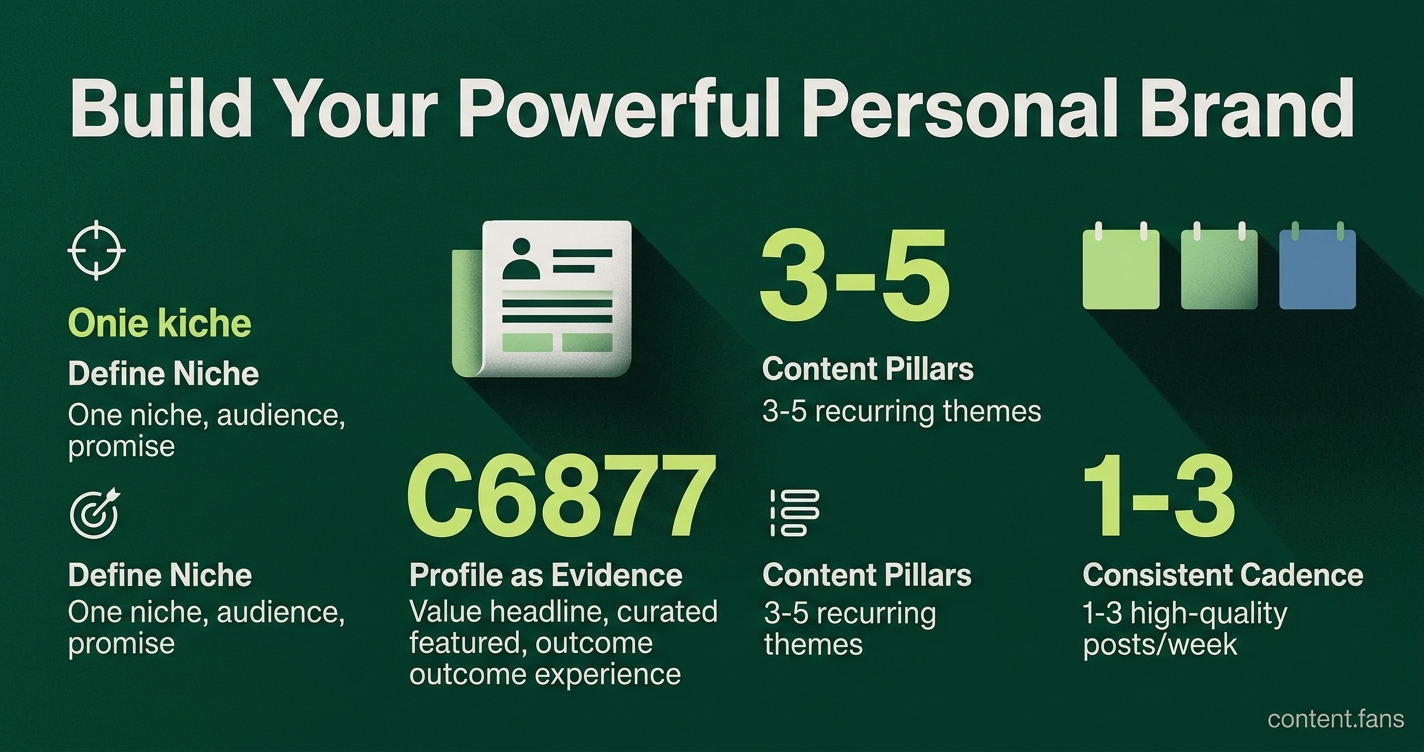
1. Cement the positioning statement
Building a strong personal brand involves defining a specific expertise for a target audience. This is articulated in a positioning statement and proven through an evidence-based professional profile. Consistent content and active engagement reinforce this brand over time, establishing you as a trusted authority in your niche.
Many expert sources identify the first step as crafting a one-sentence positioning statement: "I help X (audience) do Y (achieve a result) by Z (my method)." This powerful sentence becomes the foundation for your headline, banner, and About section. Original guidance supports consistent posting and trust-building content, not a claim that the algorithm rewards stable phrasing.
2. Turn the profile into evidence
Your profile must function as a portfolio of evidence. A leading framework from Forbes recommends three key assets to showcase proof:
- A value-driven headline: Focus on the results you deliver, not your job title.
- A curated Featured section: Display case studies, testimonials, and content with measurable wins.
- Outcome-oriented Experience: Rewrite job descriptions to highlight achievements, not just task lists.
This strategy transforms your profile from a résumé into a high-trust conversion tool that directly answers the question, "Why should I trust you?"
3. Build recognizable content pillars
Define three to five content pillars - recurring themes directly linked to your niche - to guide your content strategy. InfluenceFlow advises this structure to prevent random posting and build long-term recognition. Rotate your posts between formats like how-to guides, behind-the-scenes insights, video explainers, and case studies. According to industry reports, diversifying formats can boost engagement significantly, as it caters to varied audience preferences.
4. Prove through consistent cadence
Consistency is more critical than frequency. Expert playbooks, such as the SUCCESS guide, recommend a sustainable cadence of one to three high-quality posts per week. This rhythm is frequent enough for visibility without sacrificing quality. Experts warn that irregular posting confuses both your audience and platform algorithms, hindering growth.
5. Engage before you broadcast
Prioritize engagement over broadcasting. Newcomers are advised to spend at least two weeks leaving thoughtful comments on relevant posts before publishing their own content. This strategy establishes your presence in niche conversations and provides valuable feedback on which topics resonate with your target audience. The approach is supported by a Frontiers in Psychology study that links active, relationship-focused personal branding with higher perceived employability.
6. Close perception gaps with feedback
Your personal brand is defined by how others perceive you, not by your résumé. As Berkeley Executive Education highlights, it's crucial to actively manage this perception. Solicit brief feedback from peers, mentors, or clients monthly to understand how they describe your value. If their perception differs from your positioning statement, adjust your content to close the gap.
7. 30-day starter roadmap
Follow this accelerated 30-day plan to launch your brand:
- Week 1: Draft your one-sentence positioning statement and update your headline.
- Week 2: Rewrite your About section, add two proof points to your Featured section, and refresh your banner art.
- Week 3: Define your 3-5 content pillars and create an outline for your first six posts.
- Week 4: Publish two posts, comment daily on relevant content, and track which topics generate the most meaningful engagement.
While a LoudScale guide suggests measurable impact can appear within six months of consistent effort, most experts agree that the full compounding benefits of a strong personal brand take 12 to 24 months to materialize. Your timeline will depend on your niche and content quality. Ultimately, the consensus is clear: a memorable professional brand is built on specificity, social proof, and unwavering consistency.
How do I choose the right positioning for my personal brand?
Start with one clear niche, one specific audience, and one outcome you want to be known for. Current guidance consistently shows that trying to be known for everything makes you memorable for nothing. Industry research recommends beginning by answering three questions: Who do you help? What problem do you solve? What do you want to be known for?
Your positioning should emerge from self-awareness about your genuine strengths combined with feedback about how others actually perceive you. A systematic review on personal branding found that the gap between your desired self and perceived identity shrinks dramatically when you actively seek external input. Consider 360-degree feedback from bosses, peers, and direct reports to understand how different groups see you similarly or differently.
Why is consistency more important than posting frequency?
The compounding effect of consistent presence outweighs sporadic bursts of activity. While sources suggest 1-3 posts per week as a sustainable cadence, the real competitive advantage comes from reinforcing the same positioning point repeatedly over 12-24 months. LoudScale's guide emphasizes that measurable business impact typically emerges within this timeframe when messaging stays coherent.
Consistency builds recognition, trust, and differentiation - three elements that directly improve conversion rates and lead quality. Leadership Visibility's analysis notes that AI and search systems now reward people with "consistent themes" and "repeated expertise," making your expertise easier to understand, verify, and recognize across platforms.
What role does my LinkedIn profile play in personal branding?
Your profile functions as a landing page that does the selling before you ever speak with someone. Best practices emphasize optimizing five key elements: headline, banner, About section, Featured section, and experience entries. Each should communicate your value proposition and social proof rather than just listing job titles.
The Featured section deserves particular attention - multiple sources recommend showcasing case studies, measurable wins, testimonials, and concrete examples of your work. This proof over polish approach builds trust faster than generic claims. Your About section should tell a story that connects your positioning to your audience's needs, not simply summarize your resume.
How do content pillars strengthen my personal brand?
Content pillars are 3-5 recurring themes tied to your expertise and audience needs that prevent random posting and strengthen recognition. When followers see the same topics addressed from different angles, they begin to associate your name with specific value. This predictability builds the trust necessary for conversion.
Effective pillars often emerge from your actual work. Practitioner advice recommends documenting lessons from your job, questions you receive offline, and case examples from day-to-day work. Combine these with varied formats - text posts, carousels, short videos, and polls - to reach different audience preferences while maintaining thematic consistency.
How do I know if my personal brand is working?
Track leading indicators rather than vanity metrics. Meaningful signals include inbound inquiries, speaking invitations, partnership requests, and engagement quality from your target audience. Industry reports suggest that personal branding can become a "revenue engine" with measurable impact when activities tie directly to business KPIs.
The most important validation comes from closing the perception gap: regularly compare how you intend to be seen with how others actually experience you. Research in Frontiers in Psychology established that personal branding has a positive and significant indirect effect on career satisfaction via perceived employability - meaning the investment pays off in concrete professional outcomes when sustained over time.