
Executive Thought Leadership Adds $367M in Shareholder Value Within a Week
Serge Bulaev
Recent data suggests that strong CEO thought leadership may quickly add major shareholder value - possibly around $367 million in one week for typical large firms. Studies report that buyers are more open to sales and might pay more when companies share useful insights from executives. However, poor thought leadership could lower a company's reputation with almost half of buyers. Experts recommend regular and relevant content sharing, using employee networks, and focusing on metrics that show real business impact. This approach may help companies influence deals, create new needs, and gain faster returns.

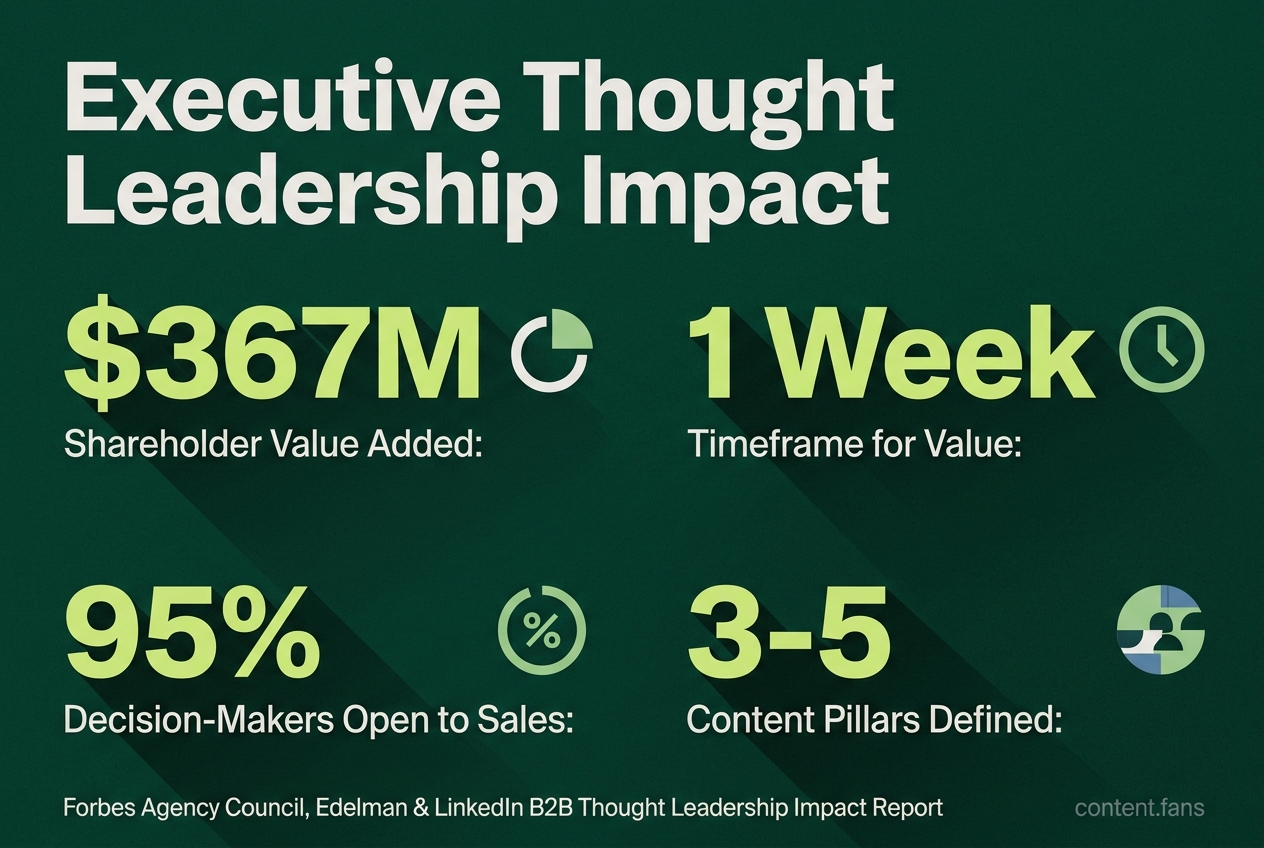
Effective executive thought leadership is no longer just a marketing promise; new data reveals it delivers substantial and rapid ROI. According to a recent analysis, strong CEO-led insights can add an average of $367 million in shareholder value to a typical S&P 500 company in just one week (Forbes Agency Council).
This significant business impact stems from how executive insights influence high-stakes B2B decisions. Buyers actively seek credible expertise before engaging with vendors, and a well-crafted thought leadership strategy can accelerate sales cycles and build lasting client loyalty, as noted by the Forbes Business Council.
How Thought Leadership Translates to Business Value
High-quality executive thought leadership creates value by influencing key decision-makers early in the buying process. It builds trust, makes buyers more receptive to sales outreach, and establishes the authority needed to command premium pricing, directly connecting content strategy to revenue generation and margin protection.
Quantitative data from the 2025 Edelman and LinkedIn B2B Thought Leadership Impact Report confirms this trend. The study found that 95% of previously unidentified decision-makers become more open to sales conversations after engaging with strong thought leadership. Furthermore, a significant portion are willing to pay more for services from companies that provide such substantive insights.
However, the report also highlights a significant risk: many buyers develop a negative perception of a company after consuming low-quality thought leadership. This underscores the critical need for content to be both rigorous and relevant to avoid damaging brand reputation.
A Framework for a Revenue-Generating Program
To connect executive brand building directly to revenue, content and social media teams can follow a proven operational framework:
- Define 3-5 content pillars that address complex, high-risk decisions facing the target audience.
- Publish a weekly LinkedIn insight post, paired with a monthly deeper asset such as a podcast or long-form article.
- Use employee advocacy to expand reach and schedule daily comment-and-reply windows to sustain dialogue.
- Track metrics beyond vanity numbers, including content-assisted pipeline, sales cycle velocity, and branded search growth.
Beyond content creation, distribution is equally vital. To maximize impact, insights should be embedded in key relationships through executive briefings, peer roundtables, and client co-creation sessions. This relationship-focused strategy, rather than a reliance on passive content downloads, is key to unlocking the significant shareholder value gains.
Key Metrics for Measuring Thought Leadership ROI
| Metric | Why it matters |
|---|---|
| Share of voice | Signals topical authority against competitors |
| Pipeline velocity | Indicates whether thought leadership accelerates deals |
| Premium pricing acceptance | Connects insight leadership to margin protection |
| Hidden stakeholder engagement | Captures influence on finance, legal, and procurement reviewers |
A crucial, yet often overlooked, function of thought leadership is its ability to create new demand. Edelman's research highlights that 91% of hidden buyers uncover previously unrecognized needs through high-quality content. This positions executive insights as a powerful tool for shaping the customer's problem-solving journey in complex B2B markets.
The 2025 analysis includes three critical audit questions; one is whether the content offers data-driven insights. Organizations should also evaluate whether content helps stakeholders better navigate risk and whether it is actively used and discussed by client-facing teams. A 'yes' to all three indicates the program is on track to deliver measurable ROI.
How quickly can executive thought leadership impact shareholder value?
Research indicates that effective CEO thought leadership can generate substantial returns rapidly. According to a recent Forbes analysis, effective thought leadership from CEOs can generate an estimated average of $367 million in shareholder value within just a week for a typical S&P 500 company. This demonstrates that executive visibility functions as an immediate value driver rather than merely a long-term branding exercise.
What measurable effects does thought leadership have on B2B purchasing decisions?
Thought leadership significantly influences buying committees beyond simple brand awareness. The 2025 Edelman-LinkedIn B2B Thought Leadership Impact Report reveals that 95% of hidden decision-makers become more receptive to sales and marketing outreach when exposed to strong thought leadership. Additionally, a significant portion of buyers are willing to pay a premium for vendors who demonstrate substantive expertise through quality content, while 91% say such content helps them uncover challenges they had not recognized themselves.
Can poor thought leadership content actually harm business relationships?
Yes, weak execution carries significant reputational risk. Industry research shows that a substantial number of B2B buyers thought less of a company after consuming poor thought leadership content. Low-quality content can diminish trust and sow uncertainty, making it essential for executives to maintain high standards of insight and relevance rather than publishing for volume alone.
Which distribution methods prove most effective for executive thought leadership?
Moving beyond simple publication is critical for maximum impact. Organizations should leverage executive briefings, peer roundtables, advisory boards, and client co-creation opportunities to deepen engagement. The most effective approach involves client-facing teams actively discussing insights in real business conversations rather than relying solely on passive content consumption.
How should content teams structure an executive brand strategy?
Successful executive brand building requires strategic focus and consistent execution. Content teams should define 3-5 core content pillars aligned to specific business problems, maintain a sustainable cadence such as weekly LinkedIn posts supplemented by deeper monthly assets, and coordinate with employee advocacy programs to expand reach. Measurement should focus on business impact metrics like pipeline velocity, share of voice, and inbound opportunities rather than vanity engagement numbers.