
CPG Firms Shift 39% of Digital Ad Budgets to Retail Media by 2026
Serge Bulaev
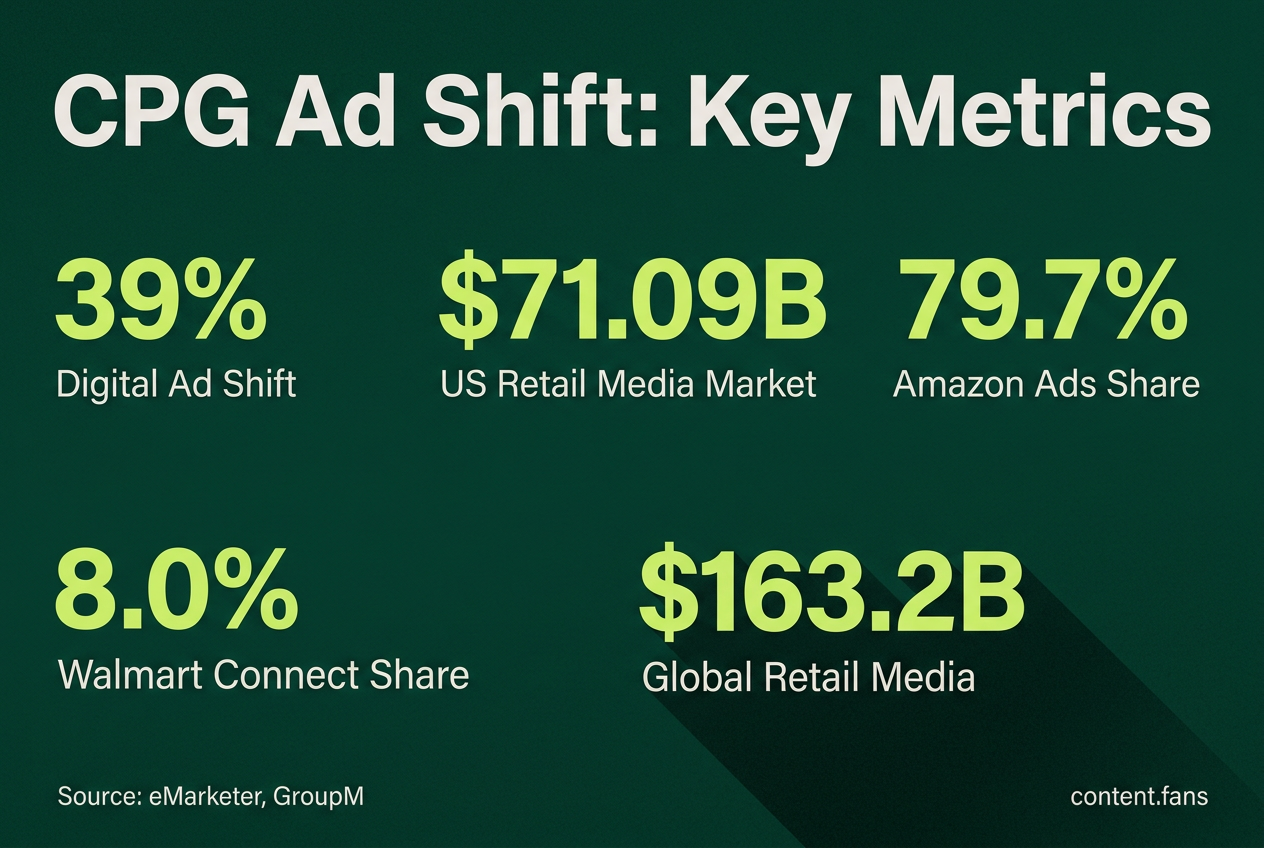
US consumer packaged goods (CPG) companies may shift about 39% of their digital ad budgets to retail media networks by 2026, rising from around 5% in 2020, according to forecasts. This move appears to be driven by the ability to directly connect ads to store purchases. The US retail media market might reach $71 billion in 2026, with Amazon Ads taking most of the share. Some studies suggest inventory-aware ads may improve sales and ad efficiency. However, challenges seem to remain with managing multiple retail media platforms and proving that retail media truly increases sales.
In a landmark shift for digital advertising, US CPG firms are projected to move a significant portion of their digital ad budgets to retail media by 2026, according to industry reports. This migration of spend highlights a strategic pivot toward closed-loop ecosystems where every ad impression can be directly attributed to a final sale at checkout.
This concentration of investment is fundamentally altering both media planning and daily operations. CPG marketing leaders now operate in a highly dynamic environment, using weekly, store-level sales data to make real-time decisions on campaign funding, creative deployment, and geographic targeting.
Where the Money Goes
This budget reallocation is driven by the unparalleled ability of retail media networks to connect advertising exposure directly to consumer purchases. Marketers can now track an ad's impact down to an individual product scanned at the register, providing clear, closed-loop attribution that has long been elusive.
The US retail media market is forecast to reach approximately $71.09 billion by 2026, dominated by Amazon Ads with 79.7% US retail media market share in 2025 per eMarketer, followed by Walmart Connect at 8.0% US retail media market share in 2025 per eMarketer. Global retail media spending is projected to reach $163.2 billion by 2027 per GroupM. CPG is a major contributing sector, expected to account for a significant portion of all retail media revenue.
While marketers point to this closed-loop reporting to justify higher CPMs, the growing number of competing networks creates challenges, including audience duplication and increased operational overhead.
Inventory Data Turns Ads into Shelf Signs
A key driver of performance is the integration of real-time inventory data into ad creative. By connecting ad platforms to live stock levels, advertisers can serve dynamic messages that reflect product availability. For example, industry reports show that inventory-aware banners for beverage brands can boost click-through rates and in-store visits. This technology allows for automated campaign adjustments, such as suppressing ads in areas where a product is out-of-stock and reallocating budget to locations with excess inventory.
Pilot programs have demonstrated significant performance lifts from this approach, according to industry reports:
- Higher return on ad spend (ROAS) compared to static creative
- Improvement in overall marketing efficiency
- Increased in-store sales velocity in matched-market tests
These results stem from a simple principle: reducing consumer friction by ensuring that advertised products are actually available for purchase at the moment of interest.
Fragmentation Headaches Grow
Despite the benefits, the rapid expansion of retail media presents significant operational challenges. Large CPG teams often find themselves managing multiple separate buying portals, each with its own interface and reporting system. This fragmentation leads to several key issues:
- Data Silos: Many grocery retailers do not integrate retail media data with broader brand campaigns, which prevents unified audience and frequency management.
- Talent Gaps: A significant number of marketing practitioners report a shortage of talent skilled in crucial areas like incrementality testing.
- The Incrementality Question: Finance departments are increasingly demanding proof that retail media spending drives new sales, rather than simply attributing sales that would have happened anyway. While holdout tests and geo-experiments provide this proof, they are complex and time-consuming to execute across multiple retailer platforms.
Tactical Playbook for Future Budgets
To navigate this complex landscape successfully, leading brands are adopting a disciplined operational playbook:
- Validate Incrementality: Implement rigorous test-and-control methodologies to prove the true incremental value of retail media spend.
- Diversify Investments: Allocate budget across a mix of national, regional, and in-store networks to optimize cost efficiencies and maximize reach.
- Integrate Funnels: Use newly available APIs to pair bottom-funnel retail media with mid-funnel channels like video and CTV, extending retailer audiences to off-site environments.
Furthermore, industry experts caution against an over-reliance on bottom-funnel tactics like sponsored search, which can deliver short-term results at the expense of long-term brand equity. The central challenge for future planning is to strike a strategic balance between conversion-focused media and brand-building activities, creating a sustainable path to growth for CPG and retail partners alike.