
Generative AI Integrates With IIoT Security for Predictive Maintenance
Serge Bulaev
Factories are starting to use generative AI and new security methods to manage older industrial devices that cannot be updated. Experts suggest that isolating these old devices with special certificates and network zones may help stop security problems. Meanwhile, generative AI is being used to look at data from these devices and might predict failures weeks in advance. Some reports say these AI systems could make root cause analysis much faster and reduce false alarms. Industry guidelines now recommend combining tight security controls with AI so that factories stay safe while using old equipment.

As Generative AI integrates with IIoT security for predictive maintenance, strategies for managing end-of-life devices are shifting from patching to containment. With unsupported sensors and controllers common on factory floors, maintenance leaders now pursue a dual agenda: isolating legacy assets while leveraging new AI services to analyze their data for early fault diagnosis.
Why isolation outranks patching in 2026
For end-of-life IIoT devices, traditional patching is often impossible as manufacturers no longer provide firmware updates. Therefore, the industry is moving towards containment strategies, such as network isolation and cryptographic identity, to manage security risks without requiring software agents or updates on the devices themselves.
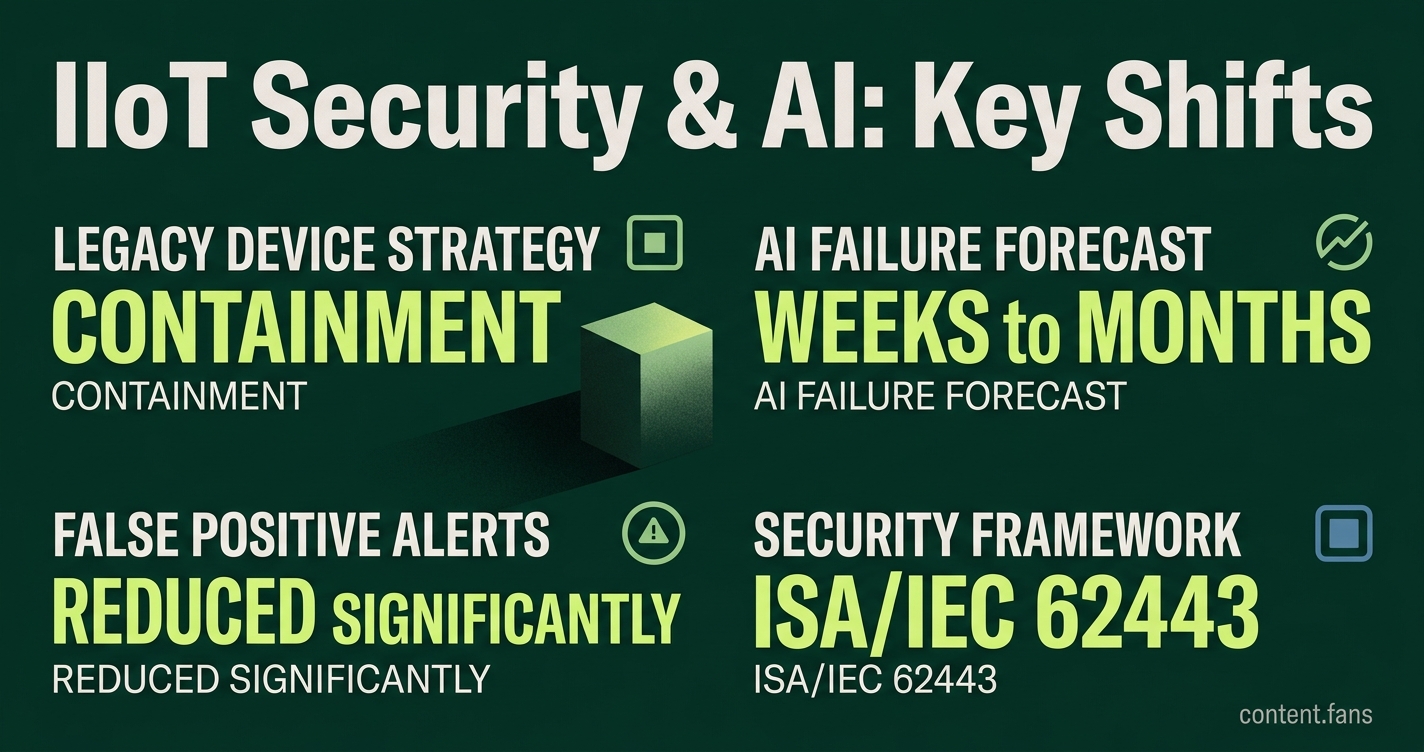
Industry experts identify unmanaged IoT endpoints as a significant security concern, since they no longer receive firmware updates and cannot run security agents. A common approach involves agentless discovery tools that fingerprint device traffic and bind each to a unique cryptographic certificate, allowing network access to be instantly revoked if necessary.
This isolation is enhanced by placing certificates in dedicated VLANs to limit lateral network movement. Following recommendations from firms like Vectra AI, organizations restrict each end-of-life device to a minimal list of approved IP addresses and ports. This practice has proven effective, with many factories successfully segmenting legacy PLCs and achieving significant reductions in attempted rogue traffic.
Generative AI pulls insight from noisy legacy data
While security teams contain obsolete hardware, reliability engineers are leveraging its telemetry. Data streams are fed into Generative AI models that transform raw anomalies into prescriptive work orders. Advanced models like transformers and GANs can process complex vibration data to forecast equipment failures weeks to months in advance with high accuracy rates.
For instance, IBM's Maximo Application Suite features language model capabilities. These tools can process technician descriptions and help generate structured maintenance reports, significantly reducing root cause analysis time.
Ensuring the quality of these AI insights is crucial. To maintain data integrity, edge deployments utilize lightweight variational autoencoders that generate synthetic sensor readings if a physical device temporarily disconnects. This approach reportedly has several benefits:
- Reduces false positive alerts significantly.
- Maintains balanced training datasets, even with scarce historical failure data.
- Operates efficiently within the power constraints of standard industrial gateways.
ISA framework ties both threads together
The International Society of Automation (ISA) provides a framework that connects these security and AI initiatives. ISA updated ISA/IEC 62443 in January 2025 to address organization-wide security. Additionally, ISA has published position papers offering forward-looking perspectives on opportunities, risks and standards-driven pathways for safely implementing AI in industrial environments, including adherence to cybersecurity standards.
Industry guidance suggests linking automation standards to distinct AI tiers for different applications such as predictive analytics, production optimization, and supply chain forecasting.
The framework also recommends pairing zero-trust segmentation with automated certificate rotation. This allows an aging sensor to transmit data to a designated AI service while preventing it from contacting any other network resource. This convergence of standards underscores a key principle: the reliability gains from Generative AI are only sustainable when robust, identity-based controls mitigate the security risks of legacy hardware.
Continuous monitoring completes this integrated strategy. Network Detection and Response (NDR) platforms inspect traffic from end-of-life devices, flagging deviations for review. When a security anomaly corresponds with an alert in the AI maintenance dashboard, teams can cross-reference security posture with mechanical health, significantly reducing investigation time and preventing potential downtime.