
Suade claims "AI-native" RegTech edge amid rising competition
Serge Bulaev
Suade claims to be the only AI-native platform for regulatory reporting, saying its cloud-based design helps banks automate complex data tasks. The company appears to have gained attention through awards and software listings, but there are few independent user reviews. Other AI compliance tools, like Compliance.ai and ValidMind, also use AI for automation, suggesting growing competition in this area. Research suggests agentic AI software like Suade's may cut manual work and improve risk detection, but experts warn about possible accountability challenges. There is some recognition for Suade's platform, but public usage data and independent evaluations seem limited so far.

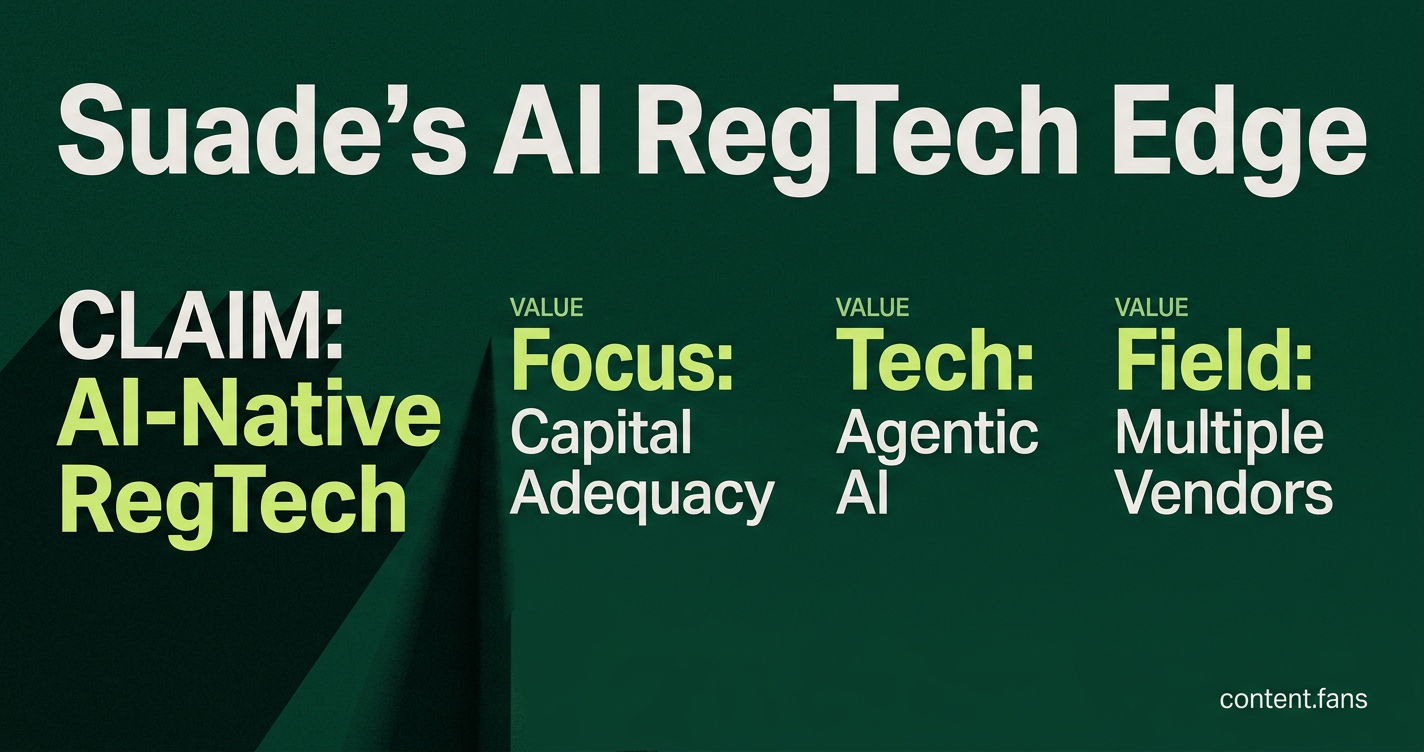
London-based vendor Suade is positioning itself at the forefront of AI-native RegTech, claiming its platform is the only one of its kind for regulatory reporting. According to the company, its API-first and cloud-native design allows global banks to automate complex data tasks for Basel III, PRA, and EBA compliance.
While the company has gained visibility through industry awards and software comparison listings, its market presence is not yet supported by independent user reviews. This suggests growing interest in its technology but reveals a lack of publicly available data on adoption and performance.
Awards and Listings Serve as Primary Evidence
According to industry reports, Suade has received recognition for its platform's transparency and use of the open-source FIRE data standard. Additionally, software comparison sites like Slashdot and SourceForge list the Suade Regulatory Design System (SRDS) against competitors such as Capnovum and MAP FinTech, highlighting its use of ML and NLP for real-time error checking and unified data modeling (Capnovum vs. SRDS). However, these sources lack independent client testimonials or ratings, with most available feedback originating from vendor statements and product listings.
Suade claims its AI-native RegTech platform is unique because its architecture was built on AI and APIs from its inception, not retrofitted. The system uses agentic AI for end-to-end automation of reporting tasks, from data ingestion and validation to final submission across different regulatory templates.
The Competitive Landscape for AI in Compliance
Although Suade asserts its unique position, the market includes several other AI-driven platforms for automating regulatory workflows. For instance, industry analyses identify competitors like Compliance.ai, SAS, and S&P Global for their AI-powered monitoring and analytics. Other specialized tools include ValidMind, which automates model validation reports, and various platforms that offer automated evidence collection for compliance certifications.
A quick comparison shows:
- Compliance.ai - alerts on regulatory change and configurable workflows.
- ValidMind - model inventory plus autogenerated validation documentation.
- Various platforms - continuous control monitoring across multiple integrations.
This points to a competitive field where multiple vendors claim AI-native capabilities, though Suade maintains a specific focus on capital adequacy reporting.
Agentic AI: Potential Gains and Governance Risks
Agentic AI is generally defined as AI systems that plan, reason, and act autonomously toward goals across workflows. According to industry reports, this technology is projected to significantly reduce manual work and improve risk detection. Suade's marketing for its SRDS aligns with these benefits, promising to orchestrate the entire reporting process without manual intervention.
However, this level of autonomy introduces critical challenges in auditability and accountability. FINRA warns of GenAI risks like unauthorized autonomous actions and data misuse. Suade aims to address these risks through features like transparent data lineage and its adherence to the open FIRE standard, although independent verification of these controls is not yet widely available.
Currently, Suade stands as a platform recognized for its innovative, API-driven architecture in a growing market of AI compliance solutions. While its recognition through awards is notable, future validation will depend on public usage data and independent evaluations to confirm the real-world efficiency gains of its agentic AI model.
What makes Suade describe itself as the only "AI-native" RegTech platform?
Suade says it has been AI-native and API-first since its founding, long before the current wave of generative and agentic AI. The company couples this heritage with agentic AI - systems that can plan, act and coordinate tasks without constant human prompting - to automate the full regulatory reporting chain from data ingestion to submission-ready files. According to industry reports, Suade is among the RegTech platforms that was conceived around machine-learning pipelines rather than retro-fitted with AI modules.
How does Suade's approach differ from better-known names such as SAS, S&P Global or Compliance.ai?
Competitors typically apply AI to analytics, monitoring or change-tracking, but many still rely on rule-based workflows for the final report package. Suade, by contrast, targets end-to-end automation: data mapping, validation, calculation, narrative generation and portal submission are all handled by agents embedded in its ** Regulatory Design System (SRDS)**. Industry reports credit SRDS with real-time error checks and a unified data model that can be re-used across Basel III, EBA and PRA templates - a depth of automation that general-purpose analytics platforms rarely match.
Does any independent evidence back Suade's performance claims?
Independent user reviews on common software sites have not yet appeared, but third-party coverage offers some validation:
- According to industry reports, Suade has received recognition for excellence in regulatory reporting automation, citing lower risk, cost and fragility.
- Software comparison portals indicate that SRDS ranks favorably among rivals for "full-lifecycle automation" and "multi-jurisdiction re-use".
- While case studies don't quote exact client names, Suade's own reports list additions such as stress-testing analytics and Basel III capital modules without push-back from auditors.
What efficiency gains can banks expect from agentic AI in regulatory reporting?
According to industry reports, cross-industry studies suggest significant potential benefits:
- Substantial reduction in manual workload across AML, KYC and reporting tasks.
- Significantly faster cycle times for transaction-level reporting processes.
- Notable improvement in risk-detection accuracy when AI agents screen data before it reaches the regulator.
Suade's architecture is built to capture similar gains by letting agents prepare, check and submit returns without hand-offs to spreadsheet teams.
What governance issues arise when AI agents control compliance output?
Autonomy brings new questions:
- Audit trails must show why an agent changed a number or linked an exposure to a lookup table.
- Accountability remains with senior managers, so Suade keeps every agent decision inside a controlled, versioned environment that maps to the open-source FIRE data standard.
- FINRA warns of GenAI risks like unauthorized autonomous actions and data misuse. Platforms such as Suade try to pre-empt this by embedding governance inside the API layer, ensuring only validated agents can alter reports.
In short, the competitive edge Suade claims rests on its early focus on AI-native design, depth of reporting automation, and an architecture that tries to balance autonomy with auditability - a balance the wider market is still racing to achieve.