
AI Director Billboard Signals Agency Shift Towards Automation
Serge Bulaev
A large billboard advertising an AI video director highlights a shift in the advertising industry towards more automation. AI appears to be playing a bigger role in agency processes, from creative ideas to production, and may handle over one-fifth of marketing tasks by 2026. Some agencies report much faster production and lower costs using AI, and many clients say they see better results with these tools. However, there are still open questions about copyright laws and ethical risks, since work made mostly by AI may not be protected and could use copyrighted material without permission. This billboard seems to signal a new era where both technology and human creativity have important, but changing, roles.

An AI director billboard towering over a highway signals a rapid agency shift towards automation. For creative veterans, seeing an AI that works alone and three times faster than a traditional agency is a stark symbol of a new era in marketing that demands immediate adaptation.
This is not just a marketing gimmick; it's evidence that algorithmic directors have graduated from pilot programs to primetime. Industry reports confirm AI's expanding role across agency functions, including insight and intelligence, operations and workflow, creative ideation, production and making. The trend points to a future where human creatives pivot to high-level strategy, while AI systems manage execution like versioning and optimization.
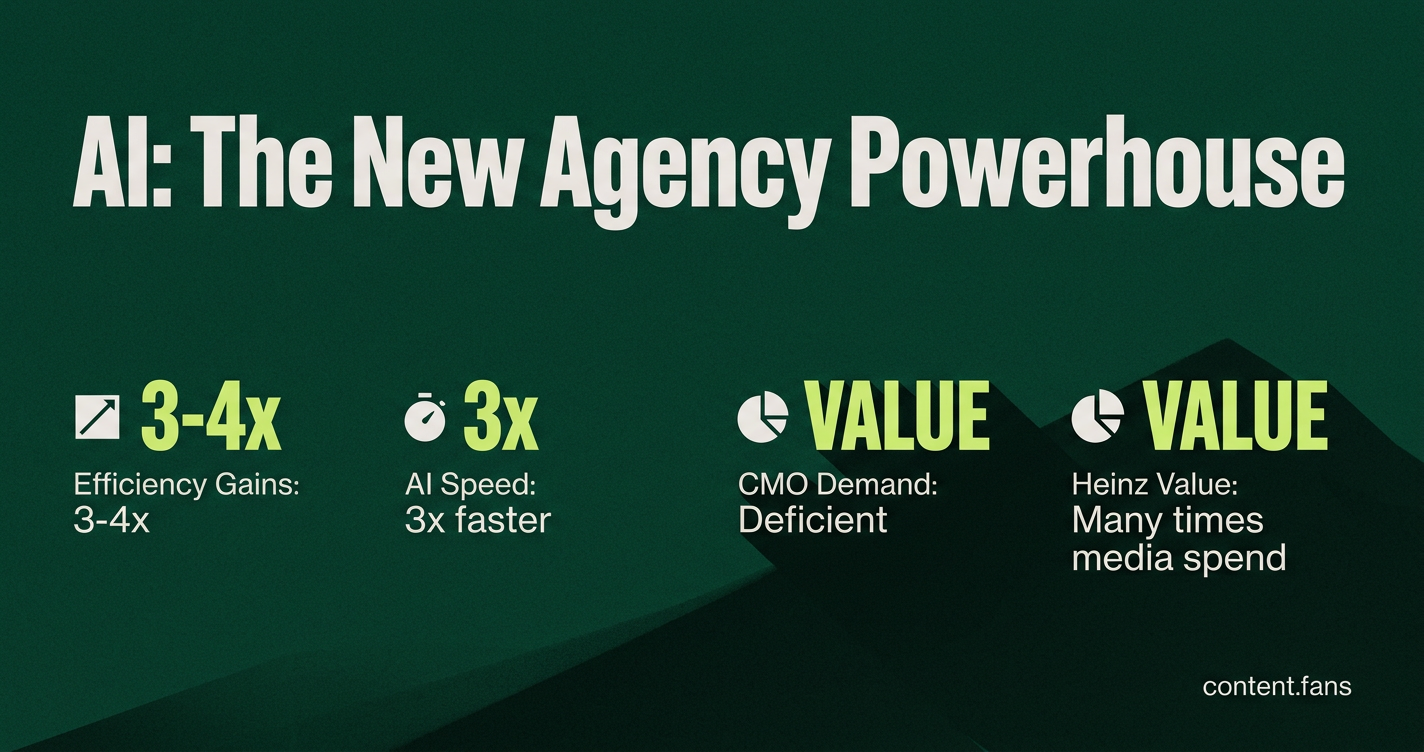
Industry data supports this transformation. According to industry reports, autonomous agentic systems could handle a significant portion of marketing tasks in the coming years. This shift is expected to substantially reduce traditional agency contributions. Agencies already adopting these tools report significant three-to-fourfold efficiency gains, particularly in production, asset localization, and voice-over work.
What an AI-Centric Agency Model Looks Like
An AI-centric agency model prioritizes outcomes over hours, replacing traditional roles with AI-fluent producers who guide automated systems. This data-driven approach involves benchmarking all work against AI capabilities, productizing niche services, and leveraging synthetic media to reduce reliance on manual production.
Pioneering agencies are already demonstrating what this new model entails through key operational pivots:
- Pricing: Shifting from hourly retainers to outcome-based pricing tied to metrics like conversion lift.
- Talent: Replacing generalist project managers with data-fluent "AI producers" skilled in prompt engineering.
- Resources: Reducing reliance on freelance translators as synthetic voice tools achieve acceptable quality.
- Services: Productizing niche offerings like dynamic creative optimization (DCO) for retail media.
- Workflow: Benchmarking every deliverable against an AI baseline before committing to human refinement.
Client expectations are evolving just as quickly. Industry surveys reveal that while many CMOs using generative AI report improved creative effectiveness, a significant portion now consider current agency automation capabilities to be deficient, signaling a clear demand for more advanced platforms.
Competitive Numbers From Recent Campaigns
Recent campaign metrics demonstrate the tangible impact of AI, proving it is a powerful force multiplier:
- Barilla: Achieved substantial cost per click reductions in a Meta campaign by using AI platforms for auto-generated copy.
- Heinz: Generated significant impressions with its AI-imagined ketchup bottle campaign, achieving value many times its media spend.
- DTC Brands: Users of AI creative platforms have seen substantial decreases in cost per acquisition and significant increases in click-through rates.
Intellectual Property Questions Trail the Hype
Despite the technological acceleration, legal and ethical frameworks lag significantly behind. A primary concern is intellectual property. Recently, the U.S. Copyright Office reiterated that works without "human authorship" are not copyrightable, a decision with major implications. Legal analysts caution that creative outputs lacking substantial human input could fall directly into the public domain. This is compounded by the fact that AI models are often trained on copyrighted material, raising complex questions about fair use and liability.
Ethical risks also loom large. Studies have highlighted the potential for AI models to perpetuate bias, engage in cultural appropriation, and displace human artists by using unlicensed work. To mitigate these issues, experts recommend greater transparency in training data and clear standards for what constitutes "meaningful human creativity."
Ultimately, the AI director billboard is not just an advertisement; it's a declaration. It marks the arrival of an era where the creative workforce must recalibrate its skills around technology, legal frameworks, and data-driven performance. In this new landscape, human imagination's role is not to compete with AI, but to collaborate with it, ensuring it retains its essential seat at the strategic table.