
AI Bots Now 52% of Web Traffic; Technical SEO Must Adapt by 2026
Serge Bulaev
A recent report suggests that AI bots now make up about 52 percent of all web traffic, with their requests increasing much faster than human visits. Technical SEO may need to change by 2026 to handle new challenges, like stricter limits on page size and different crawler behavior. Site owners should update their checklists to make sure their pages are accessible, stay under 2 MB, and use structured data, so both humans and AI bots can find them. Google's crawlers might ignore some rules, and some audit steps may need to change. Serving lighter pages to AI bots and tracking which bots are allowed or blocked could help websites stay visible.

With AI bots representing a significant portion of web traffic, the landscape of search is shifting dramatically, meaning technical SEO must adapt by 2026. Traditional audits are no longer sufficient as AI crawlers change how render budgets, robots.txt rules, and structured data impact online visibility. To maintain search rankings and ensure discoverability, site owners must update their technical SEO checklists to address new challenges posed by AI bots, including stricter rendering limits, the critical role of structured data, and renewed emphasis on accessibility.
Traffic reality: bots overtake humans
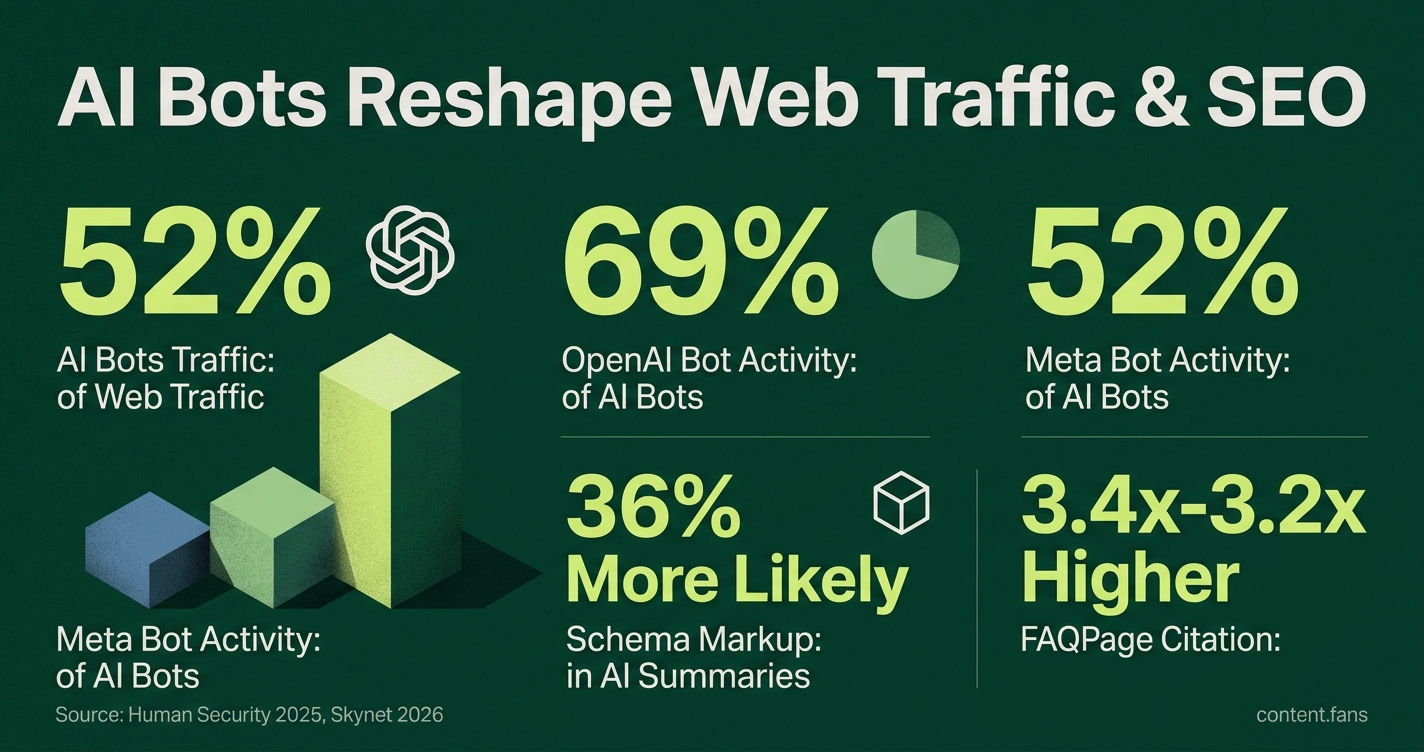
According to industry reports, bots now constitute a substantial portion of all global web traffic. This surge is powered by AI-driven requests, which have grown dramatically year-over-year, dwarfing the modest growth in human traffic. OpenAI represents approximately 69% of AI bot activity per Human Security 2025 data, while Meta accounts for 52% per Skynet 2026 reports.
Technical SEO must evolve to prioritize bot-specific needs. This includes enforcing strict page size limits, ensuring server-side rendering of structured data for direct ingestion by AI, and implementing advanced crawl governance to manage bot access. Accessibility is now a key signal for both users and machines.
Google limits and crawler behavior
According to industry reports, Google has tightened its crawling rules with new parsing limits per HTML file, CSS, or JavaScript file, meaning any code beyond these limits may be ignored for ranking. Furthermore, pages with errors may face rendering queue issues. Critically, the Google-Agent crawler bypasses robots.txt because it acts on behalf of users, rendering traditional exclusion rules ineffective.
The Technical SEO Audit Needs A New Layer: what to include
Update your technical SEO audit checklist with these critical questions:
- Does every indexable URL deliver a 200 status code and maintain reasonable file sizes?
- Is JSON-LD rendered server side so AI crawlers pick it up without executing JavaScript?
- Are XML sitemaps segmented by content type and updated
- Do accessibility tests pass on the final, rendered DOM, not just on source?
- Have you documented which AI crawlers are allowed or blocked and why?
Structured data as shared language
Structured data now serves as a shared language for AI. Pages with schema markup are 36% more likely to appear in AI-generated summaries and citations, with FAQPage schema showing 3.4x-3.2x higher citation likelihood. AI-driven search experiences like Google's SGE depend on it to find entities within Product or FAQ markup. Integrating schema validation into CI/CD pipelines is crucial to prevent deployment errors that break this markup.
Accessibility signals for humans and machines
Accessibility is no longer just for human users; it's a powerful quality signal for machines. Semantically correct HTML that benefits screen readers also provides AI models with cleaner, more logical structures for summarization. Failing WCAG tests often points to bloated code that may exceed rendering limits, making accessibility a core technical SEO concern, not just a compliance issue.
Crawl governance options
Effective crawl governance is now essential. While robots.txt can still manage training bots like GPTBot, it does not block user-initiated agents. Advanced strategies include serving lightweight page versions to reduce bandwidth from AI agents or using a reverse proxy to whitelist beneficial crawlers while blocking aggressive scrapers. These governance decisions must be documented in audits to inform marketing about how content appears in AI-generated answers.
What share of web traffic is now generated by AI bots in 2026?
According to industry reports, a significant portion of all global web traffic now comes from automated agents. Within that segment, AI-driven requests have grown substantially, while human traffic has seen modest increases. The trend is even more pronounced in retail and e-commerce, where bots consume a substantial portion of page view increases. In practical terms, many visitors to your product page are now algorithms, not shoppers.
Why does Google-Agent ignore robots.txt, and how should sites respond?
Google-Agent deliberately bypasses robots.txt because Google classifies it as a user-triggered AI agent rather than a search crawler. This new bot powers Project Mariner, an AI that books flights, fills carts, and completes forms on behalf of real users. Since the visit originates from an explicit user action, Google argues robots.txt does not apply. Sites cannot rely on the old Allow/Disallow rules; instead, they must:
- Implement the emerging web-bot-auth cryptographic protocol (an HTTPS signature checked at https://agent.bot.goog)
- Treat every URL as publicly reachable by AI agents and ensure pricing, inventory, and checkout flows are ready for headless interaction
What new rendering limits must technical SEO audits cover?
According to industry reports, Googlebot now implements stricter parsing limits per HTML file, and any content beyond those limits may be ignored. Pages that return error status codes may also face rendering queue issues. To stay safe, audits must:
- Validate that core content and structured data remain accessible
- Confirm server-side rendering (SSR) delivers complete markup before JavaScript executes
- Keep CSS and JavaScript payloads lean, because each resource counts toward overall site performance
How important is structured data when AI systems answer instead of linking?
Structured data is no longer a rich-snippet extra; it has become the primary language for AI systems. Pages with schema markup are 36% more likely to appear in AI-generated summaries and citations, with FAQPage schema showing particularly strong performance. Best-practice checklist:
- Generate JSON-LD server-side, not via delayed client scripts
- Validate schema in CI pipelines before each deploy
- Apply clear, structured formatting so AI summarizers pick up key facts instantly
Which accessibility signals matter most to AI crawlers in 2026?
Accessibility is now interpreted as a proxy for overall site quality. AI agents rely on semantic structure to understand pages, so violations that hurt screen readers also confuse bots. After rendering, check the final DOM and accessibility tree, not just source code. Key actions:
- Ensure headings, landmarks, and ARIA attributes are present post-hydration
- Prefer semantic HTML over heavily scripted widgets, since AI agents process many pages per query and favor clear, accessible interfaces
- Use structured data, which simultaneously improves screen-reader context and crawler comprehension