
Study: AI-native firms boost revenue 1.9X, cut capital needs 39.5%
Serge Bulaev
A study by Harvard and INSEAD suggests that AI-native firms may perform much better in revenue, capital efficiency, and customer growth compared to others. Startups that reorganized their work around AI reported 1.9 times the revenue and used 39.5 percent less outside capital than those that did not. These firms also completed more tasks and were more likely to gain paying customers. The results come from three months of tracking 515 startups, but the authors note that long-term effects are still unknown.

A landmark study finds AI-native firms generate 1.9x more revenue and require 39.5% less capital by reorganizing operations around AI. Research from Harvard and INSEAD tracked 515 startups, demonstrating a direct link between strategic AI integration and superior firm-level performance in revenue, capital efficiency, and customer traction.
How the experiment worked
In a randomized controlled trial, researchers divided a cohort of 515 startups. The treatment group received guidance and case studies on mapping AI into product development and strategy workflows. The control group received only standard technical resources. The complete methodology is detailed in the INSEAD working paper "Mapping AI into Production".
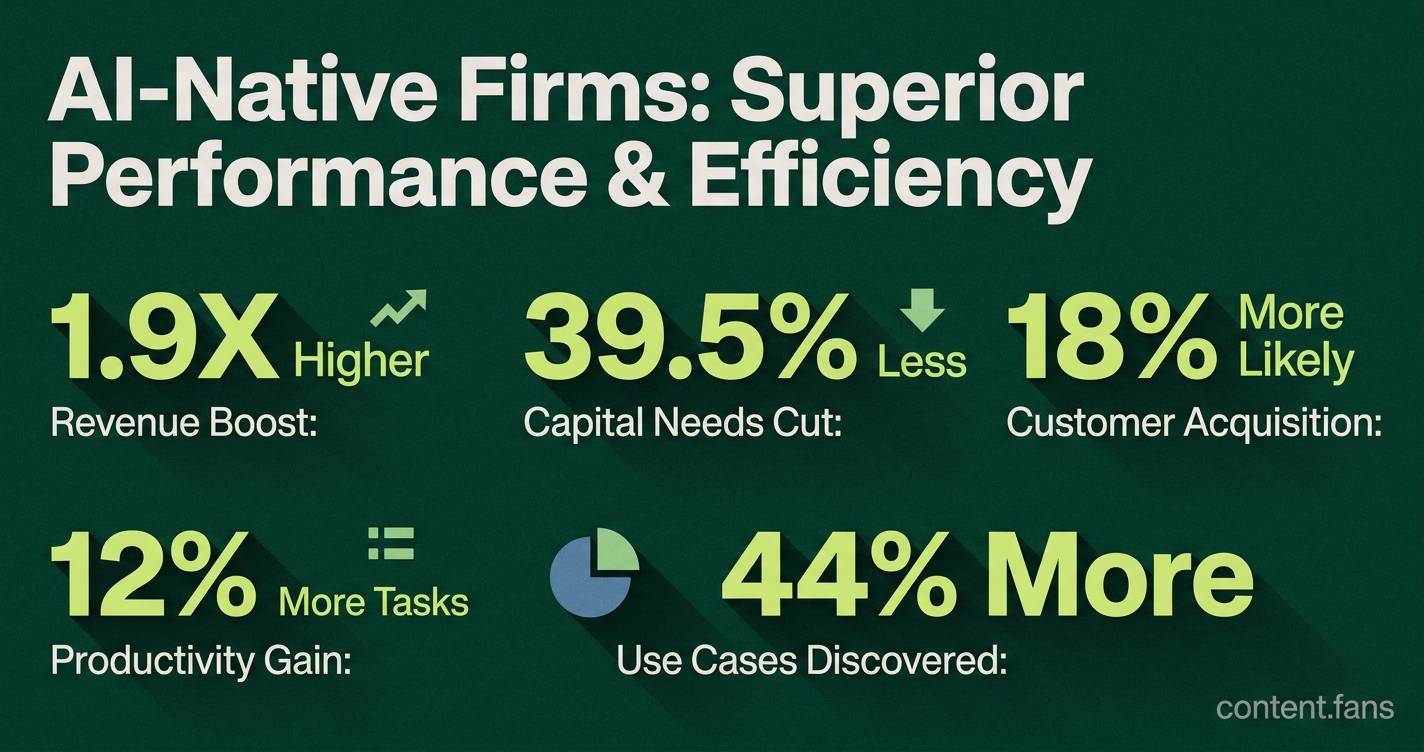
The experiment provided one group of startups with strategic blueprints for integrating AI into their core workflows. By comparing their performance against a control group that only received technical tools, researchers isolated the impact of AI-native reorganization, proving it drives significant gains in revenue and efficiency.
Measured performance gains
Firms guided on AI integration discovered 44% more use cases, particularly in product and strategy. This translated directly to superior performance metrics, as detailed in the study and the HBS AI Institute's post, "Everyone Has AI. Which Firms are Going to Win?":
- Revenue: 1.9 times higher than the control group.
- Customer Acquisition: 18% greater likelihood of securing a paying customer.
- Productivity: 12% more tasks completed.
Capital and labor inputs
Remarkably, this accelerated growth did not require more resources. Treated firms reduced their need for external capital by 39.5% while maintaining the same headcount. The authors posit that solving AI's "mapping problem" enables founders to scale by redeploying existing resources. The benefits were most significant for top performers (90th percentile and above), suggesting AI amplifies success rather than lifting all firms equally.
Accelerator context
These findings align with current trends in leading startup accelerators like Y Combinator and the AWS Generative AI Accelerator. These programs are shifting focus from simply providing AI tools to mentoring founders on fundamentally integrating AI into core business operations, validating the study's emphasis on process reorganization over simple tool adoption.
What the findings cover
The study's results are based on three months of observation, with self-reported financial data audited by the research team. While the authors caution that long-term effects are still unknown, the short-term evidence provides a strong causal link between systematic AI mapping and achieving higher revenue with less capital and no additional labor.
What is the "mapping problem" and why does it matter for AI adoption?
The mapping problem refers to the central challenge of discovering where and how AI creates value within a firm's production process. According to the INSEAD and Harvard Business School study, this is the primary bottleneck in AI adoption - not the cost of technology or lack of technical skills. Startups that received case studies showing how to reorganize production around AI discovered 44% more AI use cases, concentrated in product development and strategy. This suggests that simply having AI tools is insufficient; firms must strategically identify where AI can transform workflows rather than just automate isolated tasks.
How much did AI-native reorganization actually improve startup performance?
The field experiment of 515 high-growth startups produced measurable, significant gains across multiple dimensions. Treated firms that learned to reorganize around AI completed 12% more tasks, were 18% more likely to acquire paying customers, and generated 1.9x higher revenue compared to the control group. These results provide causal evidence that AI improves firm-level performance even with current capabilities - not through replacing workers, but through more efficient production design.
How did capital efficiency improve while labor demand stayed unchanged?
This finding reveals a crucial insight about AI-driven growth: revenue expansion became more capital-efficient. Treated firms achieved nearly double the revenue growth without proportionally scaling inputs. Their demand for external capital investment fell by 39.5% (averaging over $220,000 in savings per firm), while labor demand remained unchanged. The study indicates that AI-native reorganization allows startups to scale faster with less dilution and lower burn rates - a structural shift in how high-growth companies can build.
Were the benefits evenly distributed across all participating firms?
No - the gains were concentrated at the top. Revenue and investment benefits were largest at the 90th percentile and above, suggesting that AI-native reorganization expands the upper range of firm achievement rather than producing modest, uniform improvements. This implies that the biggest winners are those that successfully solve the mapping problem for their specific context, not just those with generic AI access.
What practical steps can startups take to apply these findings?
Based on the accelerator intervention, startups should focus on case study-based learning about AI-driven production reorganization rather than just technical training. Key steps include:
- Broadening the search for AI use cases across all firm functions, not just obvious automation targets
- Prioritizing product development and strategy - where the 44% increase in use cases was concentrated
- Designing workflows around AI capabilities rather than adding AI to existing workflows
Leading startup accelerators are increasingly incorporating this operational transformation approach, offering mentorship on reorganizing production infrastructure and compute pipelines for AI-native efficiency.