
Studies show AI coding boosts speed, but review bottlenecks stall releases
Serge Bulaev
Recent research suggests that while AI helps developers write code faster, it does not always make software releases quicker because reviewing and integrating the extra code may create new delays. Studies show coding tasks may be finished 20 - 45 percent faster with AI, but review times for code appear to increase, and more bugs might be released. Only teams that change their workflows see big improvements, and most of a developer's time is still spent on tasks other than just writing code. Experts recommend updating work habits and tracking new metrics to get the most value from AI tools in software development.

While studies show AI coding boosts speed, review bottlenecks are stalling releases and preventing faster software delivery. Major research from McKinsey, Google, and Microsoft confirms that unless development workflows adapt, the productivity gains from AI assistants are lost in the verification and integration of a higher volume of code. This creates a new critical constraint for engineering teams.
McKinsey, Google DORA, Microsoft Research and BCG on AI productivity: core numbers
While AI coding assistants accelerate individual code writing, overall release cycles often fail to shorten. This occurs because the increased volume of generated code creates a new bottleneck in the manual review and verification process, shifting the constraint from code generation to quality assurance and integration.
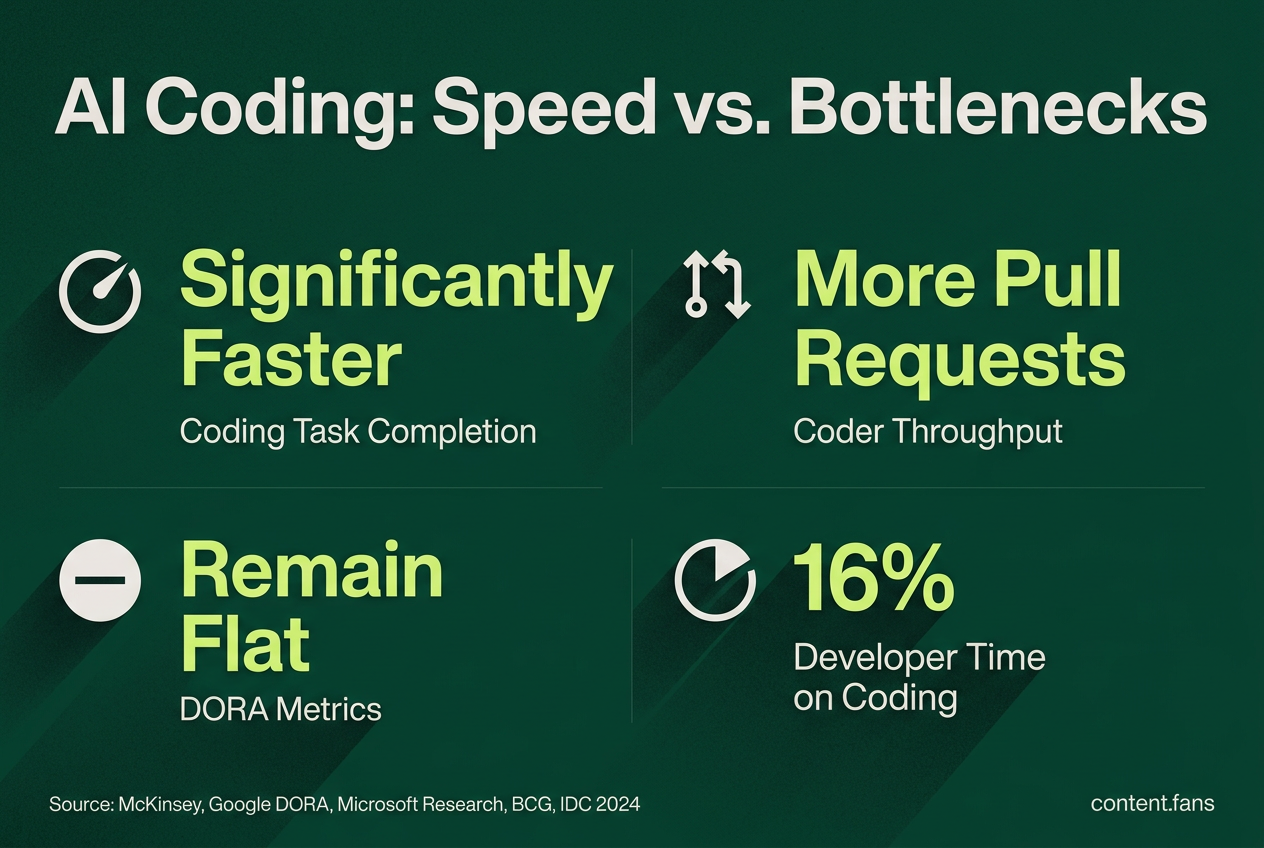
Foundational research highlights this paradox with several key findings:
- Faster Task Completion: Developers complete coding tasks significantly faster using AI assistants, according to industry reports.
- Increased Coder Throughput: Teams using AI complete more pull requests weekly, based on growing industry data.
- Stagnant Delivery Metrics: Many organizations report that key DORA metrics remain flat despite widespread AI adoption.
- Workflow is Key: BCG research confirms that significant velocity gains are only achieved by teams that fundamentally reshape their work processes.
Verification bottleneck shifts the constraint
The increased volume of AI-generated code directly leads to a new bottleneck: code review. Industry reports show pull-request review times climbing substantially after AI adoption, making review the new critical path. This speed-up also introduces quality risks, with many firms reporting increased defect rates and shipping more bugs. Furthermore, legacy metrics often fail to distinguish AI-authored code, obscuring these new risks from engineering leaders.
Where the extra hours go
Industry surveys confirm that developers spend a significant portion of their time on activities other than writing code. The IDC 2024 report allocates 16% of developers' time to application development, with the remainder spread across requirements and test cases, security, CI/CD, performance monitoring, deployment, and infrastructure management. While AI assistants shrink the time spent on coding, the effort required for adjacent tasks like testing and specification expands to fill the gap.
Workflow adjustments that unlock value
To realize the full value of AI, experts recommend three key workflow adjustments:
- Adopt Specification-Driven Development: Define clear requirements before using AI to generate code.
- Automate Early Reviews: Implement AI-powered tools to automatically review pull requests for syntax, style, and basic errors.
- Reinvest Saved Time Wisely: As recommended in the Baytech Consulting 2026 guide, reallocate the time saved from coding to high-value activities like system architecture, user research, and security audits.
Teams implementing these changes can achieve significant reductions in their Lead Time to Value. However, AI's impact varies: low-performing teams see dramatic improvements, while high-performing teams see more modest gains, suggesting AI amplifies existing capabilities rather than providing a universal speed boost.
Emerging measurement practices
To manage AI's impact, leaders must adopt new metrics. Instead of tracking commit counts, focus on business-aligned outcomes like Cycle Time and Cost to Serve Software. It is also critical to implement repository-level analytics that can identify AI-generated code, providing essential visibility into its effects on quality and technical debt.
The evidence is clear: AI is becoming foundational infrastructure in software development. However, realizing its benefits isn't about writing code faster. Success hinges on establishing disciplined verification processes and strategically reallocating engineers' time to higher-value work beyond pure code generation.