
Storytelling Becomes a Financial Advantage, Boosts Sales and Valuations
Serge Bulaev
Recent research suggests storytelling may give companies a financial advantage, as strong narratives appear to influence how people spend, invest, and value businesses. Studies show storytelling can boost sales, customer loyalty, pricing power, and even predict stock performance. Real-world cases, like campaigns by Notion, Sephora, and Lenovo, show story-driven strategies might lead to better commercial results. Experts note that companies seem to be looking for leaders skilled in both finance and storytelling, as clear, authentic narratives could become more important in a crowded and skeptical marketplace.

In today's marketplace, storytelling becomes a financial advantage by directly influencing how people spend, invest, and value businesses. Research shows strong narratives can lift sales, secure customer loyalty, and even justify premium pricing. This shift repositions storytelling from a marketing "soft skill" to a measurable lever for profit and growth, making it an essential leadership competency.
Why Storytelling Is a Key Competitive Edge
A company's narrative shapes economic outcomes beyond what financial statements can show. Persuasive stories build trust, increase brand differentiation, and make products more memorable. This leads to higher sales conversions, stronger customer loyalty, and can even result in significantly different stock valuations for fundamentally similar companies.
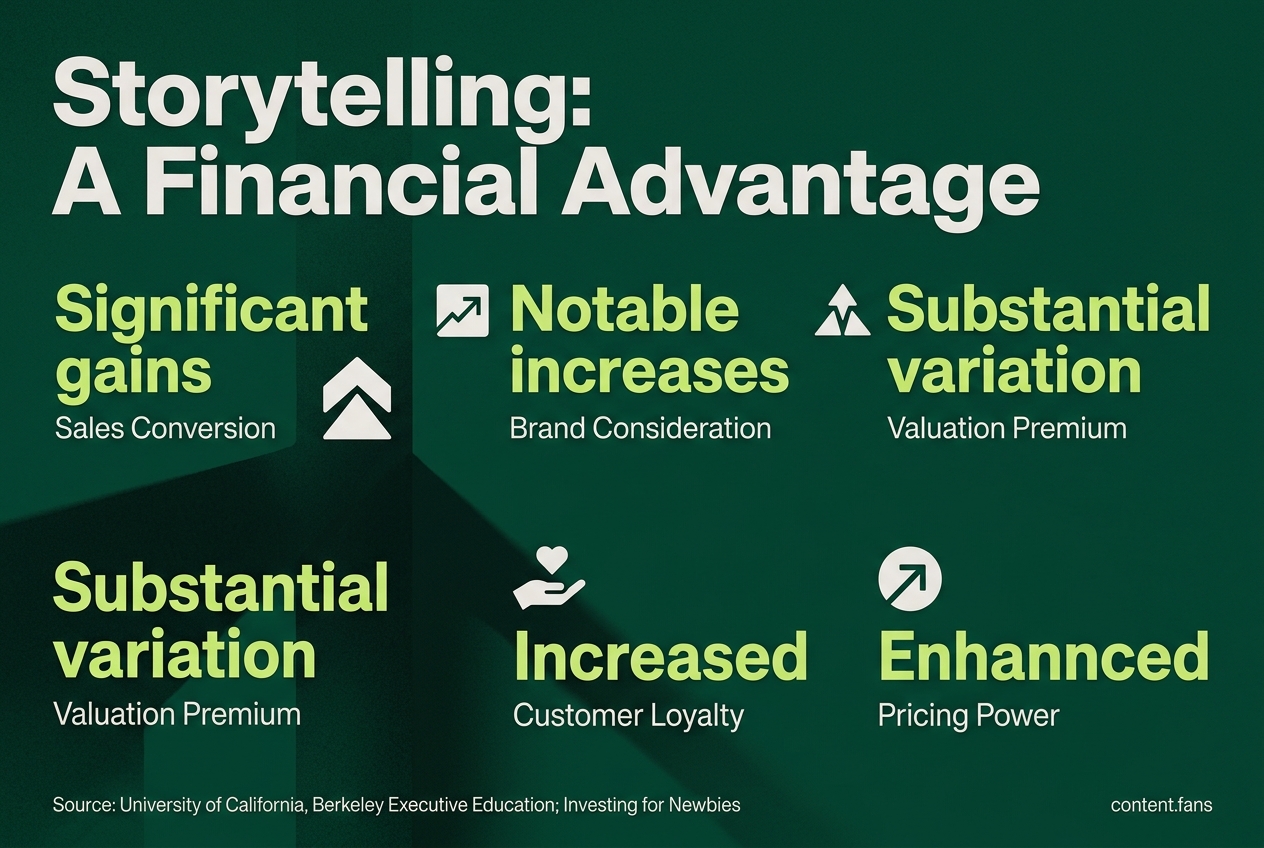
Narrative competence now functions as economic infrastructure, reallocating attention and capital. Storytelling drives value through several documented levers:
- Higher Sales Conversion: Story-led pitches build greater trust and purchase intent, according to a University of California, Berkeley Executive Education analysis.
- Increased Loyalty: Emotionally resonant brand stories encourage repeat business and customer advocacy.
- Enhanced Pricing Power: Companies with clear, compelling narratives can command wider margins as they increase perceived value.
- Valuation Premiums: Research into "narrative capital" reveals that companies with stronger stories can "trade at wildly different valuations," even with similar fundamentals.
- Better Internal Alignment: A coherent origin story improves employee focus, clarity, and productivity.
How Much Revenue Lift Can Storytelling Deliver?
Industry reports show significant impact across multiple channels:
| Channel | Observed Lift | Notes |
|---|---|---|
| Direct conversions | Significant gains | According to industry reports across many brands |
| Brand consideration | Notable increases | Documented in recent campaigns |
| Valuation premium | Substantial variation | Analysis of narrative-capital research |
While exact numbers depend on industry and audience maturity, the directional gains are consistent across the board.
What Recent Campaigns Illustrate Storytelling's Economic Power?
- Sephora (2026): The Faces of Music series generated substantial viewership on Hulu and boosted brand consideration among Gen Z, according to a Forbes report.
- Salesforce (2025): Celebrity-led Super Bowl ads drove significant annual investment in dedicated narrative talent, reports Column Five.
- Lenovo x Intel (2026): The Creator Odyssey mini-series had 17 million views, over 800,000 engagements, and a 10% engagement rate as of January 14, with engagement rates that outperformed platform averages, also covered by Forbes.
These successful campaigns share two core principles: the story positions the audience as the hero, and the narrative operates as an always-on system rather than a one-off advertisement.
Which Storytelling Skills Will Leaders Need Going Forward?
Current executive hiring patterns and board-level discussions point to three essential skills:
- Narrative Design: The ability to synthesize data, AI outputs, and fragmented customer touchpoints into a single, coherent strategic narrative.
- Authenticity Crafting: The skill to counter AI-generated noise by developing human, trust-building storylines that resonate deeply.
- Cross-Functional Storytelling: The capacity to align internal communications, marketing, customer success, and UX design under one core brand story.
As Forbes notes, "Storytelling has become a strategic function, not a creative luxury."
How to Start Investing in Strategic Storytelling
Phase 1: Clarify the One Sentence That Matters
Distill your company's mission into a single, memorable line to anchor every internal and external communication.
Phase 2: Turn Customers into Protagonists
Deploy creator programs and user-generated content that position the audience as the hero and your brand as their trusted guide.
Phase 3: Institutionalize Narrative Feedback
Set and track quarterly OKRs for story consistency, sentiment lift, and conversion attribution. Review narrative assets with the same rigor you apply to revenue dashboards.
By starting small, measuring relentlessly, and scaling what works, companies can build stories that move both hearts and margins.