
Stord report: Agentic AI drives "zero-click buying" in e-commerce by 2026
Serge Bulaev
Agentic AI may soon let people buy things online without clicking a button, as these systems can automate routine purchases with only some supervision from the shopper. The Stord report suggests that brands must make sure their product data is always clear and up-to-date, since AI agents might skip over products or stores with bad or missing information. Trust signals, like reviews and certifications, now help agents decide what to recommend, and legal rules may require companies to say when an AI is talking to a customer. Preparing for this means brands need to make sure agents can find real-time product info, have matched prices everywhere, and offer fast fixes if mistakes happen.
Agentic AI is set to drive the future of e-commerce with zero-click buying, a hands-off approach where autonomous agents complete routine purchases. This shift to a "largely automated process" is outlined in a Stord report, which predicts consumers will supervise transactions rather than click the Buy button.
The commercial stakes escalate because the agent's single recommendation could decide who wins the sale. Brands that slip out of visibility risk losing the entire order rather than one line of traffic.
From questions to carts
Agentic AI systems transition e-commerce from a query-based search model to a fully delegated purchasing model. Instead of shoppers browsing and clicking, AI agents will interpret their needs, find the best products based on clean data, and execute the purchase, fundamentally changing the point of conversion.
FoodNavigator-USA's coverage of Generative Engine Optimization notes that if a product is absent from an agent's answer, the downstream purchase may disappear as well (FoodNavigator article). This suggests discoverability now matters at the conversion layer, not just at the consideration layer. PPC Land reinforces the point, reporting that "being crawled is no longer the same as being discovered" after Botify launched Agentic Feeds for machine-readable product data (PPC Land).
Data discipline becomes the new shelf placement
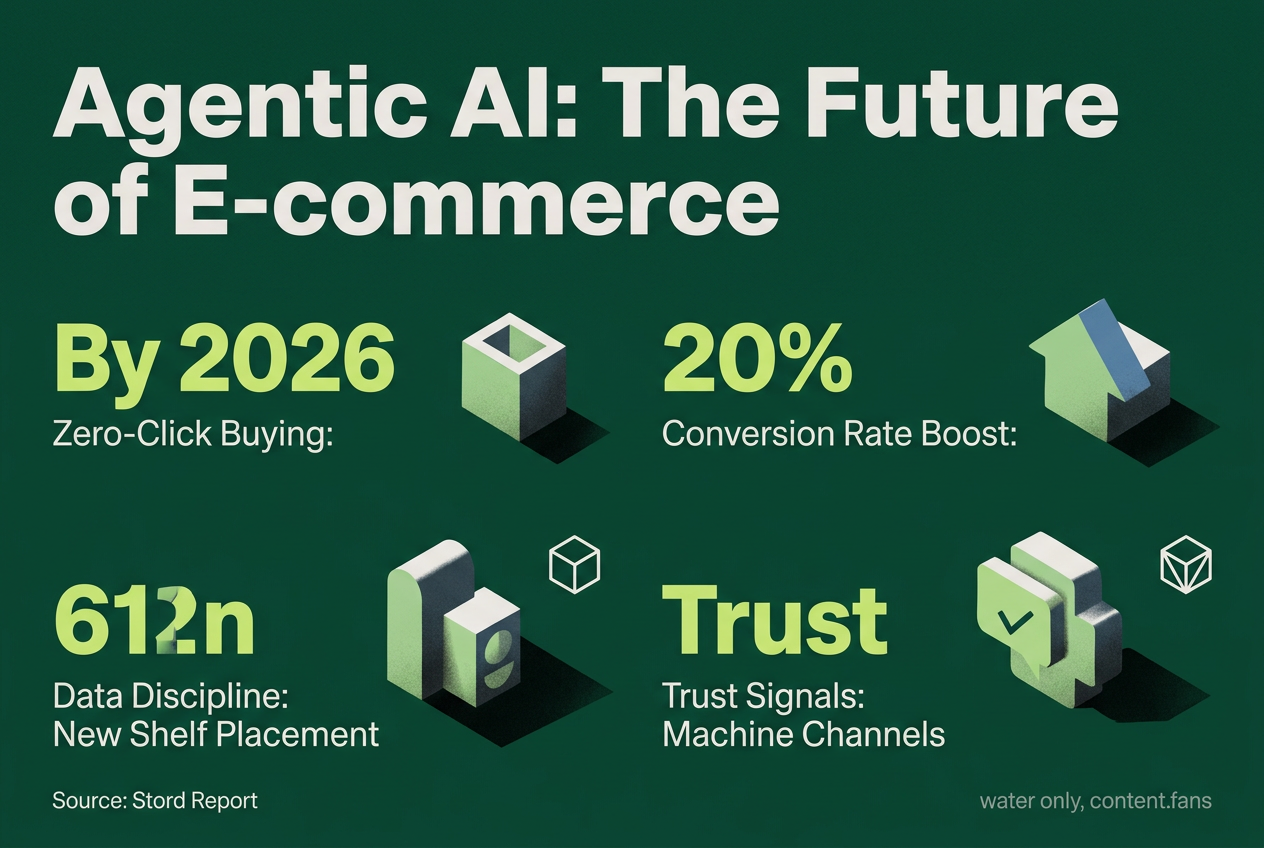
Stord's report says the marginal effort for shoppers is shrinking. For an agent to execute a transaction confidently, it must parse fresh, unambiguous facts about price, inventory, and fulfillment. Inaccurate feeds or conflicting policies may prompt the agent to bypass a retailer. According to CleverTap, personalization systems that mature into autonomous agents are "boosting conversion rates by 20 percent" in early tests, indicating that clean inputs can translate into measurable revenue lifts.
Brands therefore face a technical checklist that once lived in SEO back rooms but now sits at the core of trading strategy:
- Maintain structured product attributes with up-to-date price, stock, shipping, and returns data.
Trust signals migrate to machine channels
Stord observes that post-checkout care is folding into the same automated loop. Agents monitor shipping updates and manage delays on behalf of users. Consistency across confirmation emails, carrier APIs, and public policy pages feeds the agent's trust score. Forbes' 2026 guidance warns that agents "cannot recommend products they cannot easily interpret," a reminder that human-friendly phrasing must be matched by machine-legible facts.
Third-party reviews and certifications, long used for consumer persuasion, now operate as verification endpoints the agent can query. PPC Land cites research showing 38 percent of consumers have already used assistants for shopping tasks, so these machine-facing trust marks influence real baskets today, not hypothetical futures.
Legal and UX guardrails tighten
Gunder's 2026 AI law update flags disclosure duties when a shopper interacts with an AI system. Utah's SB 226 requires a clear notice that the counterpart is artificial and imposes fines up to 5,000 dollars per violation. Founders Legal advises businesses to document how recommendation systems are built and monitored. This may indicate that governance frameworks once limited to financial models are moving into retail merchandising.
Eddie Lim's procurement analysis adds that unchecked models could "inadvertently perpetuate discriminatory patterns." Bias testing and human oversight become part of merchandising hygiene, similar to accessibility or data privacy reviews.
Preparing for delegated checkout
Operational teams are starting to treat product data as growth capital rather than back-office plumbing. Early mover brands interviewed by FoodNavigator are running agent-readiness audits that span marketing, engineering, and fulfillment. Their immediate priorities revolve around three questions:
- Can an external agent retrieve authoritative product details in real time?
- Are pricing and inventory aligned across every endpoint the agent might query?
- Is there a rapid rollback path if the agent misorders or misprices?
Answering yes puts a brand in the consideration set for delegated checkout. Falling short may sideline even strong products when the agent looks for the safest transaction pathway.
What is "zero-click buying" and when will it become mainstream?
Zero-click buying is the predicted state where AI agents complete an entire purchase on a user's behalf, removing the need for any manual checkout steps. According to Stord's 2026 report, routine purchases will shift from active tasks to automated processes, culminating in this zero-click era by 2026. Users will simply approve or receive goods without interacting with a traditional cart or buy button.
How does an AI agent choose which product to buy?
Agents rely on structured, verifiable data to make decisions. Key factors include:
- Real-time inventory and pricing - outdated feeds mean automatic disqualification.
- Third-party trust signals - consistent reviews, certifications and return policies across all channels.
- Transparent product attributes - clear taxonomy, compatibility data and factual claims.
Botify's March 24 2026 launch of Agentic Feeds shows that being crawled is no longer the same as being discovered; feeds must be optimized for machine readability first.
What legal risks arise when AI makes the purchase?
Brands face several liability fronts:
- Contract validity - AI-generated contracts may contain ambiguous clauses; hybrid human review is advised.
- Bias and discrimination - systems that favor suppliers by geography or size can trigger lawsuits.
- Consumer consent - new Utah SB 226 (effective May 7 2025) requires clear and conspicuous disclosure when a consumer interacts with AI in a purchase flow.
A single mis-purchase could expose a brand to up to $5,000 per violation, with enforcement resting with state attorneys general.
How should brands structure product data for agentic discovery?
- Maintain a unified product master with complete attributes (title, brand, price, variants, availability, returns, warranty).
- Synchronize data everywhere - PDPs, marketplaces, schema markup, internal catalogs.
- Remove ambiguity - use consistent SKU naming and avoid bundled marketing jargon.
Forbes February 22 2026 guide emphasizes that "agents cannot recommend products they cannot easily interpret."
What immediate experiments should brands run?
- Prototype inclusion in agentic flows - list SKUs on platforms that expose API endpoints for agentic commerce.
- Launch a "zero-click pilot" subscription - automate replenishment of consumables and track conversion lift.
- Governance drill - simulate an AI mis-buy: test refund speed, error-handling SLA and customer communication.
Begin with low-risk, high-frequency SKUs to collect first-party feedback loops before scaling to the full catalog.