
OneAgrix Unveils AI Platform for Faith-Based Food Trade Verification
Serge Bulaev
OneAgrix has launched an AI-powered platform to help verify suppliers in faith-based food and FMCG trade, such as halal, kosher, and vegan products. The company says its system uses automated checks and human review to make sure suppliers meet requirements before buyers contact them, which may help reduce false claims and speed up due diligence. Market studies suggest that using AI for these checks is becoming more common, and feedback from each trade may help improve the system over time. However, the actual benefits may rely on ongoing third-party audits and strong rules for transparency. OneAgrix appears to be growing carefully, only letting in buyers and suppliers who meet its standards.

OneAgrix has launched its new AI platform for faith-based food trade verification, an agentic ecosystem designed to give institutional buyers greater confidence in supplier readiness. The Switzerland and Singapore-based company's verification-first model significantly shrinks due-diligence timelines for halal, kosher, and vegan products by positioning itself as a controlled access layer that runs automated checks before buyers and sellers connect.
How agentic AI underpins verification
The platform's agentic AI automates supply chain trust by screening supplier documents against regulatory and faith-based standards before they are visible to buyers. This human-in-the-loop system cross-checks certification databases, flags compliance gaps for review, and verifies readiness, streamlining procurement for institutional buyers.
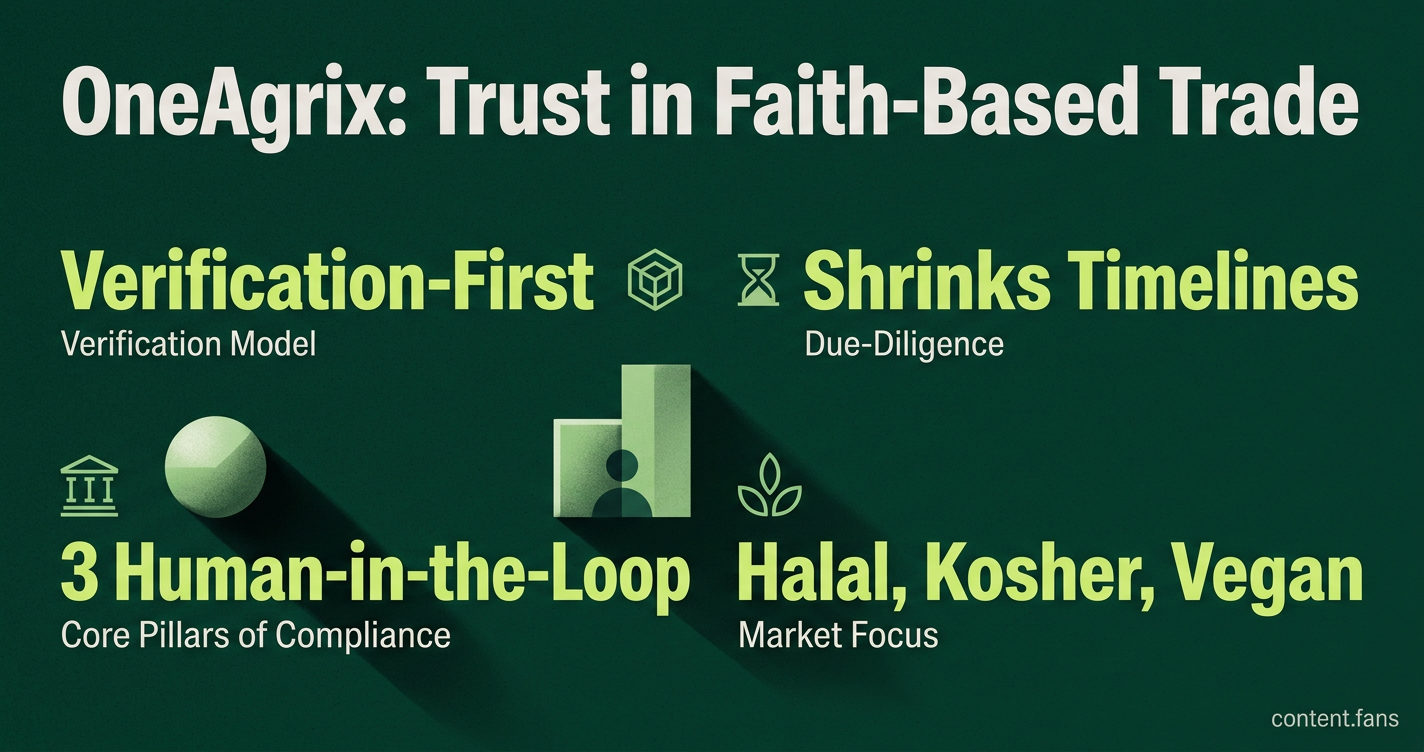
According to the OneAgrix homepage, every supplier is screened against three core pillars of compliance to ensure they are visible only to qualified buyers:
- Supplier readiness - capacity, export documentation and basic quality systems.
- Regulatory compliance - food safety certifications and jurisdictional rules.
- Faith alignment - confirmed halal, kosher or vegan certificates with scope and validity verified.
OneAgrix states this process effectively "shows buyers who's actually ready," reducing wasted outreach and combating the prevalence of false claims in cross-border trade. The AI agents drive this screening by assessing documents, validating against certification databases, and flagging discrepancies for human review, confirming a human-in-the-loop model over a fully autonomous algorithm.
Why faith-based FMCG trade needs trust infrastructure
The faith-aligned food and FMCG trade is a significant market. However, buyers face significant challenges, including fragmented certification schemes and inconsistent regional rules. OneAgrix asserts that its upfront verification model mitigates the risk of compliance failures that can lead to severe brand damage. This approach aligns with broader industry trends. A McKinsey analysis highlights the rise of agentic commerce, where AI agents handle transactions, while other reports note AI's role in eliminating manual sourcing tasks. This indicates a growing acceptance of automated pre-verification within procurement, provided that platforms maintain transparent audit trails.
OneAgrix builds an agentic AI-powered trade ecosystem for faith-based food and FMCG trade - market signals
Market signals strongly support OneAgrix's strategic positioning. Industry analysis shows AI agents are increasingly used for supply chain optimization and vendor evaluation, directly aligning with the platform's supplier-matching focus. Furthermore, with global FMCG markets showing steady growth, the addressable market for specialized trade platforms is expanding. To reassure risk-averse food buyers, OneAgrix highlights its dual Swiss-Singapore jurisdiction and its membership in the Swiss Food & Nutrition Valley. The company claims its platform is a learning system, where data from each successful trade refines the verification engine to progressively tighten standards. While experts agree such feedback loops build trust, they emphasize that the ultimate benefit depends on robust third-party audits and transparent governance - key prerequisites for any AI-driven system.
The company's roadmap emphasizes a strategy of controlled growth. Buyers gain access only after OneAgrix has curated a sufficient number of vetted suppliers in a specific category, while suppliers are onboarded only if they meet strict institutional procurement standards. This deliberate, guarded expansion signals a clear preference for compliance depth over sheer volume of listings - a strategic lesson learned from the failures of open marketplaces where false claims were common.
What exactly is OneAgrix's new AI platform?
OneAgrix is rolling out an agentic AI trade ecosystem that targets the global faith-based food and FMCG market. Instead of acting as an open marketplace, the platform runs a verification-first model: every supplier is pre-screened for regulatory compliance, certification scope and faith alignment before a buyer can even start a conversation. The result is a controlled-access layer between manufacturers and institutional procurement teams that the company claims cuts down on false claims and wasted months of due-diligence.
How does the platform reduce fraud in religious-food supply chains?
Faith-labelled foods carry an extra layer of liability: a single mis-labelled container can destroy trust and trigger costly recalls. OneAgrix attacks this with faith-fraud prevention checks that validate Halal, Kosher or Vegan certificates before engagement, not after. By pairing these checks with predictive AI risk scoring, the system can flag suspect paperwork or out-of-scope certifications in minutes instead of weeks, a feature that directly addresses the sector's chronic problem of "too many compliance disasters".
Which operational tasks are handled by the AI "agents"?
Agentic AI means the software can act without human prompting. Inside the OneAgrix ecosystem the agents:
- Monitor certification expiry dates and auto-request renewals
- Cross-reference shipment documents against sanctions or quota lists
- Rank supplier readiness so buyers see only the top suppliers that meet jurisdiction-specific rules
- Escalate anomalies to human auditors with an audit-trail attached
This keeps the final say with people while removing the manual drudgery that slows international procurement cycles.
Is the market large enough to justify an AI specialty platform?
Industry numbers suggest yes. The global FMCG market is forecast to grow from about USD 14.63 trillion in 2025 to about USD 19.72 trillion by 2033, with an estimated CAGR around 3.8%. The faith-aligned segment represents a significant portion of this market, giving the venture a sizeable sandbox even if it never expands beyond faith-labelled SKUs.
Who pays for the service and what is the onboarding path?
OneAgrix operates on a Swiss-Singapore jurisdiction and makes money from tiered subscription and success fees charged to suppliers; buyers join free after passing KYC. Onboarding follows four steps:
- Upload certificates and shipping history
- AI agent checks validity against issuing-body databases
- Platform issues a "readiness score" visible to pre-approved buyers
- Once trade occurs, OneAgrix releases escrow and keeps a small commission
Suppliers keep ownership of their data, but the platform records an immutable hash on its private ledger for audit purposes, a compromise designed to satisfy both corporate procurement policies and small-holder privacy concerns.