
MSPs monetize agentic AI, offer new governance services
Serge Bulaev
Many managed service providers (MSPs) may already be making money by selling agentic AI services in 2025, while also lowering their own costs. Experts say MSPs often start with automating their own help desk tasks, then offer these same tools to clients as a paid service. Reports suggest that these AI agents are used for things like ticket sorting and automated responses, which can reduce simple support requests by up to 40 percent. Some MSPs appear to be moving to contracts based on outcomes instead of hourly work, which might increase their profits. However, sources warn that data quality is important, and successful MSPs often focus on cleaning up their data before expanding these services to more clients.

The strategy for how MSPs monetize agentic AI is evolving from speculation into practical business models. Managed service providers are increasingly deploying AI agents to lower their own support costs while packaging these automations into new, high-margin client services. The established pattern involves perfecting internal help-desk automation before rolling it out as a paid offering.
Step 1: Drive Internal Efficiency with AI Agents
The first step for early adopters is focusing on internal cost reduction. Common use cases include ticket triage, knowledge base retrieval, and predictive maintenance, according to Integris research. Industry reports indicate that agentic triage can significantly reduce low-level tickets, allowing technicians to focus on higher-value project work.
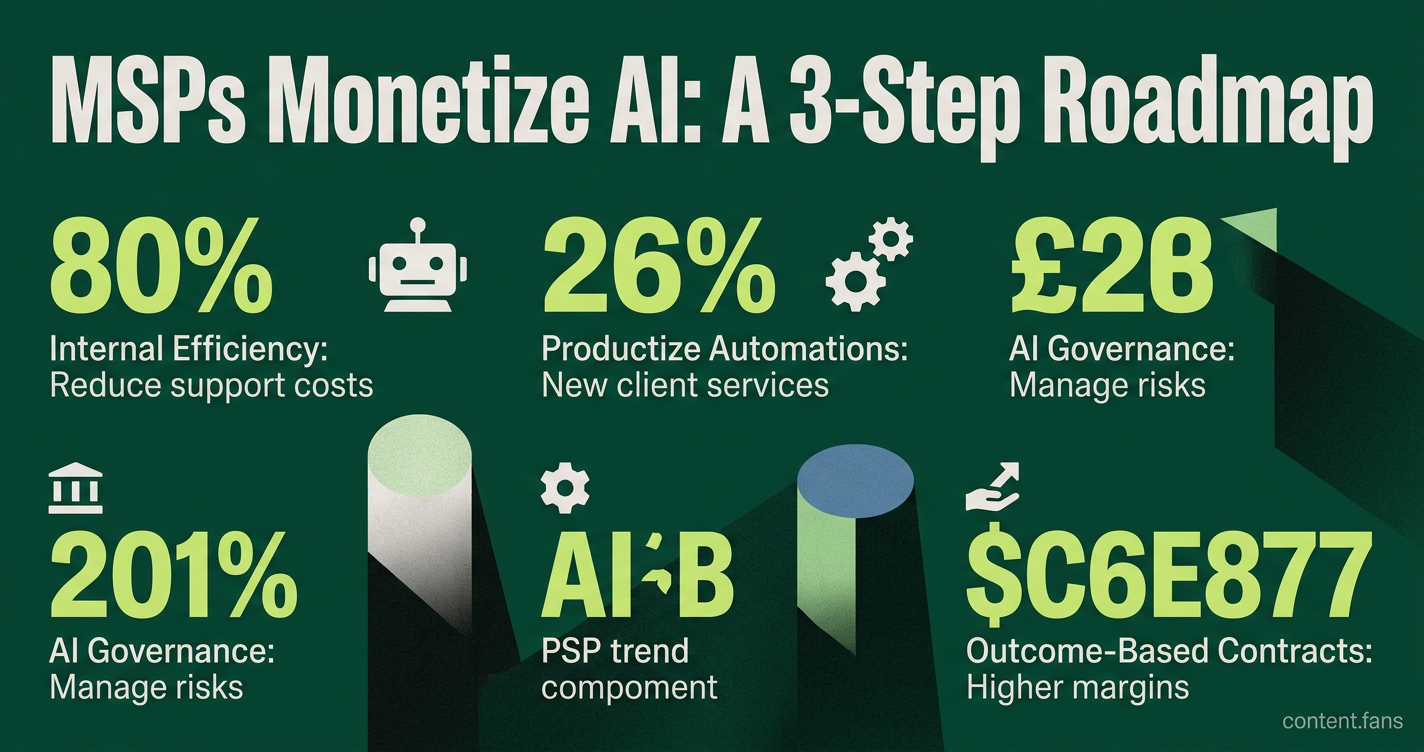
Managed service providers begin by deploying agentic AI internally to enhance their own operational efficiency. They focus on high-volume tasks like help desk ticket triage and knowledge retrieval. This approach validates the technology's effectiveness and builds a strong foundation before offering similar automated services directly to clients.
Step 2: Productize Automations for Recurring Revenue
Once internal AI agents are proven stable and effective, MSPs productize and resell them as new service offerings. For example, providers can clone an internal HR self-service bot and deploy it for multiple clients with a setup fee and monthly contract. A PwC survey reinforces the business case, showing that a significant portion of executives already have agents in production and many report measurable productivity gains.
Common revenue-generating agent bundles include:
- AI-augmented service desks for automated password resets and call summaries.
- Managed detection and response (MDR) enhanced with machine-learning analytics.
- Compliance-as-a-Service to automate evidence gathering for HIPAA, PCI DSS, or GDPR.
This strategy is also driving a shift away from hourly billing. Providers adopting outcome-based contracts - centered on metrics like ticket deflection or alert reduction - are reporting significantly higher margins, as this model simplifies the ROI for customers.
Step 3: Offer AI Governance and Risk Management Services
A critical challenge - and service opportunity - is managing AI-related risks. Experts emphasize that poor data quality is a primary barrier to success. AI agents trained on inconsistent or duplicate data will misroute issues and erode client trust. Successful MSPs address this by bundling data normalization projects with AI deployments before scaling.
This leads to a clear, three-part roadmap for monetization:
- Automate a narrow, high-volume internal workflow.
- Measure the cost savings and replicate the solution for a small group of clients.
- Layer on governance and compliance monitoring as a premium "Agent-as-a-Service" offering for a predictable monthly fee.
How are MSPs turning AI agents into steady, recurring revenue?
MSPs are productizing internal automations and selling them as managed offerings. A typical bundle includes an AI-powered knowledge bot or ticket-deflection agent, plus monthly support, policy updates, and usage monitoring. Because the stack is repeatable across clients, each new contract adds almost pure incremental margin. Industry reports indicate that a growing number of US businesses expect their MSP to deliver AI services in the coming years, so early movers are positioning to lock in multi-year seats before the market saturates.
What client problems justify a paid AI-governance service?
Agents now hold API keys to CRMs, finance platforms, and cloud workloads. The MSP Summit warns that "agents don't just talk, they act," so a rogue prompt can move files, change passwords, or expose PII. MSPs monetize guardrails-as-a-service: DLP policies, least-privilege roles, prompt logging, and quarterly AI-risk audits. Clients pay a predictable monthly fee to off-load liability and meet emerging compliance checklists for ISO 27001 and SOC 2 Type II.
Which internal use cases give MSPs the fastest ROI before they resell?
Start with high-volume, low-risk tickets such as password resets and knowledge-base lookups. Industry data shows AI agents can significantly cut ticket volume and resolve common issues much faster, freeing senior techs for project work. Once the accuracy rate reaches acceptable levels, the same workflow is cloned, white-labeled, and offered to clients as a managed self-service desk priced per seat or per ticket deflected.
What pricing models replace traditional per-device or per-hour billing?
Forward-looking MSPs adopt outcome-based pricing: a fixed monthly fee tied to measurable results such as resolving the majority of Level-1 tickets without human touch or significantly reducing mean-time-to-resolution. Industry reports suggest that the most profitable MSPs are increasingly billing for automation outcomes, not labor hours, creating stickier contracts and substantially higher effective margins.
What are the hidden blockers that can sink an AI-agent rollout?
The biggest pitfalls are dirty data and over-permissioned agents. YouTube panels with active MSPs reveal that inconsistent ticket taxonomies or duplicate client records confuse models and erode trust. Security-wise, agents given broad SaaS scopes can trigger undetected bulk changes. Solve this early by mapping authoritative data sources, enforcing least-privilege API roles, and inserting human approval gates for financial or destructive actions.