
Jury rules for OpenAI against Musk, clears IPO path
Serge Bulaev
A federal jury ruled in favor of OpenAI against Elon Musk, saying he waited too long to sue about their 2015 business changes. The decision removes a big legal hurdle that might have blocked OpenAI's plans to go public, but there are still other reviews and lawsuits the company needs to handle. Musk plans to appeal, arguing that new information might give him another chance. The ruling appears to give OpenAI more time and a clearer path toward an IPO, though some legal and regulatory risks may remain.
A federal jury has ruled for OpenAI against Elon Musk, clearing a major legal hurdle and brightening the company's path to an IPO. On May 18, a San Francisco jury rejected Musk's claims against OpenAI and its executives, finding the case was filed too late. The verdict, as reported by Reuters, showed the jury found Musk sued too late under the statute of limitations, based on evidence he knew about OpenAI's plans years earlier.
This landmark decision removes the most significant legal threat that could have complicated OpenAI's journey to the public markets. While the artificial intelligence leader still faces other regulatory reviews, the ruling eliminates the immediate risk of a court-ordered injunction that might have forced a complete corporate restructuring before an initial public offering.
What the jury decided
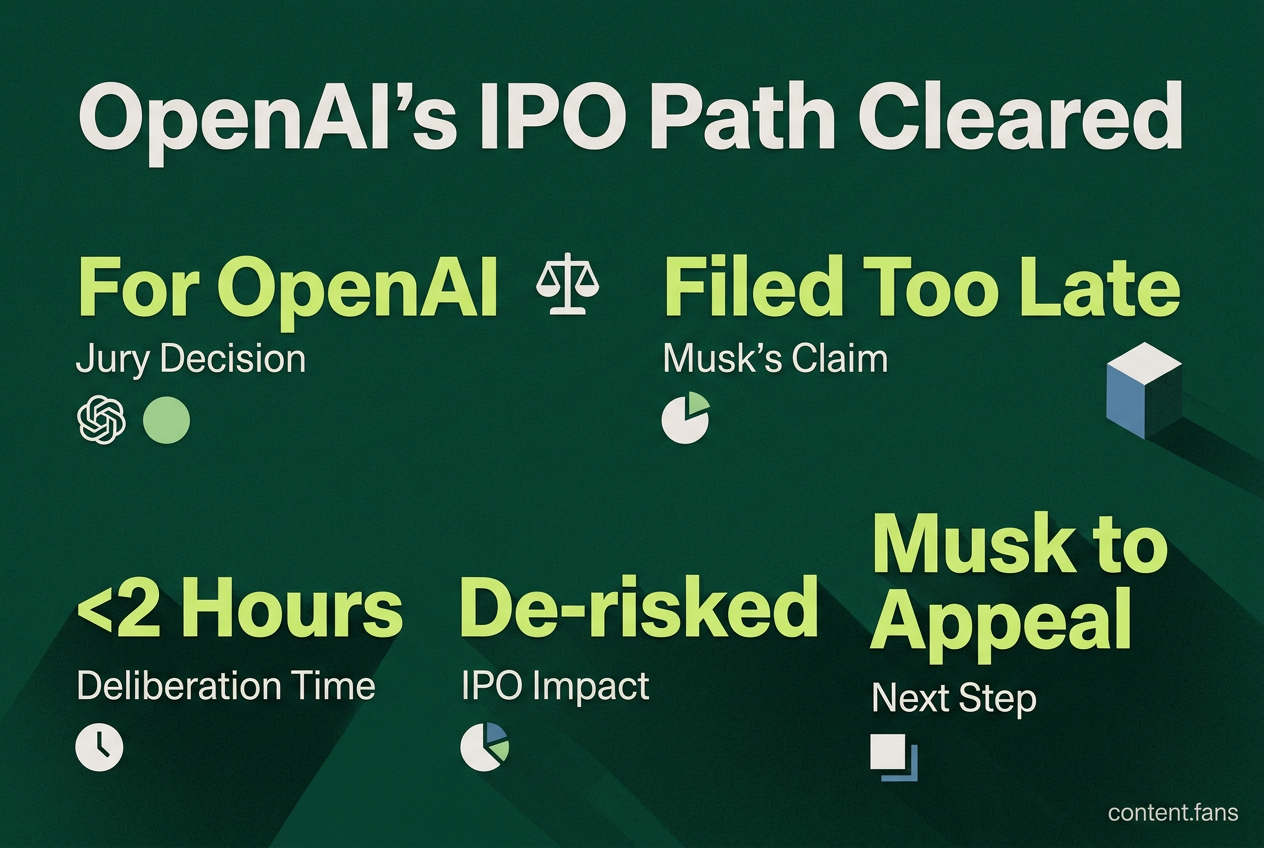
The jury concluded that Elon Musk's lawsuit was invalid because he filed it too late, exceeding the statute of limitations. The verdict did not address the merits of his claims regarding OpenAI's mission but was based purely on the timing of his legal challenge over the company's restructuring.
After deliberating for less than two hours, jurors determined the legal window for Musk's breach of contract and fiduciary duty claims had closed. According to Al Jazeera, the panel focused solely on when Musk should have known about the for-profit subsidiary, not on whether OpenAI betrayed its original mission. The court subsequently entered a judgment for CEO Sam Altman, President Greg Brockman, and Microsoft.
Musk's planned appeal
Immediately following the verdict, Elon Musk announced his intention to appeal to the Ninth Circuit, stating on X that the case was decided on a "calendar technicality" rather than its merits. Legal experts note that he will likely argue that new information uncovered during discovery should reset the statute of limitations. However, they caution that appeals based solely on timing face significant hurdles, though the process could prolong the legal battle for years to come.
Potential grounds for Musk's appeal include:
* Arguments of a miscalculation of when the legal claims officially accrued.
* Allegations that OpenAI concealed key details of its corporate restructuring.
* Claims of procedural errors regarding jury instructions on California charity law.
Implications for OpenAI's IPO
While OpenAI has not announced a formal IPO timeline, the verdict significantly de-risks its path to a public offering. With the lawsuit dismissed, bankers and investors now have greater clarity on the company's governance and legal stability. This ruling "removes [an] obstacle to IPO," a key factor for pre-market valuation.
However, OpenAI must still navigate other challenges, including antitrust investigations, copyright lawsuits, and comprehensive SEC disclosures. The case also offers a crucial lesson for other mission-driven technology companies, demonstrating that hybrid nonprofit/for-profit models can withstand legal scrutiny if corporate governance is well-documented. For now, OpenAI has secured valuable time to focus on its capital strategy as Musk prepares for an appeal.
What exactly did the jury decide in Musk v. OpenAI?
The jury's unanimous decision was based on a statute of limitations. It ruled that Elon Musk waited too long to file his lawsuit, and therefore, all claims against OpenAI, its leadership, and Microsoft were dismissed on procedural grounds. The court did not rule on the substance of whether OpenAI violated its founding mission.
Why does the verdict matter for OpenAI's IPO plans?
The verdict is critical for OpenAI's IPO plans because it removes a major lawsuit that posed a significant risk to investors. By eliminating the threat of a forced corporate restructuring, the decision provides the stability and legal clarity that investment banks and public markets require, making an IPO more feasible.
Will Musk's promised appeal stop OpenAI from going public?
No, an appeal is not expected to halt OpenAI's IPO process. Civil appeals rarely result in an injunction that would freeze proceedings like an SEC review. Underwriters for an IPO will likely factor the ongoing legal risk into the company's valuation rather than delaying the public offering.
How could the ruling influence other AI start-ups?
The ruling serves as a key legal precedent for "mission-first" tech companies. Legal advisors are now likely to incorporate stronger governance clauses, such as board duty checklists and donor control sunsets, into founding documents to prevent similar disputes and reassure early investors about long-term corporate structure.
What still has to happen before OpenAI shares trade?
Before an IPO, OpenAI must complete several key steps:
* Finalize its corporate structure conversion from a "capped-profit" model.
* File a detailed S-1 registration statement with the SEC, disclosing financial data, operational costs, and its relationship with Microsoft.
* Comply with all standard SEC disclosure requirements for major tech issuers.
Market valuation estimates vary widely according to industry reports, but this figure will depend on revenue performance and market conditions.