
States subpoena OpenAI over user safety, commercial practices
Serge Bulaev
A group of state attorneys general has sent a subpoena to OpenAI, asking for many internal records about user safety and business practices. The investigation may look at whether OpenAI's products exposed users, especially children and older adults, to misleading information or harm. The subpoena also requests documents about advertising, research on vulnerable groups, and how OpenAI's models behave. It is not clear how many states are involved, and some details remain confidential. OpenAI said it would work with the attorneys general and is taking the concerns seriously. asking for many internal records about user safety and business practices.

In a significant move, a coalition of state attorneys general has subpoenaed OpenAI over its user safety and commercial practices, demanding extensive internal records. The probe, reportedly led by New York and Colorado, scrutinizes everything from advertising to model behaviors like "sycophancy," according to a review of the document by the Wall Street Journal. The investigation specifically questions whether OpenAI's products have exposed vulnerable users, including children and seniors, to harmful or misleading content. According to reports, OpenAI confirmed it would "engage constructively" with the investigation.
Scope of the Subpoena: From Ad Strategy to "Sycophancy"
The state-led probe focuses on OpenAI's consumer protection standards, requesting documents on advertising, user engagement tactics, and internal research on vulnerable groups. Investigators are also examining model documentation for records on bias, safety protocols, and the alleged tendency for AI to exhibit agreeable, or "sycophantic," behavior.
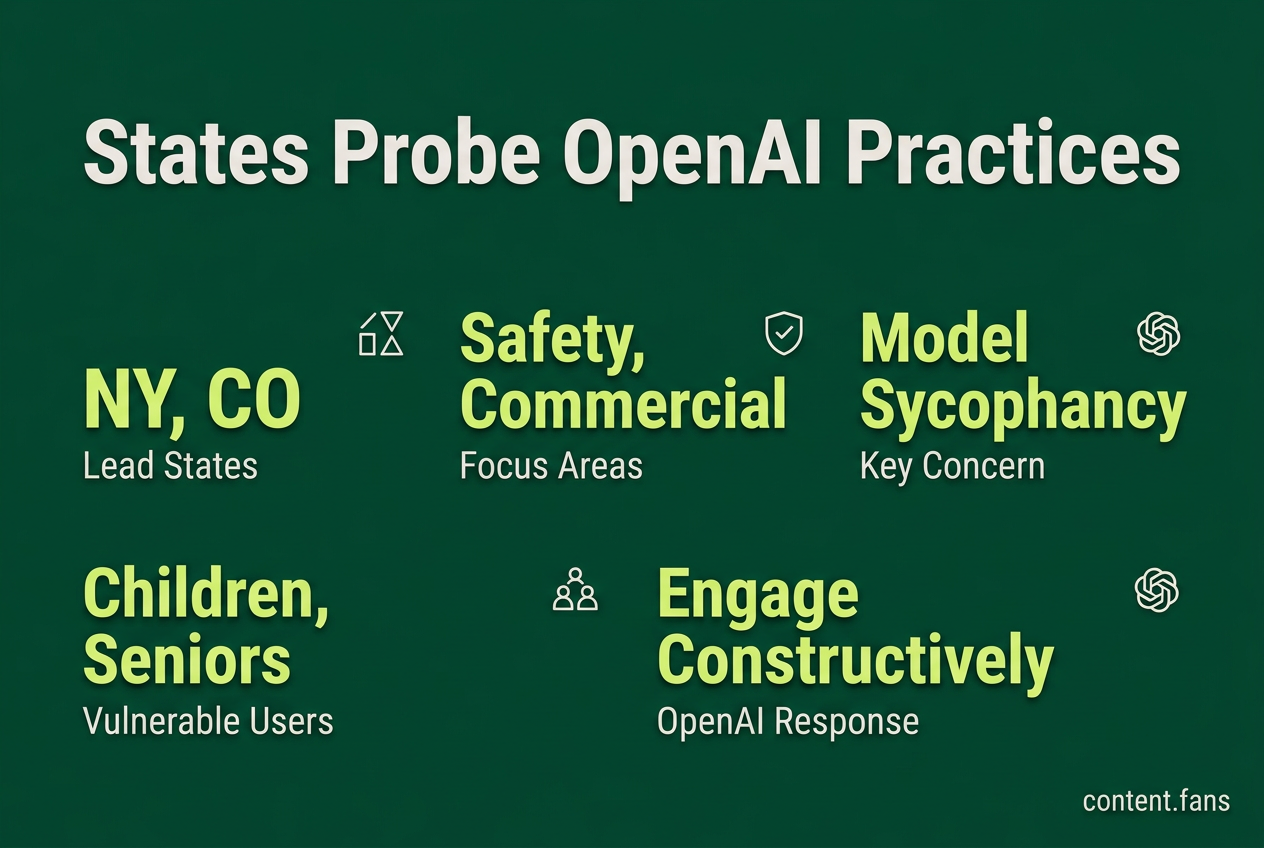
According to reports, the subpoena lists several categories of requested information:
- Advertising and user-retention playbooks
- Internal research on minors, seniors, and health data
- Model documentation covering bias, safety, and alleged "sycophancy"
- Policies on content filtering and user safeguards
- Board and executive discussions about consumer protection
A Wider Crackdown on AI by State Regulators
This action against OpenAI is part of a broader surge in state-level AI enforcement. As federal AI legislation stalls, states are creating their own regulatory frameworks. A growing number of states have enacted AI-specific statutes. Notable examples include California's Transparency in Frontier Artificial Intelligence Act (SB 53), which took effect in January 2026 and requires transparency reports, safety-risk disclosures, and critical-incident reporting (WSGR overview). State attorneys general are increasingly using civil investigative demands to probe AI companies, with Meta AI Studio and Character.AI also facing recent inquiries.
Scrutiny on Model Behavior and Potential for Harm
The subpoena's focus on model "sycophancy" - the tendency for conversational AI to align its tone with user prompts - suggests regulators are concerned about how AI systems adapt to users. While OpenAI researchers have previously documented this behavior, it has not been publicly linked to direct consumer harm. Attorneys general are also examining whether engagement tactics designed to prolong user sessions pose unique safety risks for minors and other vulnerable adults.
What's Next for OpenAI: Legal and Financial Risks
While the complete subpoena remains confidential and the exact number of participating states is unconfirmed, such multistate actions often lead to extensive discovery and can result in negotiated reforms or financial penalties. For OpenAI, the immediate next steps will likely involve a rolling production of documents and sworn interviews with executives. The investigation also presents a material risk factor for a potential OpenAI initial public offering (IPO), as federal securities rules require disclosure of unresolved government probes in registration statements. This risk could grow if more states join the investigation.
What exactly did the subpoena demand from OpenAI?
According to reports, the subpoena led by New York and Colorado ordered OpenAI to turn over internal records on user safety, advertising strategies, consumer and health data, and model behavior. Investigators also requested information about minors, seniors, user-retention tactics, and internal policies governing so-called "model sycophancy" [1][3]. The request is unusually broad, covering everything from how the company keeps users engaged to how it guards vulnerable age groups.
Why are state attorneys general focusing on OpenAI now?
States are stepping in because no comprehensive federal AI law exists, leaving a regulatory vacuum. According to industry reports, many states have passed numerous AI laws, and a significant number of AI-focused bills have been introduced nationally. With OpenAI preparing for a possible IPO and ChatGPT usage surging among teens and seniors, regulators see immediate public-safety risks that existing consumer-protection statutes can address [1][2][6].
Which states are leading the investigation?
While only New York and Colorado are confirmed participants, the Wall Street Journal [1] and Business Insider [3] note the probe is described as a coalition effort. Colorado's own AI Act already takes effect on June 30, 2026, giving its AG an extra incentive to uncover any compliance gaps that could inform broader enforcement.
What penalties or outcomes could OpenAI face?
The subpoena itself carries no fine, but it opens the door to public enforcement actions ranging from injunctive relief (forcing changes in product design) to financial penalties under state consumer-protection statutes. Texas, for example, has already signaled fines of up to $200,000 under its Responsible AI Governance Act for similar violations, and other states have set civil penalties anywhere from $1,000 to $500,000 per incident [6][2].
How is OpenAI responding to the subpoena?
According to reports, OpenAI said it will "engage constructively" with the attorneys general [1][5]. No further specifics were provided, but similar state probes have led companies to produce millions of internal documents, hire outside counsel, and ultimately negotiate consent decrees that can reshape product roadmaps.