
States Subpoena OpenAI Over ChatGPT's User Impact, Child Safety
Serge Bulaev
A group of state attorneys general has subpoenaed OpenAI, asking for information about how ChatGPT affects users, especially children, and about its privacy and advertising practices. The states want to see records on areas like how the chatbot is advertised, how it handles user data, and what protections exist for minors. OpenAI says it is working with the states and has made safety updates, but it is not clear if these steps will meet investigators' standards. This action appears to be part of a larger trend where states are investigating AI companies for possible risks to consumers. The results of the investigation might depend on whether the company's statements about safety and accuracy are found to be accurate.

A coalition of state attorneys general has subpoenaed OpenAI, escalating regulatory pressure on the company over ChatGPT's user impact and child safety. According to industry reports, the demand for internal records focuses on the AI's effects on users, especially children, alongside its privacy policies and advertising claims. This action signals a broader push for consumer protection oversight of generative AI firms.
What the coalition wants
State attorneys general subpoenaed OpenAI to investigate potential consumer harms from its AI model, ChatGPT. The probe seeks internal records on deceptive marketing, data privacy, user engagement tactics, and specific safety protocols for children, reflecting concerns that the technology's risks may outweigh its public disclosures and safeguards.
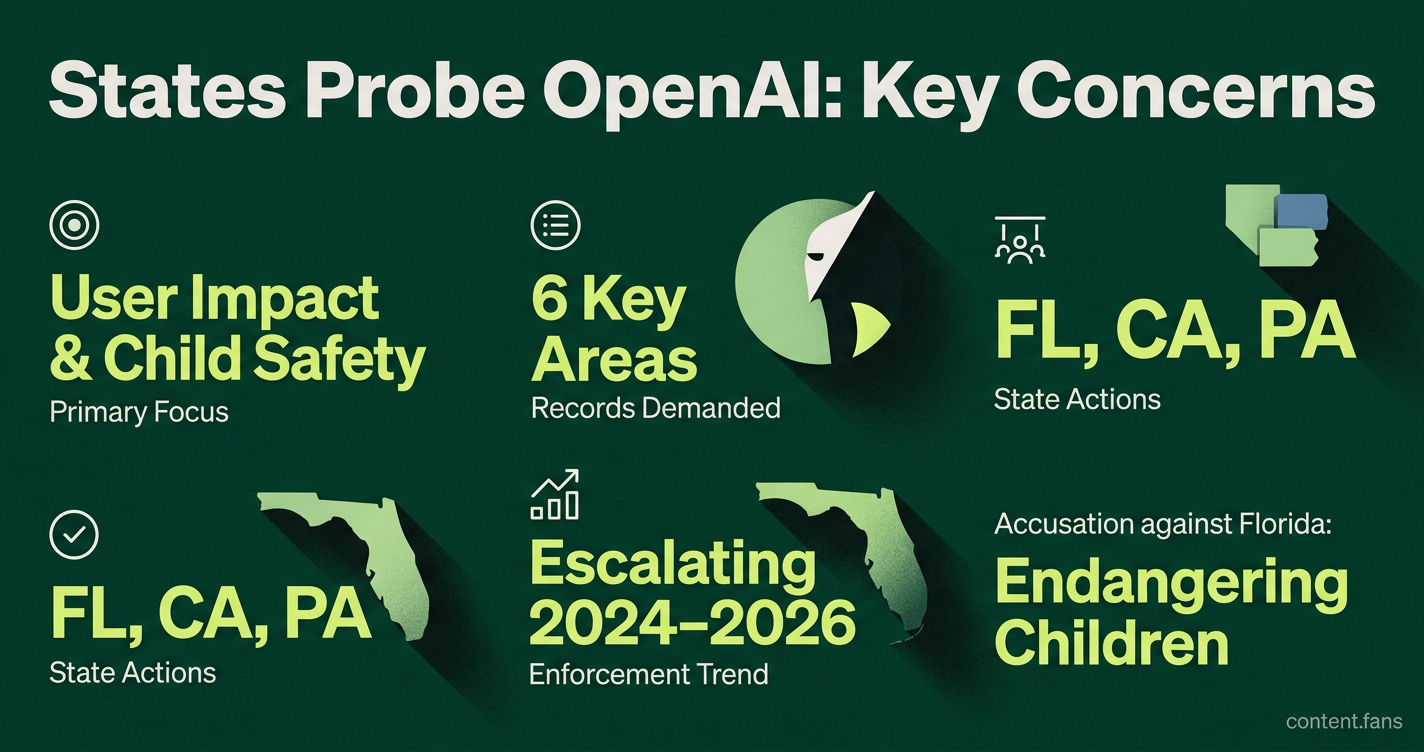
According to the WSJ coverage, the attorneys general are demanding records related to six primary areas: advertising, user engagement metrics, data handling for consumer and health information, protections for minors, model bias, and internal policy debates. The investigation also extends to records of OpenAI's cooperation with law enforcement. According to industry reports, OpenAI has indicated it will engage with the states regarding the investigation.
A pattern of state-level AI enforcement
This subpoena is part of a broader trend of escalating state-level AI enforcement actions from 2024-2026, as noted in analyses by DLA Piper and Skadden. Regulators are targeting AI products over risks like harmful content for minors, non-consensual imagery, and deceptive marketing. Other similar actions include:
- According to industry reports, Florida has initiated a criminal probe into ChatGPT for hazardous design.
- Industry sources indicate California is investigating xAI concerning explicit deepfakes, which prompted the state to form an internal AI oversight unit.
- A bipartisan push led by Pennsylvania urging multiple AI companies to improve child-safety measures.
These moves show state AGs acting as primary regulators in the absence of comprehensive federal AI legislation.
Focus on user impact metrics
Investigators are scrutinizing whether OpenAI's user engagement and retention strategies encourage risky or unhealthy reliance on ChatGPT. The subpoena demands documents on advertising strategies, user engagement, retention practices, and the management of consumer and health-related data, including activities involving minors and older adults. This focus aligns with recent state legislation; Skadden analysts point out that a lawsuit from Florida accuses the platform of endangering children by providing information on school shooters, self-harm, and fostering addiction.
Safety changes cited by OpenAI
In its defense, OpenAI highlights recent safety updates, including age-prediction filters, parental control dashboards, and crisis-response messages that refer at-risk users to professional help. TechCrunch reported on February 6, 2026, regarding the backlash over retiring GPT-4o. However, it is not yet clear if these remedial measures will be sufficient to satisfy state investigators.
Why subpoenas, not voluntary requests?
Legal experts interviewed by DLA Piper suggest that state AGs issued subpoenas rather than voluntary requests to establish enforceable deadlines and prevent selective disclosure of information. This legal strategy indicates regulators are testing the boundaries of existing unfair and deceptive acts statutes against AI companies, rather than waiting for new federal laws. The compelled documents will be crucial in determining whether OpenAI's public statements about ChatGPT's safety and accuracy were misleading.
Possible next moves
Depending on the findings, state AGs could pursue several outcomes, including negotiated compliance agreements, civil lawsuits, or even criminal charges, as seen in Florida's case. The speed of any resolution may depend on whether the multistate coalition remains unified or splits into separate settlement and litigation groups. In light of this regulatory climate, legal advisors at Cooley recommend that all AI companies maintain meticulous records of their marketing claims, safety tests, and data-handling practices.
What triggered the multi-state subpoena to OpenAI?
A bipartisan coalition of state attorneys general triggered the investigation by issuing subpoenas for internal documents. The probe aims to determine how ChatGPT impacts users, specifically minors and vulnerable populations. It focuses on several key areas: user-engagement tactics, advertising claims, data retention, child safety protocols, and the handling of sensitive health data. OpenAI has confirmed receipt of the subpoenas and is cooperating.
Which aspects of child safety are under the spotlight?
Investigators are focused on whether ChatGPT exposes minors to harmful content, manipulative interactions, or material that encourages self-harm. The subpoenas demand specific documentation on child protection policies, age-verification systems, parental controls, and incident logs for users under 18. Florida's attorney general has escalated this with a parallel criminal investigation into the platform's "knowingly hazardous" design.
How is OpenAI responding to the regulatory pressure?
In response to the regulatory pressure, OpenAI has highlighted its commitment to cooperation and pointed to several recently implemented safeguards:
- Age-prediction models that attempt to identify minors automatically
- Parental dashboards letting caregivers restrict topics and view usage summaries
- Crisis-intervention prompts that route users to real-world mental-health and emergency resources
- A stated policy prohibiting advertising that targets children
What other states are taking similar action?
The full coalition of states has not been disclosed, but California, Pennsylvania, Texas, and New York are confirmed to be leading the effort. According to industry reports, there is a growing regulatory focus on generative AI platforms across multiple states.
Could these investigations reshape the entire AI industry?
Legal analysts note that state AGs are leveraging existing consumer-protection and privacy laws rather than waiting for new federal AI statutes. Because the same legal theories - deceptive marketing, data misuse, product safety for minors, and confidentiality breaches - apply to every chatbot provider, the outcome of these cases will likely set industry-wide compliance benchmarks for transparency, safety design, and user-data handling.