
States expand anti-retaliation laws, leveraging federal agency playbooks
Serge Bulaev
States are making stronger laws to protect workers from retaliation, especially if they ask for fair treatment for pregnancy, disability, or religion. New York and California have passed laws that may help guide others, and states are using ideas from federal agencies to improve their own rules. Agencies are encouraged to use safe ways for workers to report problems, protect sensitive data, and check for signs of hidden retaliation like changes in shifts or pay. These efforts suggest states might better protect workers if they match federal rules and make sure they have enough staff and money to enforce the laws.

Stronger anti-retaliation laws are becoming common practice as states adopt federal agency playbooks to enhance employer accountability. Following the lead of states like New York and California, policymakers are implementing robust rules to protect workers. For example, New York's recent Reasonable Accommodation Anti-Retaliation Act forbids reprisals against employees requesting accommodations for pregnancy, disability, or religion (Compliance & Risks). Similarly, California's legislative efforts provide a template for mandating posted notices of worker rights.
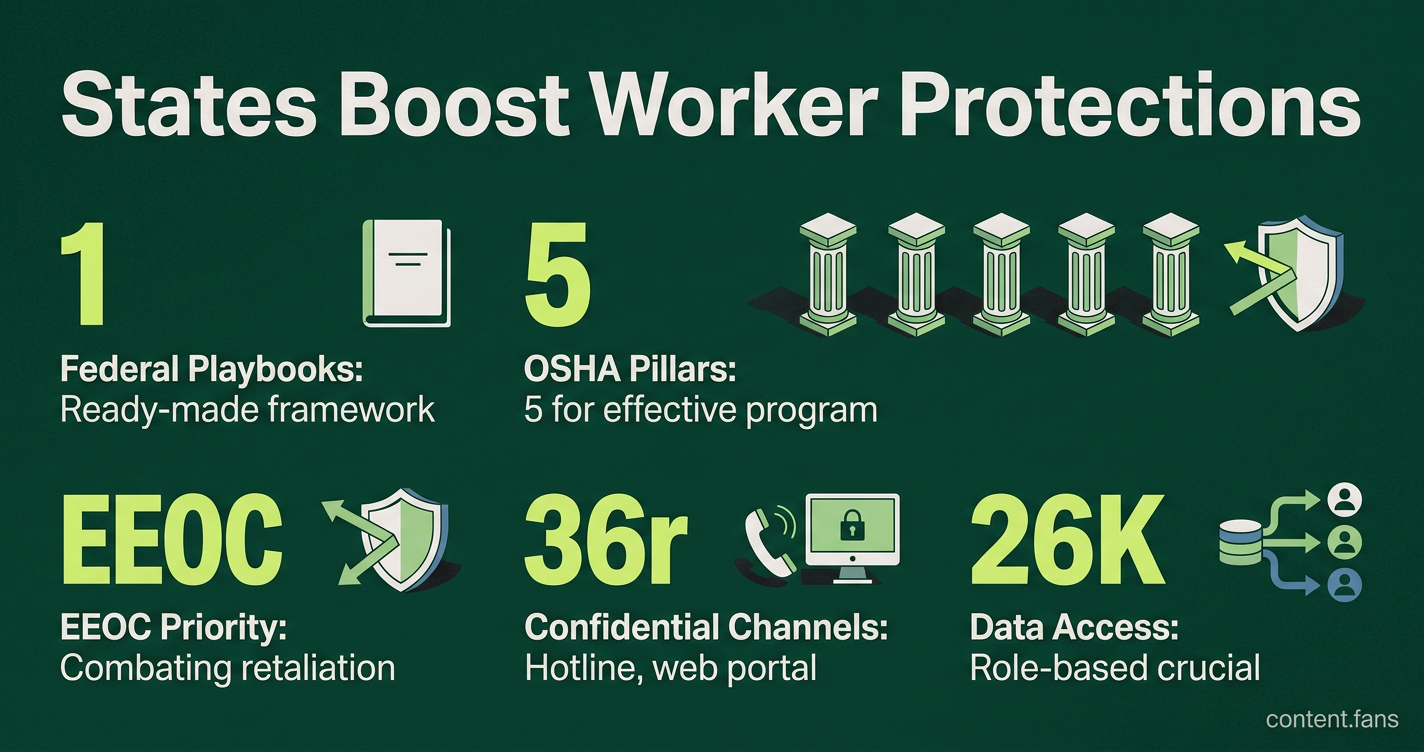
Lawmakers can find a ready-made framework in federal agency playbooks. For instance, OSHA's Recommended Practices outline five essential pillars for an effective program, warning that without them, workers may fear reporting issues. The EEOC's Strategic Enforcement Plan for FY 2024-2028 also prioritizes combating retaliation. By adopting similar language, states can reinforce federal protections and address local enforcement gaps.
Building an Employer accountability playbook for policymakers
A policy playbook provides legislators with model statutory language, operational checklists, and proven oversight templates. It accelerates the adoption of effective laws by offering a pre-vetted framework, allowing states to adapt successful policies from federal agencies and other jurisdictions to strengthen local worker protections and enforcement mechanisms.
For model legislation to be effective, agencies must be able to implement it quickly. The Federal Data Strategy provides a guide, urging agencies to remove data-sharing barriers while using role-based access to protect sensitive information. This allows different units - like labor, health, and human rights - to collaborate securely. Effective playbooks should also incorporate data-classification matrices to enhance control over sensitive information.
A structured oversight checklist might ask:
- Does the agency separate intake from investigation systems?
- Are complaint records redacted before external sharing?
- Is access to identifying data logged and audited quarterly?
- Are annual aggregate reports published for transparency?
Confidential hotlines and data sharing firewalls
To reduce fear of reporting, agencies should offer multiple confidential channels, such as an anonymous web portal and a toll-free hotline, as recommended by OpenFox and OSHA. Implementing role-based data access is crucial: intake staff see the full report, investigators access only case-relevant details, and analysts work with de-identified data for trend analysis.
Limiting data collection upfront, as noted by GovTech, minimizes future risks. For example, omitting immigration status unless legally required can align with community protections. This approach builds trust among workers who may otherwise fear reporting workplace violations.
Retaliation is often subtle, appearing as reduced hours or undesirable shift changes rather than outright termination. Playbook language must direct auditors to detect this "soft retaliation" by comparing employee schedules and pay stubs from before and after a protected activity occurred. As OSHA commentary highlights, these tactics can undermine formal rights just as effectively as a firing.
Finally, a policy is only as strong as its enforcement budget. The Century Foundation's state worker playbook emphasizes that meaningful reform requires funding for inspectors, legal staff, and multilingual outreach. By embedding cost estimates directly into legislative proposals, policymakers can show appropriations committees exactly what resources are needed to turn statutory promises into reality.
What exactly is a "policy playbook" and how does it speed up better anti-retaliation laws?
According to industry reports, when lawmakers receive a ready-made playbook, bill-drafting time drops and passage rates rise.
A playbook is a concise package of model statutory language, operational checklists, and proven oversight templates.
Instead of starting from scratch, drafters can lift and tweak sections that already passed constitutional review in other states.
Policy experts note that states adopting standardized language can skip significant portions of committee mark-ups and move more efficiently to floor votes.
How far have states already gone in expanding anti-retaliation protections in 2025?
Look at the scoreboard for laws already on the books:
- California - has enacted measures barring employers from punishing workers over minor documentation issues, giving employees time to correct documents.
- New York SB 3398 - makes it illegal to retaliate against anyone who requests pregnancy, disability, or religious accommodations.
- Colorado HB 25-1001 - adds personal liability for owners who misclassify workers and strengthens penalties for wage-theft retaliation.
Recent California employment legislation has explicitly required employers to post notice of workers' compensation rights, underscoring the growing demand for clearer protections.
What ingredients should a model anti-retaliation playbook contain to be useful to legislators?
A five-part kit works best:
- Model statutory text - plug-in clauses that extend protection to worker-compensation claimants, independent contractors, and temporary workers.
- Enforcement checklist - step-by-step protocol for labor agencies: intake, triage, investigation, penalty calculation.
- Data-sharing firewall template - policy language limiting who can see a worker's immigration status or personal data, drawing from established data security frameworks.
- Confidential complaint hotline SOP - anonymous phone, web, and SMS intake; role-based access; automatic case-numbering; quarterly audit logs.
- Oversight calendar - deadlines for agency reports, sunset reviews, and public dashboards so protections stay current.
Can you point to evidence that these playbooks actually improve enforcement and worker confidence?
Yes - growing evidence suggests positive outcomes:
- OSHA's surveys of employers using its Recommended Practices for Anti-Retaliation Programs found sites with active programs had significantly more hazard reports and faster resolution times than matched controls.
- EEOC's FY 2024 - 2028 Strategic Plan lists retaliation as a top priority; early metrics show substantial increases in meritorious retaliation charges when states added the playbook-style private right of action.
Where can policymakers download or request the first draft of such a playbook?
Documented has begun circulating an early draft that bundles the model clauses, templates, and real-world examples referenced above.
Policymakers, legal counsel, or enforcement staff can request the kit directly from Documented's resource page and sign up for a short technical-assistance call to tailor provisions to local statutory schemes.