
Alibaba Unveils Zhenwu M890 AI Chip and Qwen3.7-Max Model
Serge Bulaev
Alibaba announced the Zhenwu M890 AI chip and Qwen3.7-Max language model, which may help reduce dependence on foreign technology. The M890 chip reportedly has much higher memory and speed than earlier versions, though no independent benchmarks are available yet. Qwen3.7-Max appears to perform well in public rankings, especially in coding and handling long tasks. Chinese government policies seem to support such local technologies, but there may still be limits for very advanced training. Alibaba's new model can now be used on its cloud platform, and the new chip is expected to be tested by government and telecom buyers in the future.

With the unveiling of the Zhenwu M890 AI chip and Qwen3.7-Max model, Alibaba has made a significant statement in its push for a comprehensive, homegrown AI stack. These May 20 announcements highlight a strategy focused on reducing reliance on foreign technology while delivering powerful tools for emerging agentic AI applications.
Zhenwu M890: A High-Memory AI Accelerator
The Zhenwu M890 is Alibaba's latest AI accelerator, designed by its T-Head semiconductor unit. It focuses on high memory capacity and bandwidth to power complex, multi-agent AI systems, representing a key component of China's strategy to build a self-sufficient technology ecosystem and reduce foreign dependency.
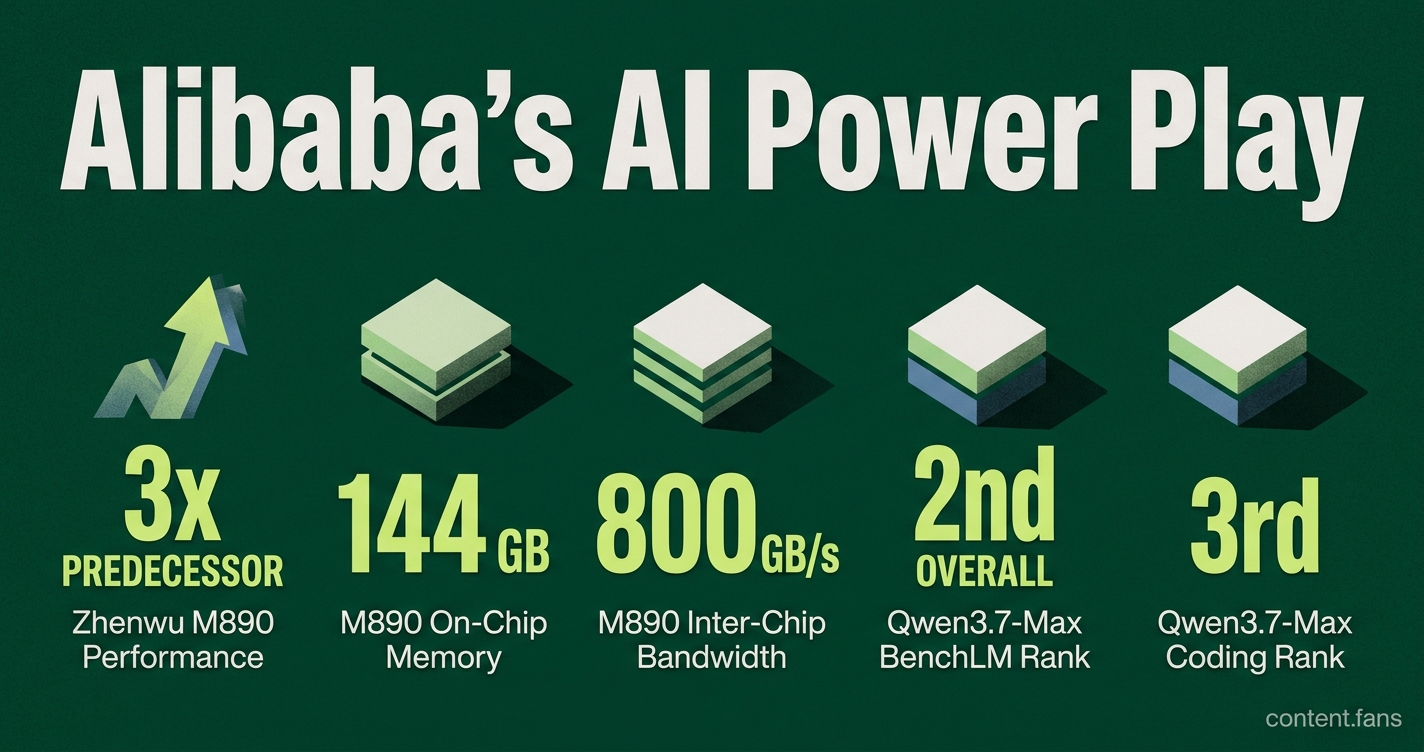
According to Alibaba's T-Head unit, the Zhenwu M890 offers three times the performance of its predecessor, the 810E. Key specifications include a massive 144 GB of on-chip memory and 800 GB/s of inter-chip bandwidth, designed to handle large-scale AI workloads efficiently link. The chip's support for multiple data formats, from FP32 down to FP4, is expected to enable faster and more cost-effective inference as software tools evolve. It is important to note that these performance figures are based on vendor statements, as no independent benchmarks are yet available.
While its predecessor, the 810E, was positioned as comparable to Nvidia's H20, TechXplore reports that Nvidia maintains a lead in raw performance. This suggests the M890 is strategically targeting domestic cloud and government clients who prioritize memory capacity and a secure local supply chain over absolute peak speed.
Government Policies Driving Domestic Demand
The development of chips like the M890 is heavily influenced by Chinese government policy, which actively promotes technological self-sufficiency. According to analyses by the Centre for Emerging Technology and Security, programs involving subsidies and preferential procurement direct significant state funding toward domestic AI accelerators, memory, and chip packaging. However, these studies also highlight that China may still face challenges in frontier-scale AI training due to persistent gaps in accessing advanced manufacturing nodes and HBM (High Bandwidth Memory) supply.
Qwen3.7-Max: A Top-Ranked Large Language Model
Alongside the new hardware, Alibaba's AI lab introduced Qwen3.7-Max, a large language model with an extensive context window designed for complex processing tasks. The model is explicitly optimized for complex, multi-step agentic workflows. It has achieved strong results on public leaderboards, with BenchLM ranking it second overall among 117 models and third for coding proficiency. Its high ranking in instruction-following further suggests a strong aptitude for executing complex task chains.
Key capabilities of Qwen3.7-Max include:
- Vast Context Processing: Capable of ingesting and analyzing large documents, research archives, or entire codebases in a single pass.
- Exceptional Coding Skills: Demonstrates high accuracy in software generation, debugging, and code review.
- Advanced Reasoning: Reportedly outperforms some Western models on complex reasoning benchmarks like GPQA Diamond.
Alibaba also announced a preview version, Qwen3.7-Plus, which will feature broader multimodal capabilities, signaling a dual-track product strategy.
Market Adoption and Immediate Availability
Alibaba has confirmed it already uses its previous-generation Zhenwu silicon to train some of its internal AI models. The new M890 chip is expected to be evaluated by key domestic customers, including government clouds and telecommunication providers, once volume shipments begin. For software developers, the Qwen3.7-Max model is already accessible on-demand via the Alibaba Cloud ModelStudio platform. This provides a powerful, locally hosted alternative that competes with top-tier commercial models in public benchmarks.