
Agentic AI storefronts raise conversion but face trust, integration hurdles
Serge Bulaev
Agentic AI storefronts in 2025 may help retailers increase conversion and make shopping smoother, but results seem to depend on customer trust and how well the technology fits into existing systems. Some reports suggest that AI recommendations can convert shoppers better than traditional search, but only when the AI is built into the store's own process. Trust remains low, with only 14 percent of shoppers comfortable letting AI place orders on their own. There are still big challenges with data, trust, and old system integration, so the full benefits might only appear for brands that carefully manage these issues. Early evidence suggests brands with clear data and strong human oversight might be best placed to succeed with agentic storefronts.

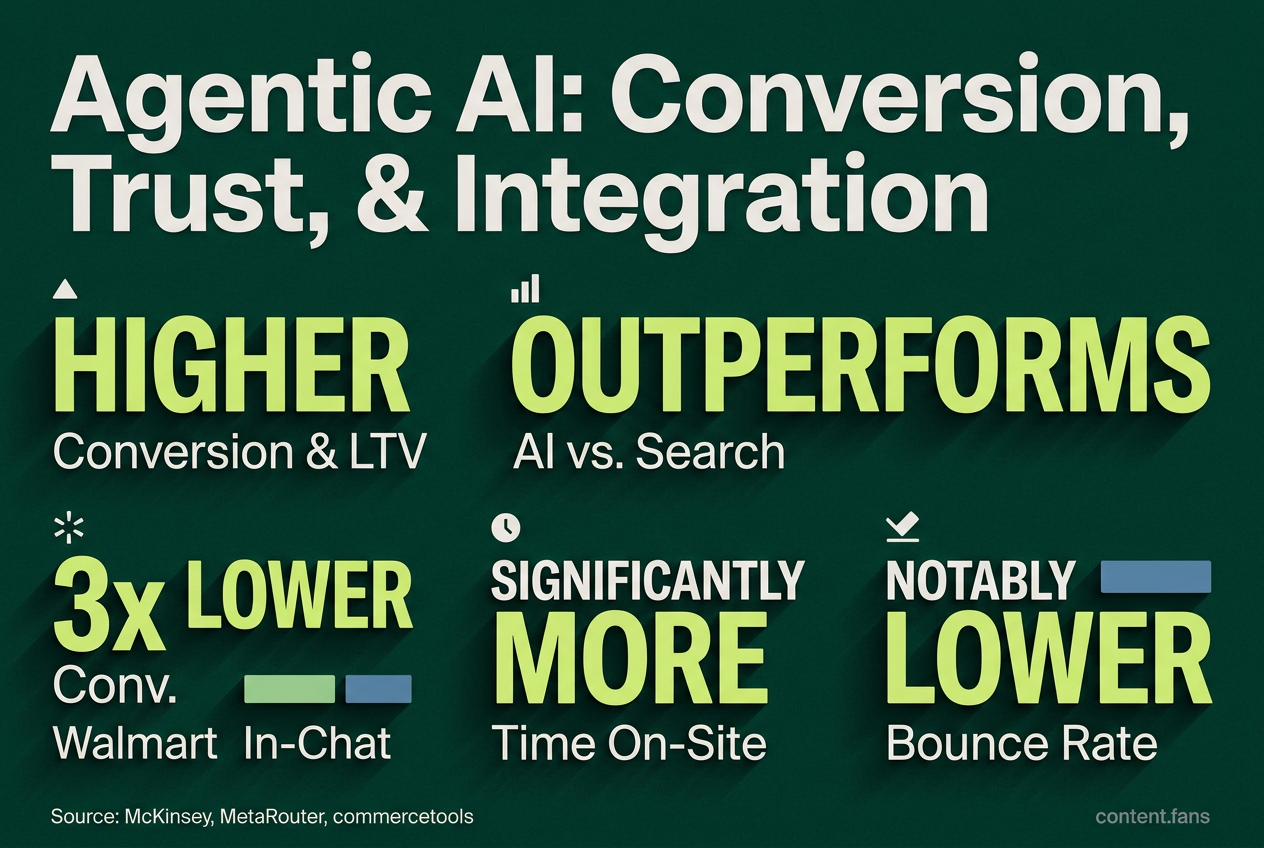
As retailers advance into the coming years, agentic AI storefronts are emerging as a pivotal technology, offering a real-time, responsive e-commerce experience that complements or replaces static websites. These AI-driven interfaces interpret a shopper's intent to recommend products, compare options, and initiate checkout, promising higher conversion and a smoother customer journey. However, success is complex, with performance depending heavily on customer trust and robust infrastructure integration. While a McKinsey report suggests agentic systems lead to "higher conversion rates and greater lifetime value" (McKinsey), current signals are mixed. For instance, industry reports suggest AI-generated recommendations can significantly outperform traditional search, yet traffic from external AIs like ChatGPT often converts poorly compared to affiliate links (MetaRouter). This contrast suggests that merchants gain the most when the agent is deeply embedded in their own sales funnel.
How agentic storefronts reshape the funnel
Agentic storefronts transform the traditional sales funnel by engaging customers earlier through conversational AI. They shorten the path to purchase by instantly surfacing personalized comparisons, real-time prices, and inventory data, which reduces choice overload and streamlines the decision-making process for the shopper.
- Upstream Discovery: AI-powered chat or voice assistants engage consumers earlier in their journey, answering complex queries like, "Compare vegan sneakers under $150 with two-day shipping."
- Shortened Decision Support: By surfacing real-time price and inventory details, agents reduce choice overload and accelerate the decision-making process.
- Split Checkout Flows: Checkout models are diverging. Some brands enable in-chat payments, while others redirect to a legacy site. Notably, Walmart's in-chat flow reportedly saw three times lower conversion than its redirect path (commercetools).
Customer satisfaction signals
McKinsey attributes the potential for improved customer satisfaction to the delivery of "personalized precision with little additional human labor." Furthermore, agents can lower cart abandonment by providing timely assistance during checkout. Behavioral metrics support this, showing visitors from AI agents tend to spend significantly more time on-site and have notably lower bounce rates than traditional visitors. While these are proxy metrics, they clearly indicate engagement gains when discovery is conversational.
Implementation hurdles
Retailers considering a shift to agentic commerce report several major pain points:
- Data Unification: Achieving real-time data synchronization across OMS, ERP, and commerce platforms remains a primary challenge.
- Structured Metadata: Agents require structured product data with schema.org markup to effectively interpret and reason over catalogs.
- Consumer Trust: Trust is a significant barrier, with only 14 percent of U.S. shoppers comfortable letting AI place orders autonomously, according to commercetools.
- Liability Frameworks: Clear frameworks are needed to address liability for misorders or fraud.
- Legacy Integration: High costs and internal skill gaps associated with integrating legacy systems are a major concern.
Early best practices
Consultancies advise a measured approach, recommending that retailers first launch agentic capabilities on owned channels. Key strategies include enforcing human authorization for final purchases and monitoring agent-specific KPIs like assisted conversion rate, return variance, and decision speed. Architecturally, API-first platforms and validated JSON-LD feeds are crucial for enabling agents to retrieve inventory and policy details without latency.
What the numbers mean so far
The current evidence suggests that agentic storefronts can significantly increase conversion by reducing friction, but the benefits are not uniform. High engagement metrics coexist with low adoption for autonomous checkout, highlighting the critical need for trustworthy payment systems and clear delegation rules. Brands that prioritize clean data, expose structured feeds, and keep a human in control of the final purchase decision appear best positioned to capture the technology's full potential.
What is an agentic storefront and how does it differ from a traditional e-commerce site?
An agentic storefront is a commerce interface that reacts in real time to shopper signals, using AI to recommend products, compare options, and assist with purchases inside chat or voice environments. Unlike static product pages, the store front reorganizes itself on every interaction and can complete the purchase without ever exposing a traditional cart. Retailers are starting to treat these experiences as primary channels rather than add-ons, putting brand presence "at the point of need" instead of waiting for the shopper to browse McKinsey.
How much can conversion rates improve with an agentic storefront?
Current evidence is positive but uneven:
- in-lab testing: AI-generated recommendations significantly outperform traditional search according to industry reports MetaRouter
- live referral traffic: ChatGPT-sourced visitors often convert poorly compared to affiliate links because most merchant checkouts are not agent-ready MetaRouter
- enterprise pilots: assisted shopping lifts overall site conversion by 8 - 12 % once inventory, pricing and checkout are exposed through real-time APIs commercetools
The biggest lesson: gains appear only when the back-end data and the front-end trust flow are fixed first.
What are the biggest technical hurdles when deploying agentic commerce?
Leading teams report several recurring blockers:
- Real-time data quality - fragmented inventory feeds cause overselling and wrong recommendations
- Structured catalog content - missing schema.org markup and product metadata stop AI agents from reasoning over the catalog
- Legacy integration - older OMS and ERP systems cannot expose sub-second pricing or stock levels
- Authorization & liability - unclear rules on who is liable when an AI agent exceeds delegated authority
- Fraud vectors - prompt injection, identity spoofing and unauthorized delegation require new guardrails
- Skill gaps - merchandising teams need to learn AI-specific KPIs like decision quality and assisted conversion rate instead of page-level metrics
How do shoppers feel about letting an AI complete a purchase?
Trust is still the choke point:
- 14 % of U.S. consumers currently trust an AI to place an order on their behalf commercetools
- Significantly more time on site and notably lower bounce rates show that agent-assisted visitors are highly engaged once they arrive
- 3× lower conversion when Walmart forced in-chat checkout versus redirecting to the brand site, proving that transparent human control remains essential
Best practice is a hybrid flow: let the agent narrow choices and surface the best option, but leave final authorization to the shopper inside a familiar checkout.
Will traditional websites disappear or coexist with agentic storefronts?
Most analysts expect coexistence, with roles shifting in the coming years:
Static website strengths
- brand storytelling and rich media
- direct traffic from SEO and paid ads
- full creative control and impulse discovery
Agentic storefront strengths
- faster product discovery for complex catalogs
- personalized comparison and decision support
- zero-click or low-click purchase paths inside assistants and marketplaces
The practical playbook for merchants is to treat the catalog as an API product: keep the website for human shoppers while exposing the same data to AI agents through structured feeds and secure checkout endpoints.