
States expand AI likeness laws, requiring consent and disclosures by 2026
Serge Bulaev
Several U.S. states, like California and Tennessee, have updated their laws to require consent before using a person's likeness with AI, and more states might adopt similar rules by 2026. New laws also suggest companies must clearly tell people when they are interacting with AI or seeing AI-made content, but details about how and where to display these notices are not always clear. Because rules differ across states and countries, companies may need to check what laws apply wherever their AI content is used. Experts recommend getting written permission, using easy-to-understand labels, and having quick ways to remove content if asked. Regulators are still working on more guidance, so companies may need to keep updating their practices as new rules develop.
Brands using AI-generated personalities face a complex legal landscape. New AI likeness laws requiring consent and disclosures create significant compliance challenges across publicity rights, advertising law, and transparency statutes. This guide outlines key legal frameworks and practical steps for mitigating risk as these rules continue to evolve.
Expanding publicity-rights statutes
A growing number of U.S. states have enacted laws requiring explicit consent before an individual's likeness, voice, or image can be replicated using AI. These statutes also mandate clear disclosures to inform consumers when they are interacting with AI-generated content or synthetic personalities in commercial contexts.
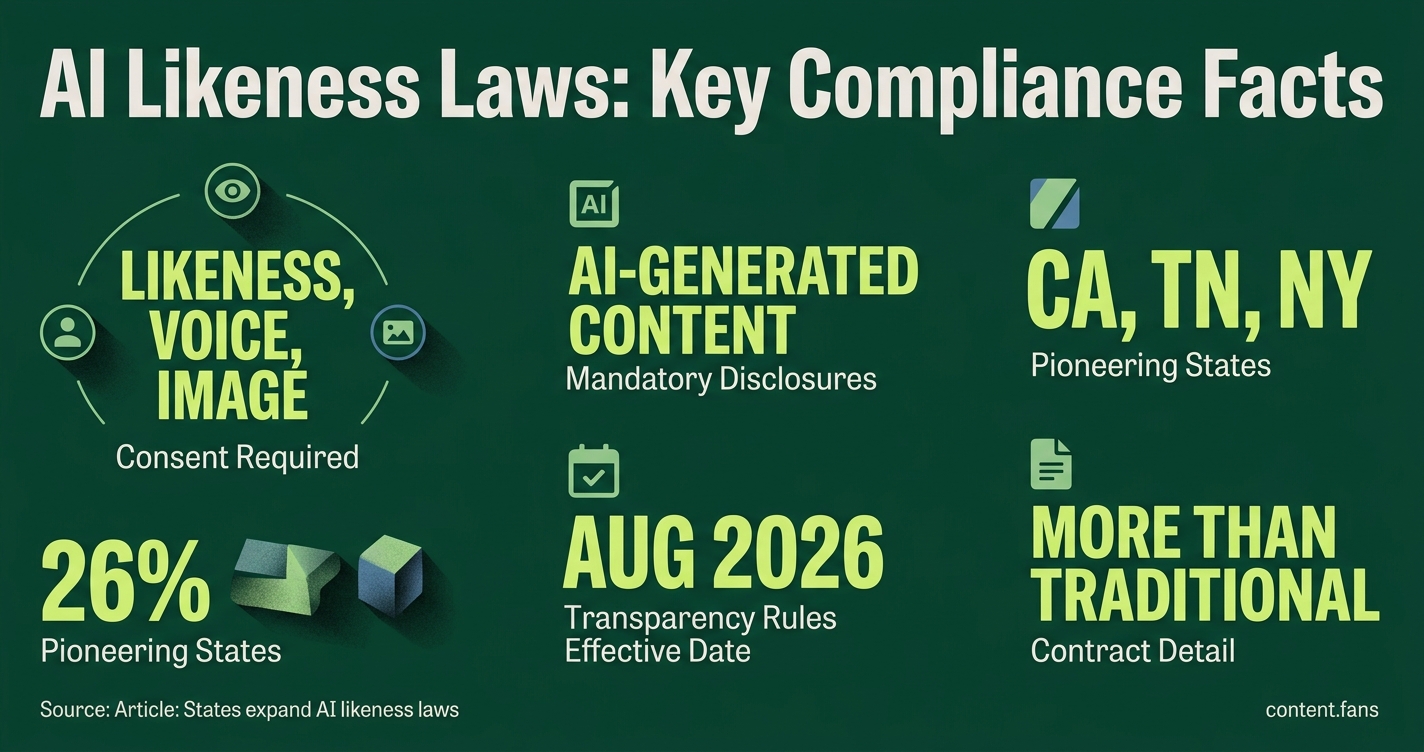
Pioneering states like California, Tennessee, and New York have broadened existing publicity laws to govern digital replicas. For example, California's AB 1836 grants heirs legal recourse against unlicensed AI performances of deceased celebrities, while Tennessee's ELVIS Act prohibits using a person's voice or likeness with AI without consent. A review by White & Case shows several additional states are considering similar consent-based laws, indicating a clear regulatory trend.
Disclosure duties under consumer-protection rules
Beyond consent, new laws focus on preventing consumer deception through mandatory disclosures. Utah's Artificial Intelligence Policy Act requires clear notice when AI communicates with people. California's SB 942 requires AI-content disclosure tools and watermarking-related disclosures, with transparency rules taking effect in August 2026. Internationally, China's synthetic-content rules require labeling and watermarking-style controls for AI-generated content through provider/platform obligations, as analyzed by Mind Foundry. Since regulations often lack specific placement guidance, contracts must clearly assign responsibility for disclosure wording and location.
Contract drafting for AI likenesses
Licensing agreements for AI likenesses require far more detail than traditional endorsement deals. Legal experts recommend drafting separate clauses for likeness use and AI model training rights, with strict limits on campaign, territory, and duration. Industry practitioners suggest contracts should include:
- Scope: Clear limitations on use by campaign, geography, and duration
- Training: Explicit restrictions on biometric data use for model training without separate consent
- Disclosure: Requirements for plain-language labels where mandated by applicable laws
- Audit: Rights to review usage logs and model repositories
This granular approach is crucial for mitigating litigation risk from vendors who might otherwise use licensed data to train future AI systems without authorization.
Cross-border enforcement hurdles
Global AI campaigns face significant cross-border enforcement challenges. The EU AI Act applies extraterritorially in certain cases, with deepfake transparency obligations requiring labeling of qualifying deepfakes taking effect in August 2026, while U.S. rules remain a fragmented patchwork of state laws. A disclosure that meets California's standards might violate EU rules if it lacks a persistent watermark. To ensure compliance, businesses must map each jurisdiction where content is displayed against its specific local requirements for disclosure and consent.
Litigation and takedown mechanisms
Rights holders are actively enforcing these new laws, with legal practitioners already using statutes like AB 1836 to issue takedown demands for unlicensed AI voice clones. The TAKE IT DOWN Act creates federal obligations to remove certain nonconsensual intimate images and deepfakes, establishing new standards for content removal. Consequently, contracts must now include rapid takedown procedures that reflect these emerging statutory requirements.
Compliance checklist for deployments
To prepare for AI likeness deployments, legal and marketing teams should follow this compliance checklist:
1. Map every jurisdiction where the synthetic asset will appear and identify consent plus disclosure triggers.
2. Secure written authorization covering image, voice, and motion data; reserve any training right separately.
3. Draft plain-language labels positioned near the content, verified against applicable state and international rules.
4. Build audit rights and data-deletion covenants to satisfy emerging transparency obligations.
5. Align takedown provisions with federal standards for flagged deepfakes.
While global regulators continue to develop specific penalties and guidance, the core trends are clear: consent-based licensing and transparent disclosure are now central to deal architecture. The most secure path forward for AI-driven endorsements involves a careful alignment of contract scope, technical controls, and jurisdiction-specific labeling.
Which U.S. states now demand opt-in consent for AI replicas of real people?
Several states are leading regulatory developments in this area.
- California AB 1836 lets heirs of deceased talent sue if a studio releases an AI replica without written permission.
- Tennessee's ELVIS Act makes it illegal to mimic a living or dead person's voice, image or name without a licence.
- Utah's AI Policy Act and similar legislation in other states extend comparable protections to commercial uses that could confuse consumers.
Bottom line: if the campaign reaches users in these states, signed consent plus disclosure is now mandatory, not best practice.
How do cross-border campaigns stay compliant when the EU, China and U.S. all label AI content differently?
No single label satisfies every regulator, so firms draft layered disclosures.
- EU AI Act imposes extraterritorial reach in certain cases: firms that place synthetic media in the EU must comply with watermarking requirements.
- China's labelling regulations require metadata-based watermarks plus visible tags for AI-generated content.
- California's disclosure requirements ask for clear language indicating AI generation.
Practical fix: insert a dual-mode label and keep the raw file so the watermark can be updated if additional jurisdictions implement requirements.
What contract language blocks model-training creep when a brand licenses a synthetic avatar?
Add a "no-training" clause that survives termination. Sample wording:
"Licence is limited to the Campaign defined in Exhibit A. Licensee may not use or permit any third party to use the likeness, voice, motion-capture data or prompt set to train, fine-tune or improve any neural network or latent-diffusion model. Breach triggers immediate takedown and liquidated damages."
Industry examples show the importance of inserting a talent-approval gate before any re-render, preventing downstream AI reuse.
When does disclosure become a Federal Trade Commission (FTC) risk, not just a state-law checkbox?
FTC Act §5 kicks in whenever a reasonable consumer could believe the AI likeness is real.
- Recent enforcement actions show the FTC will pursue brands for untrue health or earnings claims voiced by a synthetic spokesman.
- If the avatar resembles a testimonial, disclosure must be "immediately adjacent" to the claim, not in the footer.
- No fixed font size, but plain-language disclosure outperforms hashtags.
Failure to tag within the creative invites deceptive-advertising enforcement and celebrity backlash.
What audit trail should legal teams keep to prove compliance after a campaign ends?
Regulators typically want three artefacts:
1. Signed licence agreement with scope, term and territory.
2. Version-controlled render history to show the replica was not recycled.
3. Screen grabs with time-stamped disclosure in situ.
Store in immutable cloud storage for the applicable statute of limitations period in relevant jurisdictions.
Keeping this golden copy helps demonstrate compliance when regulators demand proof that AI content was properly labelled.